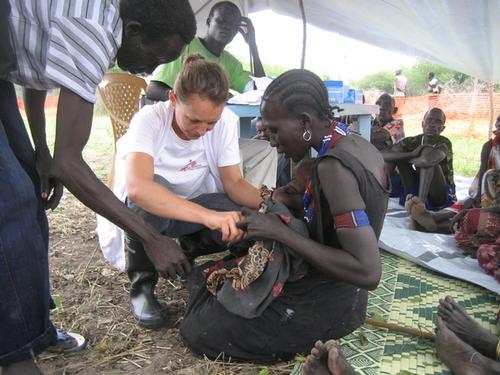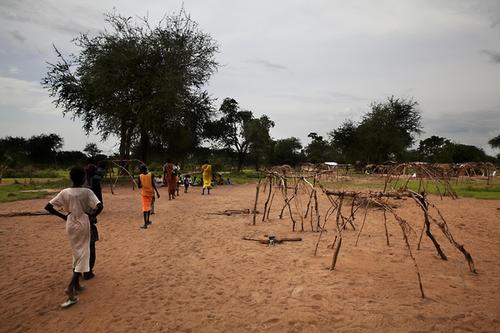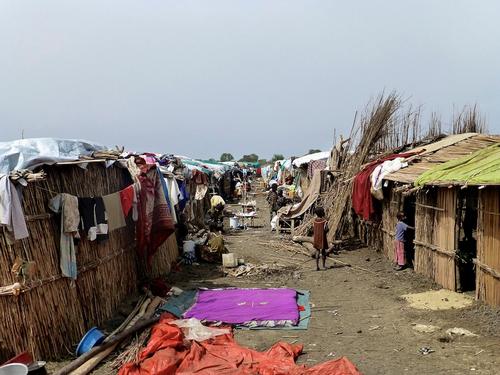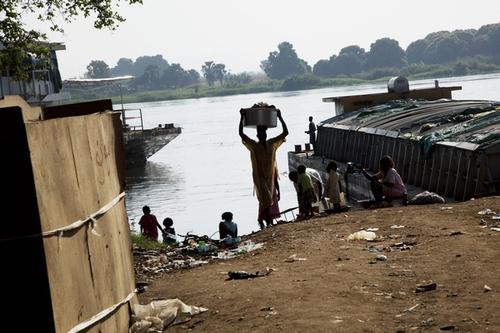
Returnees from Khartoum are camping near the Nile River in Juba, the capital of Southern Sudan, and washing their clothes and bodies. Most took a month to 6 weeks to reach Juba in order to vote the January 9th independence referendum. Also they have come to Juba since they are afraid of possible retaliation from the North, Arab majority, if they live there. *** Local Caption *** Le 9 janvier 2011, les électeurs du Sud Soudan ont voté à près de 99% pour l¿indépendance. Ce référendum - qui s¿inscrit dans le processus de paix global entre le Gouvernement de Khartoum et le Mouvement populaire de libération du Soudan (SPLM) signé en 2005 - survient au terme de plus de 20 ans de guerre civile dans le Sud. Cette guerre a fait plus de deux millions de morts et entraîné le déplacement de quelque 4,6 millions de personnes.
 9 juillet 2011 proclamation de l¿indépendance du sud.
 Aujourd¿hui, le Sud Soudan souffre d¿un manque criant d¿infrastructures et la population n¿a pas accès aux soins médicaux de base. En proie à une crise humanitaire et médicale, le pays doit régulièrement faire face à des épidémies, une malnutrition endémique ainsi qu¿à des pics de violence entraînant des déplacements de population.
 Présente dans le pays depuis plus de 20 ans, MSF travaille dans l¿hôpital civil d¿Aweil, dans l¿Etat du Nord Bahr El Ghazal depuis 2008. C¿est l¿unique hôpital de l¿Etat pour une population d¿environ 780 000 personnes. Le programme a été lancé pour réduire le taux de mortalité materno-infantile très élevé et répondre aux urgences qui surviennent régulièrement dans la région, telles que des épidémies de méningite ou de paludisme et des pics de malnutrition. Dans le service de pédiatrie et la maternité de l¿hôpital, les équipes médicales de MSF apportent des soins gratuits aux femmes enceintes et aux enfants âgés de moins de 15 ans. 
 En 2010 environ 37 000 consultations anténatales ont été menées, plus de 3 000 femmes ont accouché à l¿hôpital, 60 854 consultations pédiatriques ont été assurées. Environ 3 675 enfants ont été admis au service pédiatrique, souffrant principalement d¿infections respiratoires ou de diarrhées. Environ 2811 enfants souffrant de malnutrition aiguë sévère ont été soignés
Returnees from Khartoum are camping near the Nile River in Juba, the capital of Southern Sudan, and washing their clothes and bodies. 
© Q. Sakamaki

MSF emergency response to intense fighting in Juba

Returnees from Khartoum are camping near the Nile River in Juba, the capital of Southern Sudan, and washing their clothes and bodies. 
© Q. Sakamaki
Ebola disease in DRC: find out how we're responding
Learn more

Médecins Sans Frontières (MSF) has started its response for the wounded and displaced victims of violence in Juba, South Sudan, following  intense fighting from the evening of 15 December to the morning of 18 December in the capital.

“We are extremely concerned for people who are caught in the conflict,” says Michael White, MSF head of mission in South Sudan. “MSF has worked in South Sudan for thirty years, and we are activating our emergency response capacity now that people are in clear need.”

Drugs and medical supplies

On 18 December an MSF team provided drugs and medical supplies including tetanus vaccines, syringes, injectable antibiotics, wound-dressing material, a dedicated kit for treating 50 wounded patients and a supply of body bags in case of mortalities to the Juba Teaching Hospital. They also set up a tented ward so the hospital staff can expand their capacity from the overcrowded wards.

Other MSF teams have been assessing the situation for displaced people in several locations around the city, including a UN compound near the airport and a cathedral, where people have fled to seek safety from areas of intense fighting. There are tens of thousands of people displaced in Juba, so the priority for the coming 24 hours is to identify where the needs are greatest, and then scale up MSF’s response accordingly.

Intense fighting

“We could hear from the sound of the fighting around the town that it was very intense,” says Forbes Sharpe, MSF emergency coordinator in Juba. “Today has been calmer, but the tension and fear in the streets of Juba is palpable. The situation here is certainly serious, and our top priority is to get a better picture as soon as possible of where there is the greatest need for MSF medical assistance. We have already started donating medical supplies and we have emergency-trained teams here ready to start providing hands-on medical or logistical assistance within hours.”