



2109 Results
 
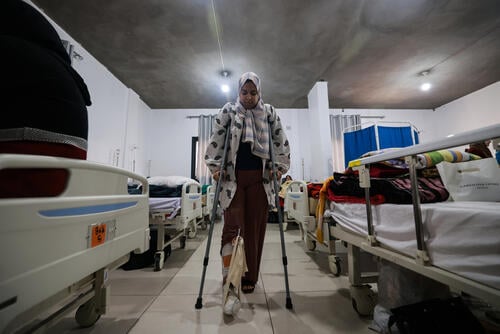
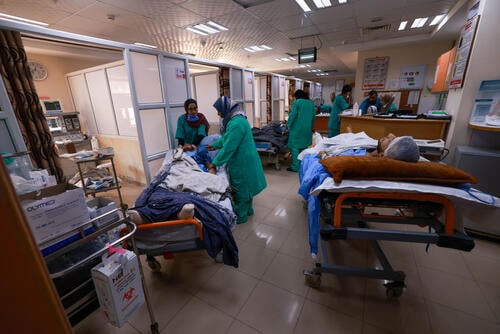
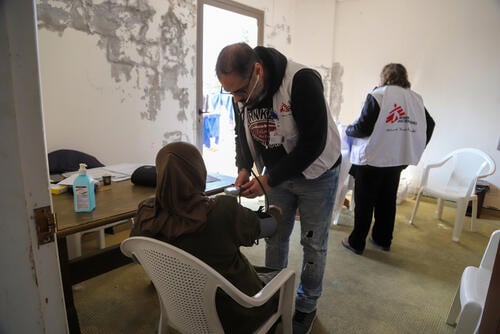
Follow up consultation at Rafah Indonesian Field Hospital.

My name is Hala Ismael Al Talla. I'm 
21-year-old. 
We are seven family members.
On the sixth day of the war, the front of our house got shelled.
We (family) got displaced so we went to one of our relatives’ houses.
Just a few minutes after we arrived, 
we started to count the shells we could hear. A first, then a second, then a third.
We could hear them leave the tank, fly through the air and then explode.
The fourth shell hit our room and suddenly everything turned white.
My mother was standing still by the wardrobe.
She told me to stand up. I stood up and suddenly I fell. 
I did not know what had happened to my leg.
I started shouting: “My leg, my leg!”
They (family) came from outside after they heard the screaming in the room and they got me out.
Then at 8pm, my father decided to leave to Al-Aqsa hospital.


The injuries are on my right leg. Two broken bones.
I lost my second toe.
At Al-Aqsa hospital they did everything they could and said my leg needed a skin graft.

Later the hospital came under threat.  
When we fled Al-Aqsa hospital, I was on a cart.
I felt the pain as my leg moved with every hole in the road that we went over. It was so hard.
The atmosphere was tough and intense.
With the sound of gunshots, warplanes and drones.
There was shelling everywhere.

Then we came to change my dressing at MSF.
When they checked my injury and saw how severe my condition was, they admitted me.
Right after my admission, they (the doctors) said I needed to have an operation 
to remove my big toe and my third toe because they were dead.
All my pain and suffering was caused by those toes. 
So, they were removed. My wound was cleaned and closed during the second operation.
I am waiting for a third operation, which is a skin graft for my leg and foot.
Gaza-Israel war

People in Gaza at serious risk of preventable deaths as healthcare crumbles

A new MSF report describes the massive struggle faced by Palestinians in Gaza to access medical care and warns of large numbers of preventable deaths caused by disruptions to critical healthcare.   Press Release - 29 Apr 2024
 
Patients waiting at Al Aqsa hospital. 29 November 2023, Middle Area, Gaza.
Gaza-Israel war

Gaza’s healthcare workers grapple with the mental health impact of an unyielding war

After over six months, the relentless war in Gaza, Palestine, has taken a toll on the mental health of medical workers. Project Update - 26 Apr 2024
 
Rita Dmitrenko, 61 years old. From Kobzartsi, Mykolaiv province. In this former frontline town, MSF supported the only health post for weeks. Everyone here is very grateful to MSF. Rita was one of the patients and she still goes to the health post, where a nurse (from the Ukrainian health system) is still working. The war was coupled with a delicate family situation. "My husband has depression. When I told him I had cancer, he started to get worse and lose weight". She underwent surgery and is feeling better. MSF gave her psychological support.

PERSONAL
Rita Dmitrenko, 61, is from Kobzartsi in the southern Ukrainian province of Mykolaiv. In this village that was close to the frontline, MSF supported the only health post for weeks. Everyone here is very grateful to MSF and the medical and psychological help it provided. Rita was one of the patients and still goes to the health post, where a nurse (from the Ukrainian health system) is still working. The war was coupled, in her case, with a delicate family situation. "My husband has depression. When I told him I had cancer, he started to get worse and lose weight". She underwent surgery and is feeling better. 
"MSF helped us a lot," says Rita, wearing a scarf. "The medical team saw us and referred us to the psychologist. I thought I didn't need psychological help, but it went very well. My husband and I used the counselling they gave us". 
War is not only the direct victims, the wounded people, but also those who are left without medical care at a critical moment. It happened to Rita. When the battlefront was close to here, Rita could not go to Mykolaiv, the nearest big city, the provincial capital, for check-ups. "I got worse. I think they could have checked my cancer better. The stress deteriorated her physical and psychological health: she was displaced with her husband for ten months some 50 kilometres from this village. And along with the war and her cancer came another terrible piece of news: one of her sons died of leukaemia. 
Now, after radiotherapy, surgery and psychological support, Rita is physically and mentally better. In a few months she is due to return to the hospital for a check-up.
War in Ukraine

War-torn minds: navigating mental health issues amid war in Ukraine

The war in Ukraine has a significant toll on people's mental health. Our teams have provided mental health support for both doctors and patients affected by the war. Project Update - 25 Apr 2024
 
MSF’s mobile medical team examine a patient with an eye infection in Hay Khun village. Hay Khun is remote, and as the majority of those living there are subsistence farmers or hunters, few people are available during the day. Because of this, MSF performs most of its medical consultations here in the evening.
Myanmar

Five things to know about the humanitarian crisis in northern Rakhine

Nimrat Kaur, MSF project coordinator in Myanmar, shares insights on the dire humanitarian crisis in the country amidst escalating violence. Interview - 15 Apr 2024
 
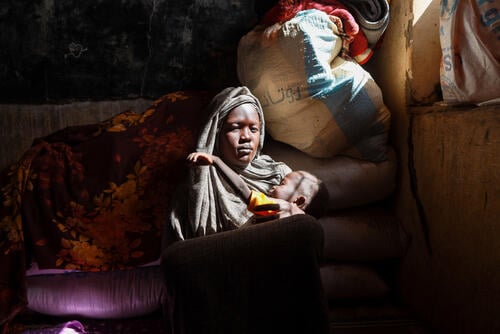
"I'm worried about the future of my children." I'm thinking about returning to Abyei so that I could provide an education for my children.
But if the war comes to an end I'll return to Khartoum and my house as soon as possible, and my husband will be able to work."
Conflict in Sudan

After a year of war in Sudan, a rapid scale up of response is needed to avoid catastrophe

After a year of war in Sudan, the aid provided to millions of people is a drop in the ocean due to political blockages and a lack of action from the UN and humanitarian organisations. Press Release - 12 Apr 2024
 
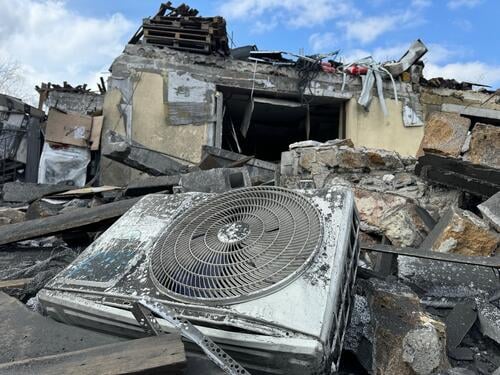
MSF team examines the scale of the destruction after the recent attack. MSF office is completely destroyed.
War in Ukraine

MSF condemns missile attack which destroys office, injures staff in Donetsk

MSF strongly condemns the missile attack on our office in Pokrovsk, Donetsk oblast Ukraine, on 5 April, which destroyed the building and injured a staff member. Press Release - 5 Apr 2024
 
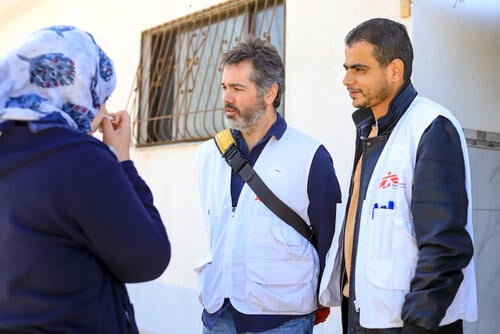
On Wednesday 20th of March 2024, MSF’ Secretary General visits the Health Post run by MSF in Al Mawasi, Gaza Strip. He is pictured here (left) talking to two women in front of the facility, alongside MSF nursing supervisor Mo’men (right).
Gaza-Israel war

Why we won't accept the narrative of ‘regrettable incidents’ in Gaza

Christopher Lockyear, MSF Secretary General, outlines the attacks on people, humanitarian workers and healthcare facilities in Gaza as being conducted within a war with no rules. Speech - 5 Apr 2024
 
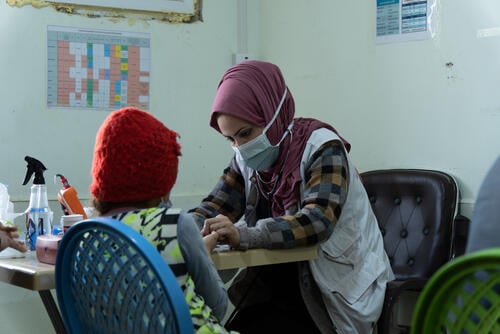
MSF nurse checking the vital signs and glucose level of a diabetes patient at the MSF-run clinic for non-communicable diseases in the Hawija General Hospital in Hawija, Kirkuk.
Iraq

Eight years in Kirkuk: following along the journey of Hawija’s recovery

MSF started working in Kirkuk, Iraq, in 2016 to assist people affected by the war. As Hawija is on its way to recovery, we handed over our activities to the health authorities. Project Update - 29 Mar 2024
 
MSF staff provide medical consultations at one of the gathering sites in Kassala, Sudan. This site has received a large number of people with disabilities, who were relocated due to violent clashes in areas of Khartoum and Wad Madani with the help of local Sudanese activists and charitable groups.
Conflict in Sudan

Displaced by war, people in eastern Sudan urgently need food, water and shelter

Displaced people in Kassala, eastern Sudan, experience limited access to food, clean water and healthcare services. The scale of the crisis demands urgent and coordinated action from the international community. Project Update - 26 Mar 2024
 
An elderly woman displaced from Lebanon’s south receives care from MSF’s mobile medical unit in a collective shelter near Saida, 60 km from the southern borders.  MSF’s mobile unit provides primary healthcare, medication and follow-up for non-communicable diseases, as well as psychological first aid and health promotion sessions in three locations in south Lebanon.
Lebanon

Five months into border conflict, displaced people’s needs are on the rise

The escalation of the armed conflict along Lebanon's southern border has led to the displacement of over 91,000 people, affecting their financial stability and psychological wellbeing. Project Update - 21 Mar 2024
Four mothers posing in a corridor of the Hospital in Bili. All four of them are staying in the hospital with their child, that's suffering from a severe case of malaria. Since the beginning of the project in 2016, the pediatric ward already treated more than 4.000 cases of complicated/severe form of malaria.
Médecins Sans Frontières (MSF)

Independent medical humanitarian assistance

We provide medical assistance to people affected by conflict, epidemics, disasters, or exclusion from healthcare. Our teams are made up of tens of thousands of health professionals, logistic and administrative staff - most of them hired locally. Our actions are guided by medical ethics and the principles of independence and impartiality. We are a non-profit, self-governed, member-based organisation.

Learn more