


- Médecins Sans Frontières (MSF) has seen a massive increase in diarrhoeal illnesses and malnutrition among children under five in Gaza.
- Without the entrance of meaningful humanitarian assistance there will continue to be more preventable deaths.
- MSF warns that a military incursion in Rafah would be a catastrophe and calls for an immediate and sustained ceasefire.
Gaza/Jerusalem/Barcelona – Gaza’s healthcare system has been devastated, leaving men, women and children at increasing risk of acute malnutrition, with their physical and mental health deteriorating rapidly, according to a report released today by MSF entitled Gaza’s Silent Killings: The destruction of the healthcare system and the struggle for survival in Rafah.
More than six months into the war in Gaza, Palestine, the devastation extends far beyond those killed by Israeli bombardments and airstrikes. MSF describes the massive struggle faced by Palestinians in Gaza today to access medical care and warns of large numbers of preventable deaths caused by disruptions to critical healthcare.
“How many children have already died of pneumonia in overwhelmed hospitals?” says Mari-Carmen Viñoles, head of MSF emergency programmes. “How many babies have died because of preventable diseases? How many patients suffering from diabetes are left untreated?
How many babies have died because of preventable diseases? How many patients suffering from diabetes are left untreated?Mari-Carmen Viñoles, head of MSF’s emergency programmes
“What about the deadly consequences of the closure of kidney dialysis units in attacked hospitals? These are the silent killings not reported in all this chaos, caused by the collapse of the healthcare system across Gaza,” she says.
Our teams working in Rafah report that the decimated healthcare system and inhumane living conditions also raise the risk of disease outbreaks, malnutrition and the long-term impact of psychological trauma. MSF warns that a military incursion in Rafah, on top of the current humanitarian crisis in Gaza, would be an unfathomable catastrophe and calls for an immediate and sustained ceasefire.
Living conditions in Rafah exacerbate health issues
Our report, drawing on medical data and the testimonies of patients, illustrates that living conditions in Rafah today are not conducive to the survival of people who are stuck there. There is a desperate shortage of clean water for drinking or bathing, while rubbish and raw sewage accumulate in the streets in this tiny wedge of land now hosting more than one million people who have been forcibly displaced from the north of Gaza.
Across just two of the general healthcare centres run by MSF in the Al-Shaboura and Al-Mawasi areas, our teams are providing an average of 5,000 medical consultations every week, many linked to people’s sub-standard living conditions. Over 40 per cent of these consultations are for patients with upper respiratory tract infections.
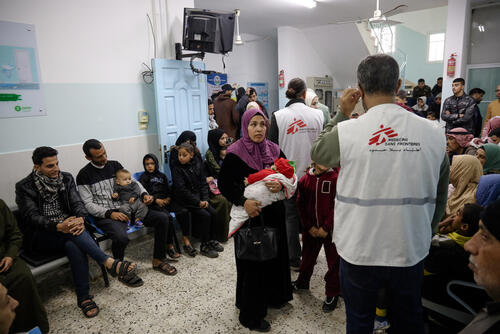
Our teams have also seen an increasing number of suspected cases of hepatitis A. In the last three months of 2023, cases of diarrhoeal illnesses reported among children under five were 25 times higher than during the same period in 2022. Between January and March 2024, our teams treated 216 children under five for moderate or severe acute malnutrition, a condition which was almost entirely absent prior to the current conflict.
As hospitals are overwhelmed with trauma patients, people with other types of medical needs, such as pregnant women with complications and people living with chronic diseases, are often unable to receive the care they require. In the Emirati hospital, where MSF is supporting the postpartum department, medical teams struggle to deal with close to 100 deliveries a day, five times more than before the war.
In our clinics, consultations for hypertension, diabetes, asthma, epilepsy and cancers have been increasing as patients seek care and medication. However, if their conditions worsen and they require specialised medication or equipment, which are increasingly difficult to obtain in Gaza, little can be done for them. Many medical referrals in Gaza today are delayed or are simply not possible.
Without an immediate and sustained ceasefire, and the entrance of meaningful humanitarian assistance, we will continue to see more people die.Sylvain Groulx, MSF emergency coordinator
The mental health of people in Gaza – including medical staff – is also in tatters. Most patients arriving at our clinics have symptoms related to anxiety and stress, including psychosomatic and depressive conditions. Some people caring for family members with severe mental health disorders have resorted to excessive sedation to keep them safe and prevent them from harming themselves or others, due to the lack of specialised services still functioning in Gaza.
For our teams, trying to support Gaza’s devastated healthcare system has been extremely challenging due to insecurity. We have also faced substantial challenges bringing medical supplies and humanitarian aid into Gaza due to delays and restrictions by the Israeli authorities, which are described in detail in the report’s annex.
“As an international emergency medical organisation, we have the expertise and the means to do much more and scale up our response,” says Sylvain Groulx, MSF emergency coordinator.
“Palestinian medical staff are highly skilled and only need to be given the means to work in acceptable and dignified conditions to treat and save lives. But today all this remains absurdly impossible. Without an immediate and sustained ceasefire, and the entrance of meaningful humanitarian assistance, we will continue to see more people die,” says Groulx.
MSF currently operates in three hospitals in Gaza: Al-Aqsa hospital (Middle Area), Rafah Indonesian field hospital and Emirati maternity hospital (South Gaza), as well as three healthcare facilities, in Al-Shaboura and Al-Mawasi, in Rafah.
Our medical teams provide surgical support, wound care, physiotherapy, post-partum care, general healthcare, vaccinations and mental health services. However, systematic sieges and evacuation orders on various hospitals are pushing our activities into an ever-smaller area and limiting our ability to respond to people’s needs.
We are also providing 300 cubic metres of clean water a day in various locations in Rafah and are continuously working to increase this quantity. On 28 March, we set up a new desalination plant in Al-Mawasi.

Gaza-Israel war
MSF concerned following loss of contact with Dr Obeid at Kamal Adwan hospital in north Gaza
Statement
26 Oct 2024
Gaza-Israel war
Last remaining hospitals in north Gaza under siege and people trapped
Press Release
19 Oct 2024