



3451 Results
 
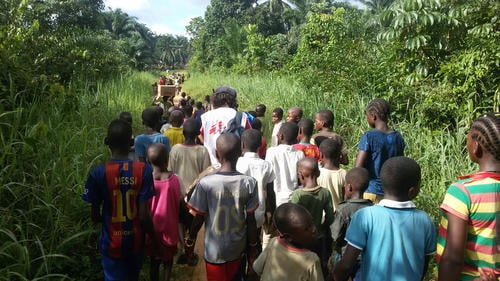
An MSF staff walks with a crowd of young villagers towards a village where a suspect case of Ebola has been notified. Near Iboko, Equateur province, DRC.
DRC Ebola outbreaks

Fighting Ebola on the ground, a race against time

Paul Jawor, an MSF water and sanitation expert, has just returned from Equateur province in the Democratic Republic of Congo (DRC). Paul was working in and around the remote village of Iboko, where cases of Ebola have been confirmed. He explains the challenges MSF teams are facing on the frontline of the ongoing outbreak.
Project Update - 7 Jun 2018
 
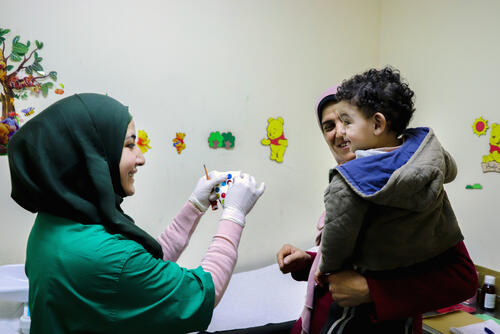
Nidal Ahmed Dahud is pictured with her son Amir Bassam Al Ahmed (1 year and a half) at MSFs clinic in Jandoula (Lebanon). Nidal is originally Palestinian and used to live in Tripoli, in Nahr al Bared camp. When she married someone from Wadi Khaled, she moved there. “Life in Wadi Khaled is extremely difficult. Families are big and services expensive. So everybody knows about MSF over here. This centre is essential for people, it’s our only resource when there is an issue with our children”, she comments. Nidal came to the MSF clinic today because her son has fever. “This is the second time I come here” she says. “The fact that services are free makes a huge difference. If I went to the doctor today, I would have to pay between 30 and 40$ for a consultation. I have 9 children and my husband is the only breadwinner in the family, so we simply cannot afford that.”
Child health

Paediatrics in West Africa: small patients, big diseases

Most West African and Sahelian countries face a significant number of childhood illnesses and diseases each year, mostly related to climate change or instability in the region. In the coming months, these countries will also contend with the usual peaks, when malaria and malnutrition are particularly risky. Health workers, paramedics and community agents are preparing once again to ensure that they do not severely affect the communities in the region. Project Update - 1 Jun 2018
 
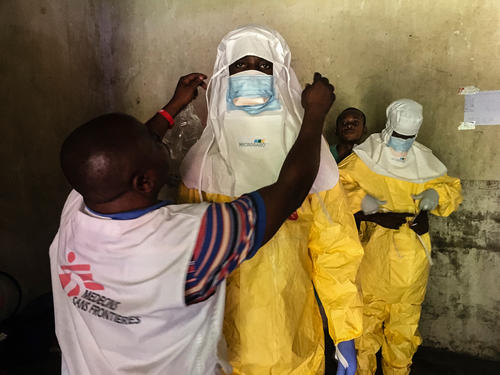
Staff getting dressed in full PPE in the ETC (Ebola Treatment Centre) in Bikoro.
DRC Ebola outbreaks

MSF response to second Ebola outbreak in DRC since 2016

Our teams are responding to an Ebola outbreak in Democratic Republic of Congo. It's the second outbreak of Ebola in DRC since the West African epidemic ended in 2016. Update as of 22 May 2018. Project Update - 23 May 2018
 
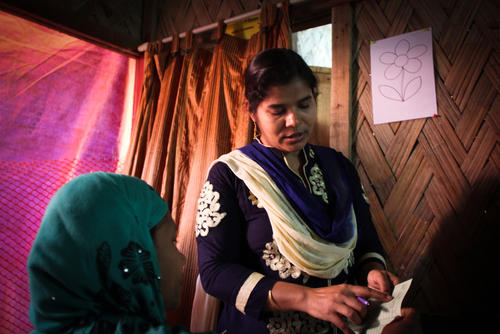
MSF has trained a group of young women to spread messages about surviving sexual violence. The presence of Rohingya women in our outreach team is vital.
Bangladesh

“This feels more like an emergency room than a normal delivery room”

In the makeshift settlements in Cox’s Bazar, Bangladesh, many Rohingya women give birth in their tents, limiting their medical options in case something goes wrong. MSF’s new maternity ward in Kutupalong, which will be able to withstand extreme weather, offers private rooms for new mothers and their babies, who face an uncertain future in Bangladesh. Project Update - 23 May 2018
 
Nurse Salma attends to a patient in the maternity ward of MSF's hospital in Dagahaley camp, Dadaab.
Kenya

MSF responds to cholera outbreak amid heavy rains and flooding

Over the last two months, Kenya has been receiving heavy amounts of rainfall, causing floods, which have so far claimed the lives of over 170 people and displaced more than 300,000. Project Update - 18 May 2018
 
Preparation of the outreach teams in Bikoro.
DRC Ebola outbreaks

Ninth Ebola outbreak in 40 years hits urban area

An outbreak of Ebola has been declared in Equateur province, Democratic Republic of Congo (DRC). The outbreak, in the northeast of the country, has affected 44 people who have presented symptoms of haemorrhagic fever in the region; 3 confirmed as Ebola, and and 23 deaths have been notified by the national health authorities. Project Update - 17 May 2018
 
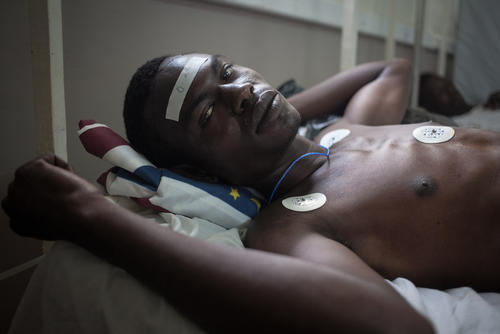
Ali, a student, was shot in the stomach during the events of April 10th. The bullet is still lodged in his body, he is waiting for surgery.

Ali, étudiant, a reçu une balle dans le ventre durant les événements du 10 avril. La balle est encore logée dans son corps, il attend d'être opéré.
Central African Republic

Days of violence and mass casualties in Bangui

For over 18 months, Central African Republic (CAR) has yet again been subjected to extreme violence inflicted on a population left traumatised by the civil war in 2013 and 2014. Until recently, the capital city Bangui appeared to have been spared the attacks and fighting that have erupted in the provinces. Project Update - 17 May 2018
 
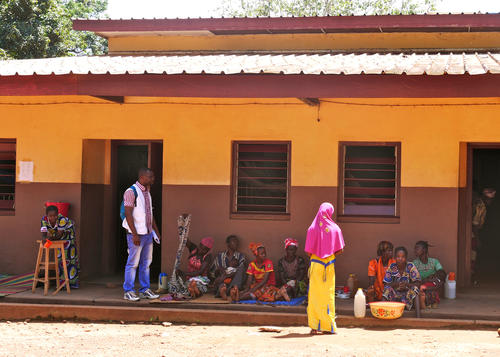
People waiting in front of the Bambari general hospital, Central African Republic. In Bambari, second city of CAR, MSF supports the paediatric and maternity wards and the national surgery team. MSF teams in Bambari treated 22 people for violence-related injuries in May 2017, in contrast to just eight in April. Four children were among the wounded from Alindao treated by MSF, including a three-year-old who had been shot in the face. Most of those injured in Alindao had gunshot wounds, but some had knife injuries and burns.
Central African Republic

Fire and bloodshed in Bambari, a town symbolising peace

Since 14 May 2018, a new cycle of inter-community violence has taken hold in Bambari, a city in the Central African Republic (CAR) that, in 2017, remained relatively stable while the rest of the country spiralled into increasingly fractured conflict. MSF’s surgery team, which supports the local hospital, cared for 17 wounded, two of whom unfortunately succumbed to their injuries. Project Update - 17 May 2018
 
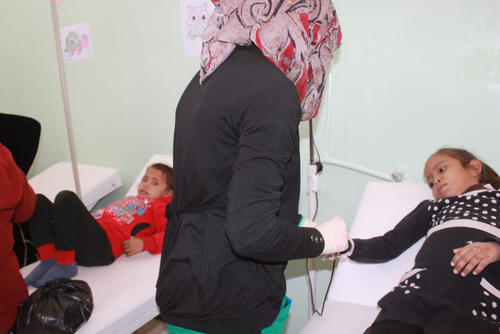
Noora is ten years old girl that is diagnosed with thalassemia.  The MSF team in Syria met Noora and her mother, Jawhara, in Tal Abyad hospital. 

Noora’s mother said: "We started doing blood transfusion for Noora when she was two months old."

"We fled from Deir ez-Zor to Tal Abyad. It takes us 15 minutes to arrive to the hospital for the blood transfusion sessions. Noora has a blood transfusion session once every 14 days, but it’s still quite a challenge. The most worrying part is not finding the medication to reduce the iron in her blood. There is limited awareness about the disease in the country and due to conflict in the country sometimes the medication or the blood units are not available."

"Noora couldn't play like other kids, sometimes she used to come back home crying." 

"We hope we will find a bone marrow transplantation donor but so far we haven’t and we can't afford it."

MSF has started providing chelation treatment to children with thalassemia in Tal Abyad national hospital.
Syria

Treating patients with chronic conditions in a war context

Médecins Sans Frontières (MSF) has started providing chelation treatment to children with thalassemia in Tal Abyad national hospital, northeast Syria. After seven years of war, patients with this chronic disease have not received the regular treatment or blood transfusions they need. Project Update - 16 May 2018
 
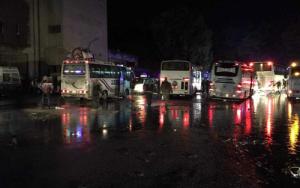
Qalaat al-Madiq buses
Syria

Newly displaced Syrians face multiple challenges in Idlib and northern Hama

Over the past two months, huge numbers of Syrians have been displaced from formerly besieged areas to northwest Syria, with more than 60,000 of them arriving in the governorate of Idlib and in northern Hama. Médecins Sans Frontières (MSF) is providing assistance throughout the area, and has strengthened the medical response in Qalaat al-Madiq in northern Hama, a location known as ‘zero point’ where new arrivals descend from buses. Project Update - 14 May 2018
Four mothers posing in a corridor of the Hospital in Bili. All four of them are staying in the hospital with their child, that's suffering from a severe case of malaria. Since the beginning of the project in 2016, the pediatric ward already treated more than 4.000 cases of complicated/severe form of malaria.
Médecins Sans Frontières (MSF)

Independent medical humanitarian assistance

We provide medical assistance to people affected by conflict, epidemics, disasters, or exclusion from healthcare. Our teams are made up of tens of thousands of health professionals, logistic and administrative staff - most of them hired locally. Our actions are guided by medical ethics and the principles of independence and impartiality. We are a non-profit, self-governed, member-based organisation.

Learn more