


Data and information from the International Activity Report 2025.
15
15
€3.2 M
3.2M
2015
2015
MSF's search and rescue activities in 2025
In November 2025, Médecins Sans Frontières (MSF) relaunched lifesaving search and rescue (SAR) operations in the Mediterranean Sea, using the new rescue vessel Oyvon.
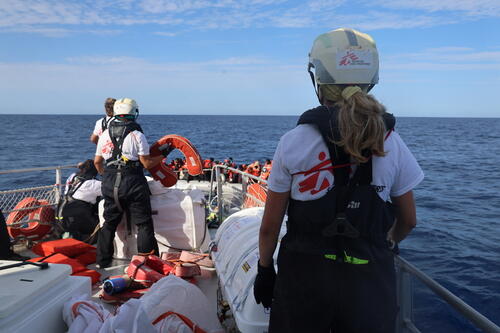
Almost a year after we were forced to suspend our activities in the central Mediterranean, we began to operate onboard Oyvon, a smaller, faster vessel than its predecessor, the Geo Barents. This was as a strategic response to restrictive Italian laws and policies, notably the Piantedosi Decree* and ‘distant port’ practices introduced in January 2023, which specifically target humanitarian rescue vessels.
Before deployment, Oyvon underwent refitting and upgrades to adapt it for SAR operations, including new radio telecommunications equipment, a crane, and a fast inflatable rescue boat, as well as an onboard clinic for general medical care.
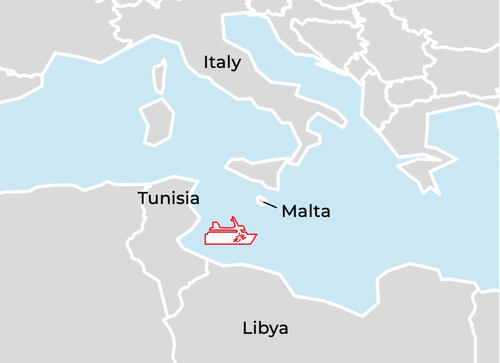
In the brief period before the end of the year, the Oyvon team carried out two operations. Everyone on board was brought to safety in Lampedusa, Italy.
During 2025, MSF, together with other NGOs, organised events in Rome and the EU Parliament to mark 10 years of civil SAR efforts and solidarity with migrants in the central Mediterranean. Our report, Deadly Manoeuvres: Obstruction and Violence in the Central Mediterranean**, released in June, details how the ability of SAR vessels to provide lifesaving assistance is actively undermined by Italy’s policies.
Over 1,330 people died or went missing attempting to cross the central Mediterranean in 2025,*** even as interceptions and forced returns rose sharply; 27,116 people were reportedly intercepted at sea and returned to Libya, up by around 24 per cent from 2024.
In the second half of the year, there was a serious escalation in violence against people on the move and SAR vessels, perpetrated by the Libyan Coast Guard.****
* The Piantedosi decree (Decree-Law 1/2023) introduced a new set of rules applicable exclusively to civilian rescue vessels, and a set of sanctions for non-compliance, ranging from 20 days’ detention in port up to confiscation of the vessel. Among other rules, the decree requires NGO vessels to head immediately to the assigned port after each rescue, and thus limits the scope for multiple rescues in a single voyage.
** MSF: https://www.msf.org/deadly-manoeuvres-obstruction-and-violence-central-mediterranean
*** IOM: https://missingmigrants.iom.int/
**** SOS MEDITERRANEE: https://www.sosmediterranee.org/sos-med-libyan-attack/
in 2025
68
68