


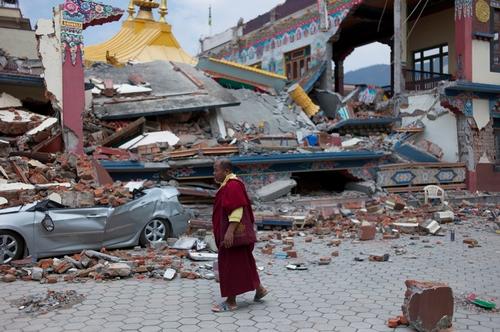
A giant earthquake struck Nepal on the morning of Saturday April 25th. Thousands are confirmed dead with many more injured and homeless.MSF teams and equipment have already arrived in the country, and more are on their way. Kathmandu has experienced relatively little destruction, with the vast majority of buildings still standing. However, many people are sleeping outside in tents and makeshift shelters as they are afraid to be inside due to aftershocks. This is a concern given that storms are expected over the coming days.
© Jean-Paul Delain/MSF

6 months after the earthquake

© Jean-Paul Delain/MSF
Ebola disease in DRC: find out how we're responding
Learn more

Two earthquakes hit Nepal on 25 April and 12 May 2015 and killed an estimated 8,500 people and injured another 20,000.

When the first, 7.8 magnitude, earthquake struck Nepal, with its epicentre in Gorkha district, 80 kilometres west of Kathmandu, MSF launched activities aimed at helping affected populations in need. MSF ran mobile clinics and supplied shelter and hygiene kits.  In some villages, teams found houses and health facilities totally destroyed, prompting MSF to provide the people with medical, shelter and hygiene materials. In Arughat, in Gorkha district, where the main health facility was destroyed, MSF set up an inflatable hospital.

Following the second earthquake on 12 May, MSF teams were already operational and started providing healthcare in the hours following the tremor.

In total within April and July, MSF conducted over 2,500 health consultations and provided psychological support to over 7,000 people, mostly via helicopter. MSF also treated 240 emergency patients and did over 1,200 physiotherapy sessions in the Kathmandu orthopedic hospital. The humanitarian organization also distributed food, and shelter, cooking and hygiene items to almost 15,000 households. MSF reduced its emergency activities in July 2015 and kept working through two projects in Sangha and Charikot.
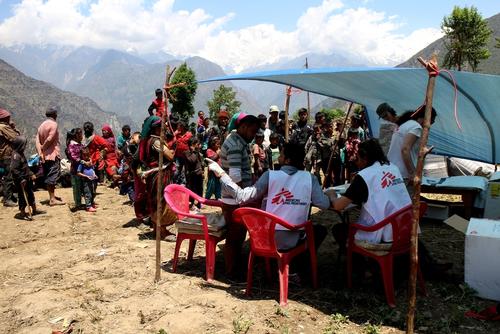
After doing a health and damage assessment, an MSF team is setting up a clinic in Dhading district, a heavily affected area in the mountains to the north-west of Kathmandu, which is only reachable by helicopter and where little or no assistance has reached. While the most critically injured
people were evacuated in the days immediately after the earthquake, those remaining have been trapped in their villages as roads and walking tracks have been cut off by avalanches and landslides. MSF's teams are seeing
people in need of basic healthcare, as well as a number of people presenting with wounds sustained in the earthquake that have now become infected.
The team will work to spread the word in the surrounding villages that people can now come to the clinic to receive care.
After doing a health and damage assessment, an MSF team is setting up a clinic in Dhading district, a heavily affected area in the mountains to the north-west of Kathmandu, which is only reachable by helicopter and where little or no assistance has reached.
Jean Pletinckx/MSF

In Sangha, MSF has been working in the Spinal Injury Rehabilitation Center a 50-bed facility situated east of Katmandu. After the earthquake a large number of patients had surgery done in various hospitals. Most of the patients suffered injuries on the lower limbs and are now fitted with external fixation, or put in traction.  MSF provides extra capacity general rehabilitation for post-operative follow up of patients (31 until now) with physiotherapy, dressings, medical follow-up and mental health assistance. MSF is also currently constructing a new ward to the existing facility for general rehabilitation suited to welcome 50 patients. All activities will be handed over to the Spinal Injury Rehabilitation Center before the end of the year.

MSF is also providing secondary health care in Charikot, a village at the edge of the mountain, in Dolakha district, the epicenter of the second earthquake, in collaboration with the Ministry of Health. In this hospital, MSF is supporting the surgical department and the inpatient departments. All activities will be handed over to a public-private partnership within the end of the year.
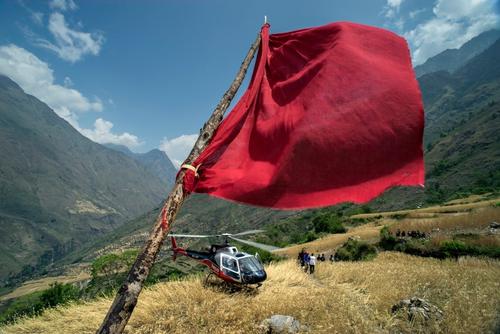
The MSF evacuation helicopter prepares to depart from Diol village, Gorkha District, Nepal after returning patient Maila Gurung home on May 21 2015. Maila had been evacuated to the MSF hospital in Arughat Bazar where his broken leg was treated.

On 25 April a magnitude 7.8 earthquake killed more than 8,000 people and destroyed massive amounts of property, including numerous temples that were on the list of UNESCO World Heritage Sites.

MSF is providing critical medical care is distributing shelter and hygiene materials across Nepal to affected communities in dire need. With the monsoon approaching, the situation is likely to deteriorate in the coming weeks, and far more assistance is rapidly needed.
The MSF evacuation helicopter prepares to depart from Diol village, Gorkha District, Nepal after returning patient Maila Gurung home on May 21 2015.
Brian Sokol/Panos Pictures