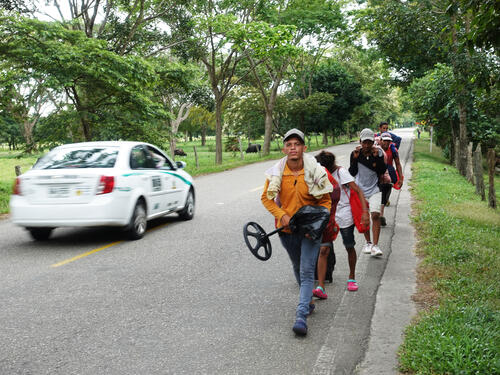
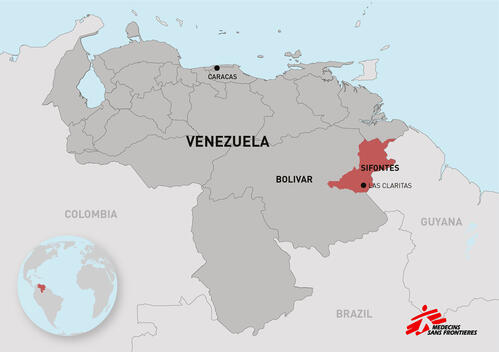
Gold is probably not the first thing that comes to mind when you think of a nation going through a severe political and economic crisis. But in Bolivar, Venezuela’s biggest state, illegal gold mining has been booming for years and the yellow metal has become a motivation for many Venezuelans to head towards the south of the country, as a last chance to make a living before potentially returning home or fleeing to Brazil.
Luis Henrique Ripa, for instance, comes from Caracas, the Venezuelan capital. He left his family behind to come work as a miner in Las Claritas, a small town located in the municipality of Sifontes, in Bolivar state, in eastern Venezuela.
“This is the second time I have come here,” he says when asked if he has previously visited the area. “To be honest, I don’t really like it, but the opportunity is too tempting. The very first day I arrived, I found gold. Some people look for months before finding anything. But it just took me a day and I took it as a sign. Being here is an adventure, and what you get is worth it.”
The fact that Luis is now bedridden, with a large cast covering most of his right leg doesn’t seem to make him change his mind about his journey. He keeps on smiling and tries to forget his pain.
Earlier that week, he broke his leg after a 11-metre free fall inside a gold mine. Luis asks a local doctor when an ambulance will come pick him up. His injuries are too severe to be handled at the local clinic he’s at now; he will have to be transferred to a hospital to be treated properly.
Malaria resurges in Bolivar state
Laying in the bed beside him is Yordan Pentoja. Yordan did not fall; he fell ill. The 27 year old is also being cared for at the clinic for a severe form of malaria. He says he has been diagnosed with the disease about a dozen times since he started working in the mine, over a year and a half ago.
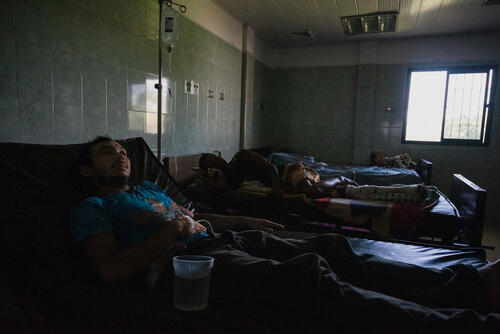
“Malaria is like a plague around here. I have so many friends and colleagues who have had it that I stopped counting”, he sighs. He closes his eyes and adds: “I came to the clinic this morning because I started to feel terrible. My head and my stomach hurt like hell.”
Fifty years ago, Venezuela was often presented as one of the leading countries in South America in the battle against malaria. Though the disease was not fully eradicated by then, efforts had been made to drastically decrease the number of cases in the country.
But in recent years, malaria has made a major comeback in Venezuela. In 2019, it ranked as the most affected nation in Latin America, with over 320,000 diagnosed cases.
“You see, this place is where everything started. Or where everything ended, it all depends how you look at it,” explains Yorvis Ascarnio, an inspector of public health who works for the National Malaria programme in Bolivar. There, in the municipality of Sifontes, malaria has become endemic.
“When the economic crisis hit Venezuela, it hit people in Sifontes very hard too. At first, we started having less and less medicines in our stock, says Ascarnio. “We soon had to choose to whom to give the few medicines we had, we could focus only on severe cases. And it was the same situation in other clinics and diagnostic points… I have been working in this area for the past 12 years. I’ve seen the highs and lows of this place. But this period was extremely hard for us.”
MSF taking steps to improve malaria diagnosis and treatment
In 2016, Médecins Sans Frontières (MSF) started working in Bolivar to provide support to the national malaria programme, in collaboration with the Ministry of Health. Since then, we have supported various diagnostic points in Bolivar and assisted with the provision of adequate treatment for malaria patients.
A year ago, we also worked with the Malaria Institute in Carúpano, in Sucre state, increasing its capacity to tackle malaria in the country.
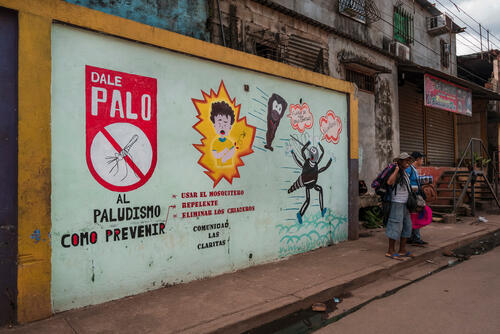
“In Bolivar, we also help with what we call vector control: we fumigate houses and distribute mosquito nets to the population, to diminish the risk of infection,” explains Josué Nonato, an MSF health promoter.
“And my job, as a health promoter, is to explain to people how to identify the symptoms of malaria and what to do when they start to feel sick, to make sure they can be treated before the disease gets too severe.”
In 2019 in Bolivar state, MSF provided...
55,000
55,
85,000
85,
65,000
65,
530
53
250,000
250,
In 2019, MSF provided information to over 55,000 people through health promotion sessions in the area. We also treated more than 85,000 people for malaria, distributed over 65,000 mosquito nets, sprayed 530 households and helped carry out over 250,000 malaria diagnostic tests.
Since then, the number of malaria cases has decreased by approximately 40 per cent in the municipality of Sifontes. To reach these objectives, our strategy has been to get as close to the people who might be impacted by malaria as possible.
That’s why most of the diagnostic and treatment points we supervise in partnership with the national malaria programme are located directly inside the mines.
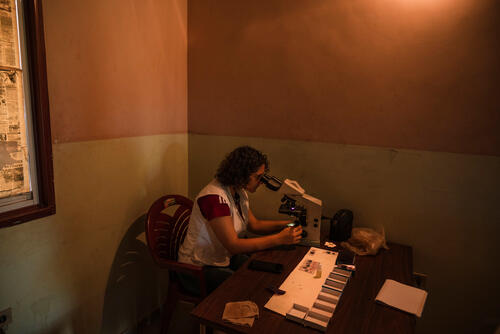
“We went from as many as 200 people queuing in front of the diagnostic points and many people who were infected with malaria to a situation a bit more manageable now,” says Monserrat Barrios, an MSF bioanalyst in charge of training new microscope technicians at diagnostic points.
Explosion in population numbers leads to more needs
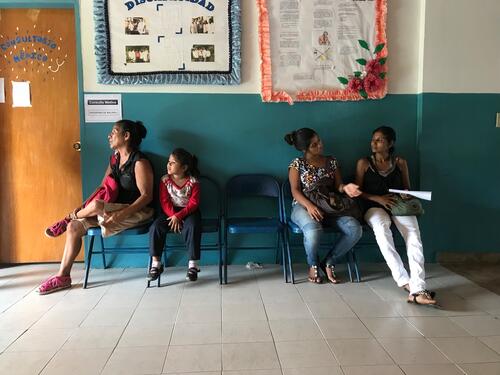
This year, MSF is also supporting Santo Domingo, the local clinic in Las Claritas. Initially built for a population of 20,000, it now has to serve the needs of over 75,000 people who have come to live in the area in the past few years. We have been providing malaria prevention, diagnostic and treatment there, but we are increasing our support to cover other diseases and health needs.
“We know other departments also need help to cope with the number of patients, including those suffering from non-communicable diseases or in case they need to take care of emergencies and referrals to a hospital,” explains Fanny A. Castro, MSF medical activity manager.
“We are focusing more on sexual and reproductive health, for instance, with services such as family planning and deliveries,” Castro says. “We want to make an overall difference and to increase people’s chances of accessing health services. We have also installed a functioning water supply and waste management system around the facility, which considerably improves the quality of care provided.”
Impact of a health system in crisis being felt far and wide
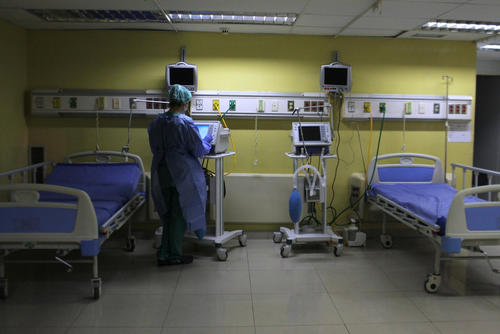
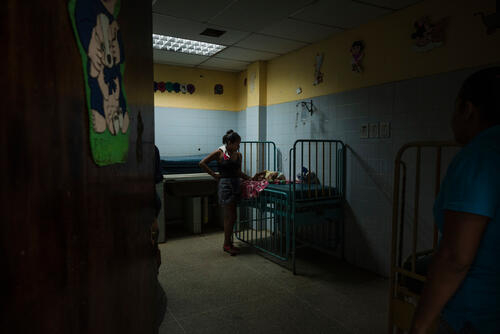
However, health needs go well beyond Las Claritas and the municipality of Sifontes. Venezuela’s economic crisis has deeply impacted the health system in general and it is felt almost everywhere. MSF tries to answer the most pressing needs in different states of Venezuela. In Bolivar, we will soon begin to support one of the regional hospitals in the city of Tumeremo, which today is barely functional.
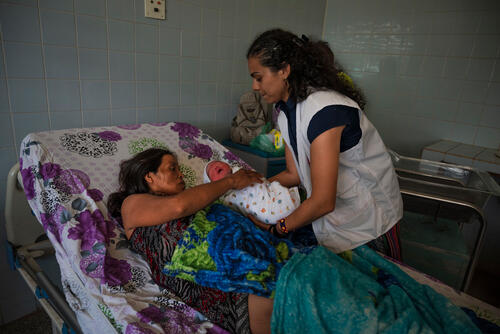
In one of the abandoned hallways of this hospital, a newborn’s cry is heard. Alicia Jimenez, an indigenous woman from Bolivar, has just given birth to her tenth child with the help of one of the facility’s remaining midwives.
She had to travel by boat and car to reach the hospital but she says that despite the difficulty of the journey and the current poor conditions of the building, she’s still blessed with this new addition to her family.
This year, we will intensify our efforts to tackle malaria in Venezuela, but also improve people’s access to health services, in Tumeremo and other places across the country.
MSF has been working in Venezuela since 2015. Teams are currently working in the capital, Caracas, and in Bolivar, Sucre, Amazonas and Anzoátegui states. Between 2016 and early 2018 we also provided medical care in Maracaibo, in the northwest of the country. MSF is an international, independent, medical humanitarian organisation. Our work in Venezuela is funded exclusively by private donations from individuals around the world.