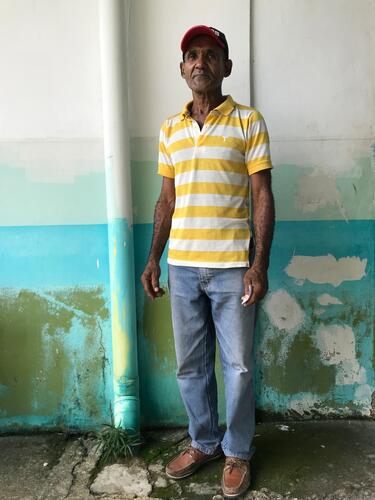
In the rural town of San Vicente, in Sucre state, on Venezuela’s northern coast, Santana Marquez goes to the local clinic. Two days prior, he began to have fever, headache, shivering and tiredness in his body. He has experienced these symptoms before, having had malaria four times. He is convinced that he has contracted the disease again.
Santana is 61 years-old; he has spent his entire life in the agricultural community of San Vicente and is dedicated to the cultivation of taro, bananas and cocoa. He lives in a humble house and his main concern is how to bring the daily bread to the table to feed his family.
He has to walk to the local medical centre, where he is examined and tested with a rapid malaria test. With a simple prick to the earlobe and after waiting for a few minutes, it is possible to have the results almost immediately.
Three pillars of malaria care and prevention
Sucre is one of the states in Venezuela with the highest incidence of malaria. Its climate and vegetation make the area perfect for the proliferation of the Anopheles mosquito, which transmits the disease. Médecins Sans Frontières (MSF) performed more than 20,000 diagnostic tests in Sucre, just in 2019, of which more than 12,000 turned out to be positive. MSF has been present in the area since the last year, working with the Malaria Programme of the Regional Environmental Health Directorate on a strategy to reduce and control the disease.
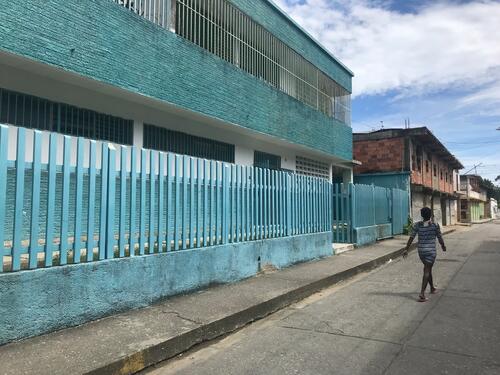
In seven healthcare centres across five municipalities in the state, MSF is working on three main pillars: early diagnosis and treatment; strengthening epidemiological surveillance and vector control activities; and health promotion. With this multi-tiered approach, the clinics in San Vicente, Agua Clarita, Guaca, Putucual, Caño Ajíes and Coicual, and the Yaguaraparo hospital are all supported by MSF, helping to provide a timely response to malaria.
Each of the centres receives not only supplies of rapid tests, malaria treatments and mosquito nets for distribution, but also primary care medicines to ensure urgent treatment of other diseases prevalent in the area, and basic medical equipment such as a sphygmomanometer to measure blood pressure and thermometers.
The centres also receive support for their sexual and reproductive health programmes and training for medical and non-medical staff on infection prevention and control measures.
Preventing multiple infections
As he suspected, and for the fifth time in his life, Santana tests positive for malaria on the rapid test. It is quite common in his environment to suffer from the disease multiple times. Upon receiving his diagnosis, a health promoter explains to him everything he needs to do during his convalescence and clarifies the myths and realities about malaria, as there are many popular beliefs and misconceptions around the disease.
He also receives information on preventive measures he can take every day at home. Afterwards, he is attended to by a medical team that provide him with the complete treatment. If he follows the treatment as advised, Santana should recover very soon.
“The medical support activities to the supported centres has been crucial in the management of malaria in Sucre state,” says Ana Teresa Afonso, MSF’s medical referent in the region. “We have seen a marked decrease in cases and their severity, which is a good sign that people are sticking to the treatment and preventive measures.”
Care for pregnant women
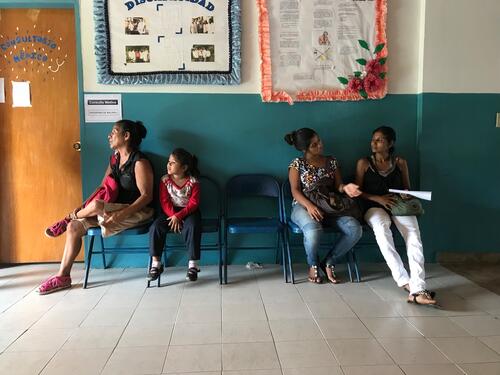
Our team also works to define preventive measures as part of a health promotion strategy for the people who live in Sucre. In a small consultation room at the clinic in the coastal community of Guaca, a group of young women talk about their concerns about pregnancy.
Most are concerned about how to access a good quality health service to follow up and deliver their babies, and how they can avoid getting sick from malaria, which is quite common in their area. They all receive practical recommendations and bed nets to keep them safe at night.
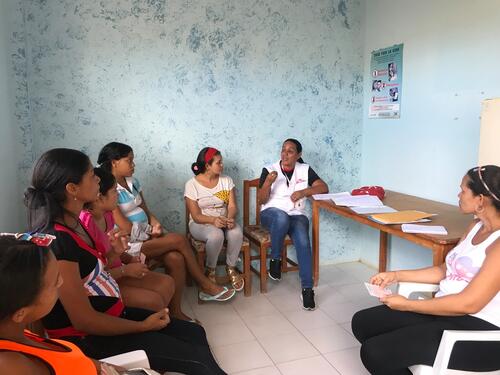
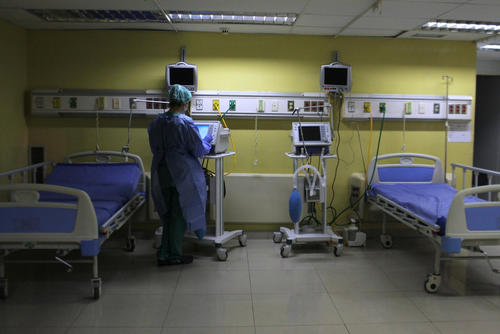
Many of these women who come to the clinics in Sucre state have difficulty coming together and reaching their appointments. Most are planning to give birth at the Candelaria García maternity ward, in Carúpano hospital, where we support infection prevention and control with the donation of cleaning and disinfection supplies, and training of medical and non-medical staff who are also facing the new coronavirus.
In addition, MSF carries out structural rehabilitation work to guarantee minimum standards of water, sanitation and waste management at the hospital, and to ensure care for expectant mothers and new-borns. This rehabilitation work includes the complete restoration of all bathrooms, the improvement and maintenance of the air conditioning system, including that of the operating rooms, the waterproofing of the roof, and the donation of hospital mattresses.
“Our work related to the water, sanitation and waste management is part of a broad line of support that aims to guarantee minimum standards for all the regional clinics where MSF is present in Sucre state,” says Marco Puzzolo, MSF Project Coordinator. “This includes the two largest health centres in Sucre; Santos Aníbal Dominicci hospital in Carúpano and Antonio Patricio de Alcalá University hospital in Cumaná.”
We are also rehabilitating a structure adjacent to the maternity ward, which will be called ‘Abrigo Materno’ (maternal shelter). This will be used to temporarily host mothers or caregivers who have travelled from far away and have limited resources, while their children are hospitalised in the neonatal ward.
Coronavirus COVID-19 pandemic
Staff entry restrictions force MSF to withdraw from COVID-19 response in Venezuela hospital
Press Release
24 Nov 2020
Venezuela
MSF teams improve conditions for Venezuelan returnees in quarantine centres
Project Update
13 Oct 2020