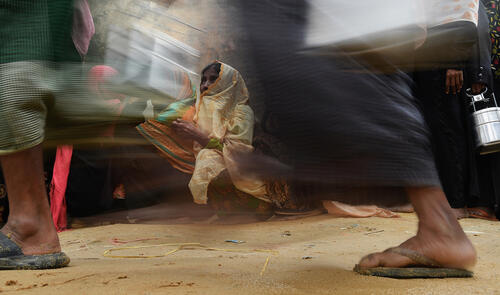
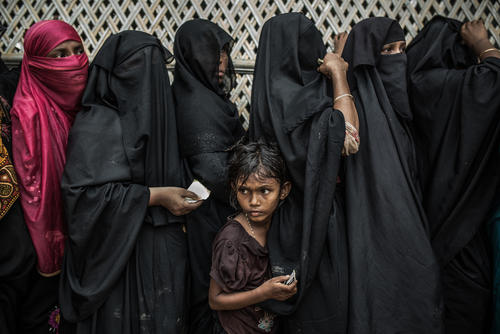
Halima and her mother wait in the rain for a distribution of food in Jatmoli refugee makeshift settlement.
April 2018, Cox’s Bazar, Bangladesh: Halima and her mother wait in the rain for a distribution of food in Jatmoli makeshift settlement.
© Pablo Tosco/Angular

A year in pictures 2018

April 2018, Cox’s Bazar, Bangladesh: Halima and her mother wait in the rain for a distribution of food in Jatmoli makeshift settlement.
© Pablo Tosco/Angular
Ebola disease in DRC: find out how we're responding
Learn more

A picture is worth a thousand words

Our teams continued to provide lifesaving and life-changing medical care in over 70 countries around the world in 2018.

Photojournalists and staff photographers were there beside them – bearing witness to and capturing the work of our dedicated teams, and the stories of the individuals and communities they assist.

Whether caught in or fleeing conflict and violence, affected by disease or epidemics, or hit by natural disasters, our patients each have their own unique story to tell. Stories of suffering and vulnerability, bravery and resilience. These pictures of the year (taken between November 2017 and December 2018) showcase a select few.
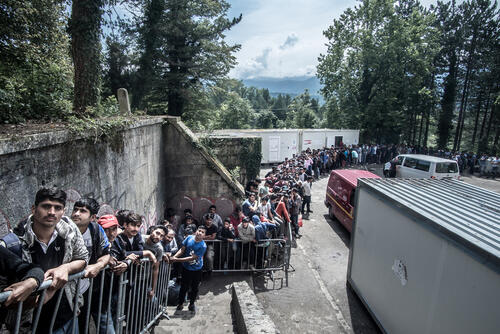
Rohingya refugees queue for a meal provided by a Turkish aid agency at a food distribution site in Shofiullah Kata Camp in the Moynargona area of Cox’s Bazar . The refugee camps in Cox’s Bazar are home to over 900,000 Rohingya refugees who fled Myanmar in August 2017. Cox’s Bazar, Bangladesh. 20th July, 2018. Photo: Kate Geraghty
July 2018, Cox’s Bazar, Bangladesh: Rohingya refugees queue for a food distribution in Shofiullah Kata Camp, in the Moynargona area of Cox’s Bazar.
Kate Geraghty/Fairfax Media
Halima and her mother wait in the rain for a distribution of food in Jatmoli refugee makeshift settlement.
April 2018, Cox’s Bazar, Bangladesh: Halima and her mother wait in the rain for a distribution of food in Jatmoli makeshift settlement.
Pablo Tosco/Angular
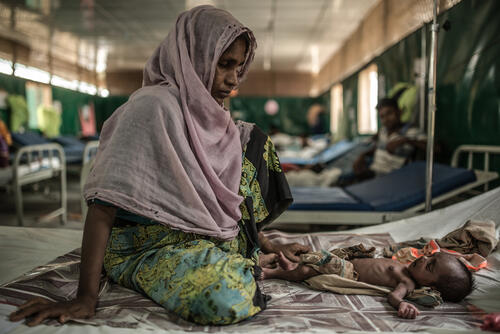
Rozia and her two-month-old son Zubair in the MSF hospital in Goyalmara. Many of the children admitted to the hospital have contracted infections from unhygienic birthing practises, and the unsanitary living conditions in the camp during their first days of life.
April 2018, Cox´s Bazar, Bangladesh: Rozia and her two-month-old son Zubair in the MSF hospital in Goyalmara. Many of the children admitted to the hospital have contracted infections from unhygienic birthing practices, and the unsanitary living conditions in the camp during their first days of life.
Pablo Tosco/Angular
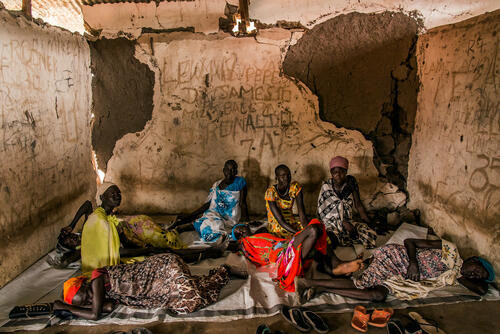
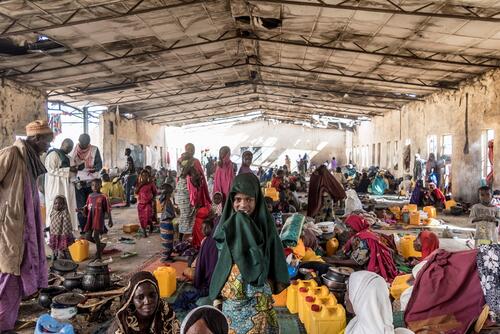
Young women gathered in a disused health facility in ruins, waiting to see the MSF medical officer, during a mobile clinic in the village of Kier.
December 2017, Kier, South Sudan: Young women gathered in a disused health facility that lies in ruins, waiting to see the medical officer from MSF’s mobile clinic.
Frederic NOY/COSMOS
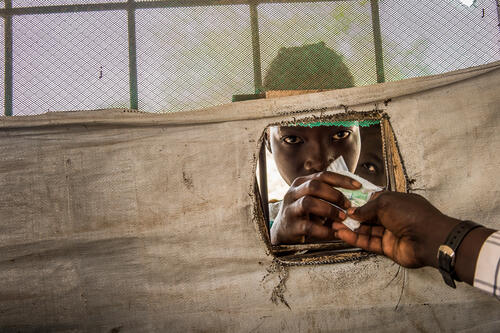
Through the small window carved in a tarpaulin, facade of the Old Fangak hospital pharmacy, a pharmacist gives his prescription to a young patient.

Par la petite fenêtre creusée dans une bâche, façade de la pharmacie de l'hôpital de Old Fangak, un pharmacien tend sa prescription à un jeune patient.
December 2017, Old Fangak, South Sudan: A pharmacist gives a young patient his prescription through a small window cut into the tarpaulin facade of the hospital pharmacy
Frederic NOY/COSMOS
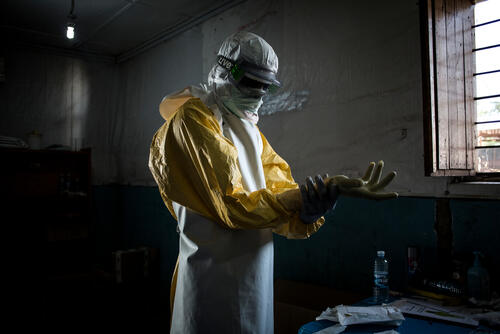
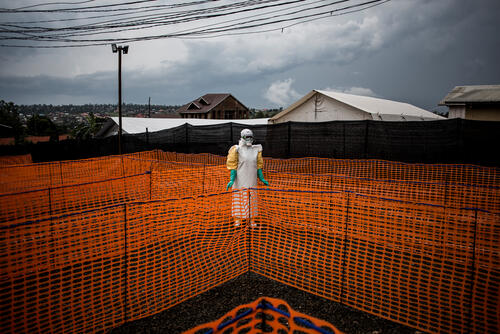
A health worker is seen putting on his personal protective equipment (PPE) before entering the red zone of a MSF supported Ebola Treatment Centre(ETC), where they will check up on patients on November 06, 2018 in Bunia.
November 2018, Bunia, Democratic Republic of Congo: A health worker checks his personal protective equipment before entering the red zone of the MSF-supported Ebola treatment centre to check on the patients there.
John Wessels
Health workers embrace whilst putting on their personal protective equipment(PPE) before heading into the red zone at a newly build MSF supported ebola treatment centre(ETC) on November 07, 2018 in Bunia.
November 2018, Bunia, Democratic Republic of Congo: Health workers hug each other as they get into their personal protective equipment, ready to enter the red zone of the newly built Ebola treatment centre.
John Wessels
A health worker waits to receive a new unconfirmed ebola patient, at a newly build MSF supported ebola treatment centre(ETC) on November 07, 2018 in Bunia.
A health worker waits to receive a new unconfirmed Ebola patient at the MSF-supported Ebola treatment centre in Bunia, Democratic Republic of Congo, November 2018.
John Wessels
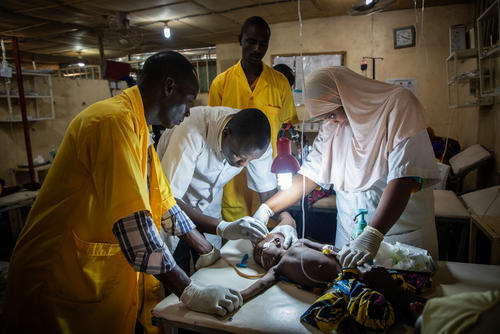
In the stabilization room, the team are administering an intravenous catheter.
MSF teams in the stabilisation room administer an intravenous catheter. Niger, September 2018.
Laurence Hoenig/MSF
MOHAMMED
Family. Hindatou, Halisa and Mohammed
Hindatou is 23-years-old and has two younger siblings, 14-year-old Mohammed and 13-year-old Halisa. They come from northern Nigeria. They were kidnapped by an armed group and spent several months in captivity before fleeing and reuniting with part of their family. 
Halisa is always restless and she has nightmares. Mohammed has similar problems; he witnessed several murders.
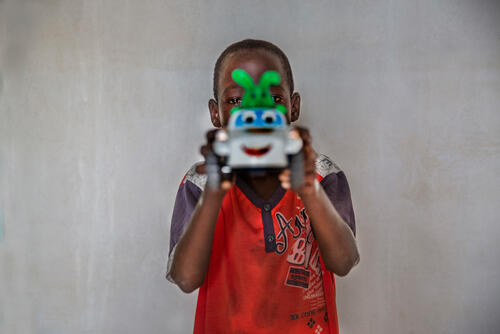
August 2018, Diffa, Niger: 14-year-old Mohammed and his siblings were kidnapped by an armed group in northern Nigeria and spent several months in captivity before fleeing and being reunited with at least part of their family. Having witnessed several murders, Mohammed started receiving support through MSF’s mental healthcare project in Diffa, Niger.
Juan Carlos Tomasi/MSF
Rasmiyya, 63, who raised seven sons and four daughters, now lives alone in a camp for displaced people. Her story reflects the multiple layers of violence and loss that many in Iraq have suffered over recent years.
In 2004, following the US invasion, she lost four of her seven sons in the bombing of their home city Falluja. Their names were Haqqi, aged 27 at the time of his death, Omar, aged 25, Adnan, 16, and Ahmad, 21. 
“I was out of the house. My husband and I had gone to buy food for the children. When we came back we saw the house had been reduced to rubble. I wished at that moment that I could have stayed home and died with them. It took me a while to find some peace again. God gave them to me, and God took them away again. I am now waiting to see them in heaven,” she says. 
The US compensated Rasmiyya and her husband for the destruction of their home, which they were able to rebuild. 
Another of her sons, Sarhan, has been jailed since 2006, accused of collaborating with militants. “He is still in prison to date. Sometimes I hear news that he is still alive in there,” Rasmiyya says.
Several years went by, the Islamic State took over Falluja, and once again life became unbearable for Rasmiyya and her family.
“The bombing (by the US-led coalition against IS) was horrific and constant,” she says. 
“I fled Falluja with my son Mohammad, on January 8, 2014. We went to Baghdad. The journey there was really hard because the roads were blocked. But we eventually made it.”
For a time, Rasmiyya’s husband Ismail refused to leave Falluja in spite of the bombing. But in 2015 she travelled back to her home city to convince him to flee. “I didn’t recognise him, he was so thin,” she said.
“And after two months in Baghdad, he died. We had no money, and there were no adequate medical services for us.”   
In October 2016, Rasmiyya had little choice but to move to Amriyat al-Falluja camp for IDPs. 
“My other son Mohammad, who came with me to the camp, was lucky to find a job in a factory nearby. But three months ago, a group of armed men arrived in a car and took him away. I have had no news of him since.” 
Rasmiyya calls Mohammad’s phone at least five times a day since he was taken and it is still turned off. “I always think he will answer.” 
Rasmiyya has four daughters living in Baghdad, as well as a son named Khaled. “I wish I could fly there to see them. The checkpoints surrounding the camp prevent me from leaving,” she says.
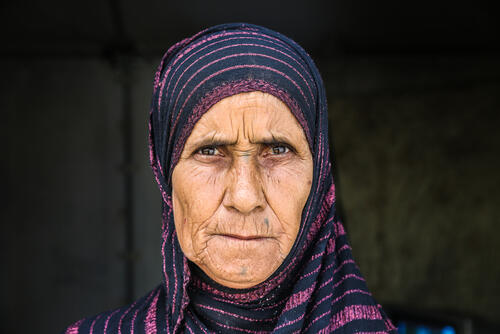
Rasmiyya, 63, raised seven sons and four daughters, and now lives alone in Amriyat Al-Fallujah camp for displaced people. Iraq, October 2018.
Mohammad Ghannam/MSF
Nashwan, 42, is prepared for surgery at the Médecins Sans Frontières / Doctors Without Borders (MSF) post-operative care facility in east Mosul. Nashwan is one of the many war-wounded patients still trying to recover a year after the conflict in Mosul officially ended. 

“On 11 March 2017, our neighbourhood was retaken [from the Islamic State group],” Nashwan recalls. “Two days later, we went out to buy food and we were happy. But fighting was continuing in the neighbourhoods around ours. There was a tall building nearby and there was a sniper on top. He started hunting us down. My neighbour was shot in the head and killed. My brother was shot in the leg. The sniper shot me in the back and in the leg.”

Nashwan went to several hospitals outside Mosul for treatment. He then returned to his home in west Mosul where the conflict was still raging. 

“I waited in my home for several months for the bombs to stop,” he says. “When I was at home during these seven months the pain started to grow in my leg and hip, and eventually it became unbearable. So in October 2017 I went to the general hospital in west Mosul. They did x-rays and tests and they said I needed a huge operation and they didn't have the capacity to do the operation.” 

Nashwan’s neighbours helped him pay for a private doctor to do the operation, but it was unsuccessful and Nashwan was soon in agonising pain again. He was forced to go back to the general hospital, which then referred him to MSF’s surgery and post-operative care facility in east Mosul.

“Life has been really hard. My injury has had a negative impact on my life - my family, the way I interact with my kids. I can’t play with them. I can't work and we haven’t had an income. I've been really depressed and I cannot talk to people. Even to go to the bathroom I need someone to come with me. And I need the crutches to go everywhere. It's been really hard for me. But thankfully the hardest part has passed now that I am here.” 

The MSF facility provides free surgeries, post-operative care, rehabilitation and mental healthcare, especially for war-wounded patients. MSF works closely with local health authorities to refer the most urgent patients for care.  

The facility is run by a team of 30 highly qualified international and Iraqi medical experts and has a 33-bed capacity.
May 2018, East Mosul, Iraq: Nashwan, 42, is prepared for surgery at MSF’s post-operative care facility. He is one of the many war-wounded patients still trying to recover a year after the conflict in Mosul officially ended.
Sacha Myers/MSF
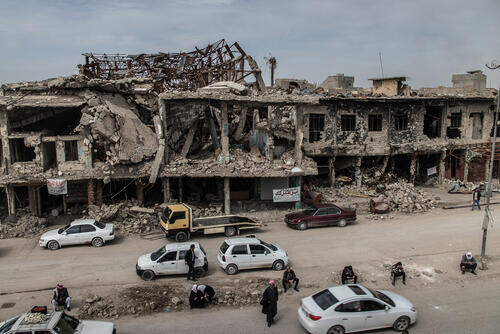
Mosul’s old town experienced intense shelling, aerial bombing and attacks with improvised explosive devices (IED) during the conflict to retake the city from the Islamic State group in 2016/17. Much of the old city is still inaccessible due to the destruction and presence of IEDs, unexploded ordinance (UXO) and booby traps. 

Between 5,000 and 7,000 people have returned to their homes in Mosul’s old city, despite the danger of explosive remnants of war. They face extremely difficult conditions, often living without water and electricity and in partially damaged houses.
April 2018, Mosul, Iraq: Mosul’s old town, which experienced intense shelling, aerial bombing and attacks with improvised explosive devices (IEDs) during the battle to retake the city from the Islamic State group in 2016/17. The destruction and the presence of IEDs, unexploded ordinance and booby traps mean that much of the old city remains inaccessible. Nevertheless, between 5,000 and 7,000 people have returned to their homes, in many cases damaged and without water or electricity.
Sacha Myers/MSF
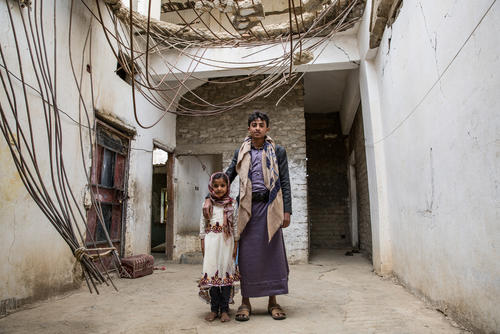
Yemen, gouvernorat de Saada, Haydan, mars 2018. Les enfants de la famille Ghani posent devant l'entrée de leur maison, bombardée pendant la guerre de Saada, entre 2004 et 2010. 

Saada governorate in Yemen, Haydan, March 2018. Ghani family children posing in front of the entrance of their house, bombed during the war of Saada, between 2004 and 2010.
Children from Haydan pose at the entrance to their home, which was bombed during the battle for Saada between 2004 and 2010. Yemen, March 2018.
Agnes Varraine-Leca/MSF
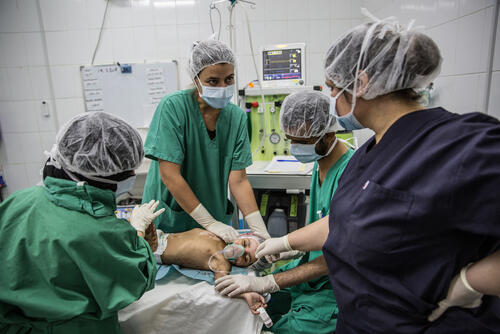
Yemen, gouvernorat d'Amran, Khamer, mars 2018. Elizabeth Braga, physiothérapeute pour MSF, intervient sur une enfant brulée à 30% pour l'aider à récupérer de la mobilité au niveau du bras droit. Les séances de physiothérapie durant une intervention chirurgicale permettent de réduire la douleur ressentie par le patient. MSF propose des activités de physiothérapie pour les blessés de guerre, les victimes d'accident de la route ainsi que les enfants.

Yemen, governorate of Amran, Khamer, in March, 2018. Elizabeth Braga, physiotherapist for MSF, intervenes on a child burned in 30 % to help him recover from the mobility at the level of the right arm. The sessions of physiotherapy during a surgical operation allow to reduce the pain felt by the patient. MSF proposes activities of physiotherapy for the wounded soldiers, the victims of road accident as well as the children.
March 2018, Khamer, Yemen: MSF physiotherapist Elizabeth carries out physiotherapy on a young patient in surgery to reduce their pain.
Agnes Varraine-Leca/MSF
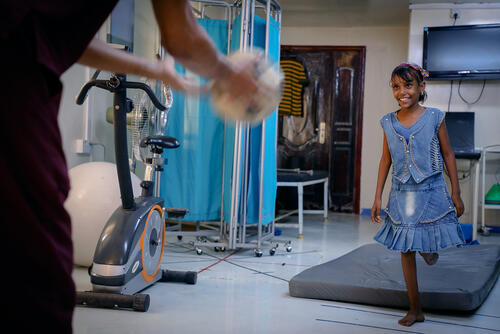
Aya Omar 10, lost her leg after an armed group threw a bomb on her family’s house. She was sleeping next to her four brothers and sisters when the incident happened, but she was the only injured.
“I always feel enthusiastic when my mom tells me that we’re going to the physio session. I’m stronger than I was after the surgery. I go to the mini market by myself and I play in front of the house.”Aya says.
December 2017, Aden, Yemen: 10-year-old Aya lost her leg after an armed group threw a bomb at her family’s home. “I always feel enthusiastic when my mom tells me we’re going to the physio session. I’m stronger than I was after the surgery. I go to the mini market by myself and I play in front of the house,” Aya says.
Ehab Zawati/MSF
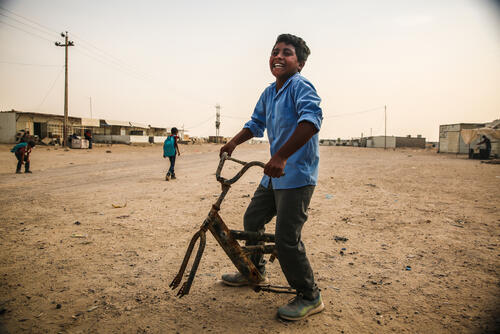
Haussian, a 13-year-old boy from Falluja, has lived with his family in a tent in Amriyat al-Falluja camp for the past three years. Asked what he wants to be when he grows up, he replies: “If I stay alive, I want to be a doctor.” He says he loves football and, above all, Argentinian superstar Leo Messi. And asked why he is playing with a broken bike, he says: “I am happy playing with this bike until God sends me a better one. God is generous.”
Haussian, a 13-year-old boy from Fallujah, Iraq plays with an old bicycle, October 2018. Haussian and his family have lived in a tent in Amriyat Al-Fallujah camp for the past three years.
Mohammad Ghannam/MSF
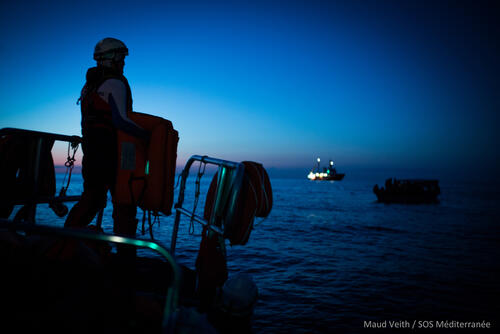
In what was a long & complicated search & rescue, and after negotiations with the Libyan coastguard, the Aquarius this morning has safely brought onboard 47 people - including 17 minors & one pregnant woman - from a wooden boat in distress in international waters.
September 2018, Mediterranean Sea: After a long, complicated search and rescue operation, and negotiations with the Libyan coastguard, the Aquarius has safely brought 47 people on board, including 17 minors and one pregnant woman, rescued from a wooden boat in distress in international waters.
Maud Veith/SOSMéditerranée
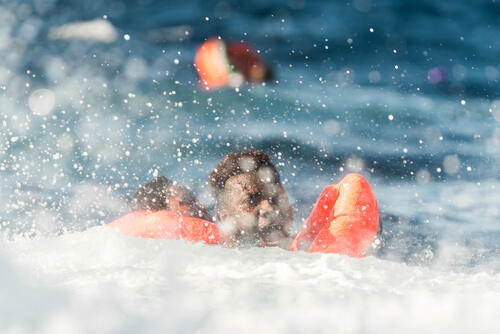
In a nightmarish day on the Mediterranean yesterday, 99 survivors from a sinking rubber boat were rescued by the Aquarius, a search and rescue vessel run by Médecins Sans Frontières (MSF) and SOS MEDITERRANEE, but an unknown number of men, women and children are missing, presumed drowned. Two women are confirmed dead.

“The scene was devastating, with many urgent medical cases in quick succession. They just kept coming, one after another, unconscious and not breathing,” said MSF nurse Aoife Ni Mhurchu. 

Dozens of people were already in the sea when the Aquarius arrived at the scene around 9.30am, and the rubber boat was already deflating. All floating devices were deployed from Aquarius, rafts were launched and the rescue team started pulling people from the sea. 

The MSF medical team on board the Aquarius resuscitated six young children, and one woman. Despite their best efforts they were unable to resuscitate two other women who had drowned. 

“It is absolutely heartbreaking. These women were mothers. We’re now trying to care for their very young children who remain onboard Aquarius” said Ni Mhurchu.

All medical emergencies together with their caretakers were evacuated from Aquarius by an Italian Navy Helicopter to Sfax, Tunisia – a total of sixteen people. This included all six resuscitated children and several women with water on their lungs. The MSF medical team also treated many severe fuel burns, as well as over a dozen mild to moderate hypothermia cases. Many survivors were disorientated and confused as a result of inhaling fuel which had leaked into the rubber boat.
January 2018, Mediterranean Sea: In a nightmarish day on the Mediterranean, 99 survivors from a sinking rubber boat were rescued by the Aquarius, but an unknown number of men, women and children remained missing, presumed drowned. Two women are confirmed dead.
Laurin Schmid/SOS MEDITERRANEE
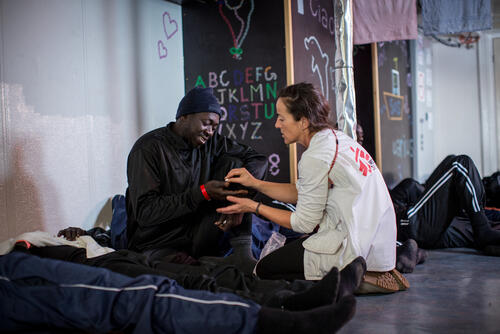
MSF nurse Aiofe Ni Mhurchu' giving some anti sea sikness pills to one of the 27 persons were rescued in the Mediterranean Sea, 2 of them are women. They were saved by a supply boat nearby an oil platform north Sabratah, 55 nautical miles from the Libyan  coast. They come from Sudan, Somalia, Guinea Conacry, Ivory coast, Senegal and Nigeria. They were on a small wooden boat and spent a long time in Lybia, some of them in a detention center named Osama in Zouarah. January 8th, 2018
January 2018, Mediterranean Sea: MSF nurse Aiofe Ni Mhurchu gives anti-sea-sickness pills to one of the 27 people were rescued at sea by a supply boat nearby an oil platform north Sabratah, 55 nautical miles from the Libyan coast. From Sudan, Somalia, Guinea, Côte d’Ivoire, Senegal and Nigeria, they were on a small wooden boat and spent a long time in Libaa, some of them in Osama detention centre in Zouarah.
Federico Scoppa
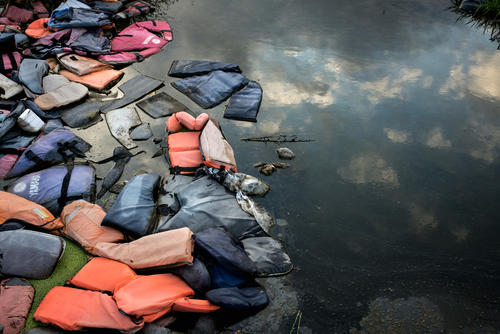
Thousands of life jackets left behind by arriving migrants are gathered at a dump on Lesbos Island, Greece. 
Thousands of people seeking safety after fleeing countries such as Syria, Afghanistan, Iraq, Sudan, and Congo continue to risk their lives to reach Europe. Those who try to arrive via Turkey and the Aegean Sea have been trapped for an indefinite period of time on islands in Greece as part of the EU/Turkey deal and its deterrence and containment approach. 
In Moria refugee camp, on Lesbos island, there are currently more than 7,500 people in a camp made for a maximum of 2,500. With the camp so full, refugees are now staying in an informal extension of the camp known as Olive Grove. The awful conditions at Moria camp/Olive Grove and arbitrary administrative situations have had a dramatic impact on their health and in particular their mental health. 
Médecins Sans Frontières teams provide medical and mental health support outside Moria camp and run a clinic for severe mental health cases in Mytilene, the capital of the island.
May 2018, Lesbos, Greece: Thousands of life jackets left behind by arriving migrants, gathered at a dump on Lesbos Island.
Robin Hammond/Witness Change
Thousands of people seeking safety after fleeing countries such as Syria, Afghanistan, Iraq, Sudan, and Congo continue to risk their lives to reach Europe. Those who try to arrive via Turkey and the Aegean Sea have been trapped for an indefinite period of time on islands in Greece as part of the EU/Turkey deal and its deterrence and containment approach. 
In Moria refugee camp, on Lesbos island, there are currently more than 7,500 people in a camp made for a maximum of 2,500. With the camp so full, refugees are now staying in an informal extension of the camp known as Olive Grove. The awful conditions at Moria camp/Olive Grove and arbitrary administrative situations have had a dramatic impact on their health and in particular their mental health. 
Médecins Sans Frontières teams provide medical and mental health support outside Moria camp and run a clinic for severe mental health cases in Mytilene, the capital of the island.
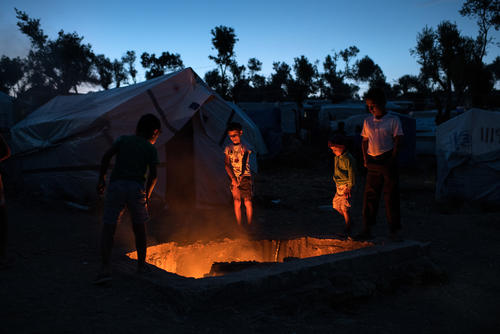
July 2018, Lesbos, Greece: Children gathered around a fire in Moria camp. Thousands of people seeking safety from countries such as Syria, Afghanistan, Iraq, Sudan, and Congo continue to risk their lives to reach Europe. Those who try to arrive via Turkey and the Aegean Sea have been trapped for an indefinite period of time on islands in Greece as part of the EU/Turkey deal and its deterrence and containment approach.
Robin Hammond/Witness Change
In October 2018, MSF teams in collaboration with MoH andHellenic Center for Disease Control & Prevention (KEELPNO) vaccinated 200 children living in VIAL camp on Chios island against measles, mumps, and rubella (MMR) as well as Polio for those who weren't already vaccinated. 
 
In March 2018, MSF mobile units began holding daily visits to the VIAL camp offering primary health care, sexual and reproductive healthcare (ante-/postnatal care; gynecology; family planning), and mental healthcare (individual clinical psychological care sessions). In July 2018, MSF set up a permanent clinic outside VIAL Camp. A social worker complements the support offered to patients at both the local hospital and the camp, linking patients as well to legal aid actors locally and in Athens. Patients in need of psychiatric treatment are referred to a local NGO since the waiting time at the local hospital’s can be as long as three months.  In addition, an outreach team is regularly deployed to the camp providing health advice, promoting MSF's activities, and referring patients to our clinic.
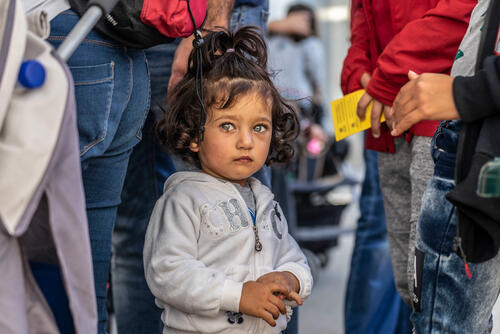
October 2018, Chios, Greece: A young child living in VIAL refugee camp waits for vaccinations.
Anna Pantelia/MSF
View from the operating theatre where Kawkab (34) is getting surgery. 

Kawkab suffered from gallstones and kidney-related problems for almost a year. To get her condition diagnosed, Kawkab carried out various tests and x-rays at her own expense in Beirut. However, she was unable to afford surgery, which costs up to $3,000. 
At the MSF Bar Elias Hopital, Kawkab will get her surgery for free. 

MSF is offering free of charge general essential surgeries at Bar Elias hospitals since November 2018. 


من داخل عرفة العمليات. يجري الأطباء عملية لانتشال حصية المرارة لكوكب.

فكوكب (34) تعاني من حصية المرارة ومشاكل كلى منذ السنة تقريبًا. قبل التوجه إلى المستشفى، قامت كوكب بالتحاليل اللازمة والصور المطلوبة على حسابها الخاص في بيروت، إلّا أنّها غير قادرة على تحمّل تكاليف العملية في مستشفى آخر، والتي تكلّف 3000 دولار أميركي تقريبًا. ستحصل كوكب على العمليّة الجراحيّة التي تحتاجها مجاناً في مستشفى أطباء بلا حدود في بر الياس. 

افتتحت منظّمة أطباء بلا حدود قسم العمليات الجراحيّة العامّة غير الطارئة في مستشفى بر الياس في تشرين الثاني 2018.
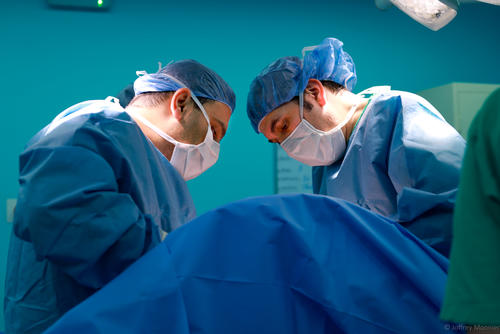
Doctors perform surgery in the operating theatre of a hospital rehabilitated by MSF in Bar Elias. Bekaa Valley, Lebanon, May 2019. 
Joffrey Monnier/MSF
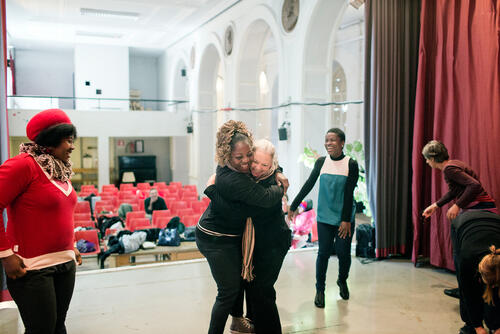
In many occupied buildings people organize social and cultural activities involving even the population living in the surrounding area: services providing social and legal aid, courses of computer, Italian and other foreign language, painting, tailoring etc. A group of women coming mostly from Italy and Nigeria are running a theatre laboratory in a primary school. The Nigerian women are among the residents of an occupied building not far from the school. Among them, Patience. She arrived in Italy in 2012 after a very difficult journey through the Mediterranean sea, when her life and her few-month child’s were almost lost. This dramatic experience is now the plot of a theatre piece, in which she is the main character.
November 2017, Rome, Italy: A group of women, Italians and refugees and migrants, most from Nigeria, have set up a theatre workshop in a primary school. Their play is based on the story of one of the workshop participants, Patience, who arrived in Italy in 2012 after nearly losing her life and her baby crossing the Mediterranean Sea.
Alessandro Penso/MAPS
Alyona and Vadim on their way back home. They have to look for such jobs that don’t require medical certificates because TB treatment is mentioned. Vadim is constantly looking for a job, mainly in construction field. Alyona works as a cleaner at a factory, and has a fixed salary. Minsk, Belarus, August 2018
August 2018, Minsk, Belarus: Alyona and Vadim on their way back home from TB Dispensary 2, where they are both outpatients. "A year ago, we were both in hospital; now we live together and we earn our living. That's why you should not give up on your treatment,” Vadim says.
Viviane Dalles
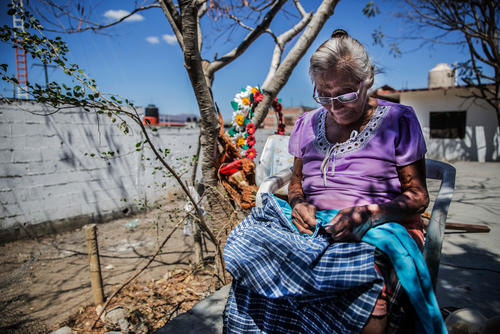
ESP Una vecina de San Felipe de Ocote, desplazada a Apaxtla por la violencia, cose con prendas donadas un toldo para protegerse del sol. 

A woman displaced by violence sews a sunshade using donated clothes in Apaxtla de Castrejón city, Guerrero state.
February 2018, Guerrero, Mexico: A woman displaced by violence sews a sunshade using donated clothes in Apaxtla de Castrejón city, Guerrero state.
Juan Carlos Tomasi/MSF
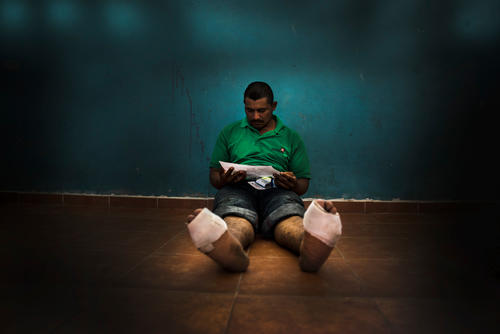
Many of the migrants arrive with sores and wounds on their feet after days on the road
A man rests in a shelter after receiving foot care. Tenosique, Mexico, February 2018.
Juan Carlos Tomasi/MSF
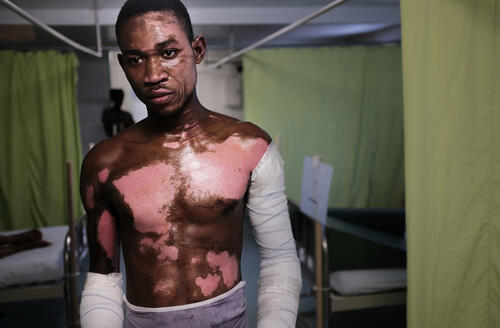
Shnider Avril, who was severely burned by an explosion from a propane tank, receives care at the Médecins Sans Frontières/Doctors Without Borders (MSF) Drouillard hospital for burn patients on February 12, 2018, in Port-au-Prince, Haiti.
February 2018, Port-au-Prince, Haiti: Shnider Avril, who was severely burned by an explosion from a propane tank, receives care at the MSF Drouillard hospital for burns patients.
Spencer Platt/Getty Images
Leonard Gangbe, 33, farmer, is treated at the Paoua hospital in northwestern Central African Republic. He says he was shot in the head while armed men were trying to steal his oxen. The day before the attack he had fled Betoko with relatives after the town had been attacked by an armed group that was trying to dislodge another one that had been occupying Betoko for several months. Paoua, December 28, 2017.
December 2018, Paoua, Central African Republic: Leonard, a 33-year-old farmer, is treated at Paoua hospital. He says he was shot in the head while armed men were trying to steal his oxen. The day before the attack he had fled Betoko with relatives after the town had been attacked by an armed group.
Alexis Huguet
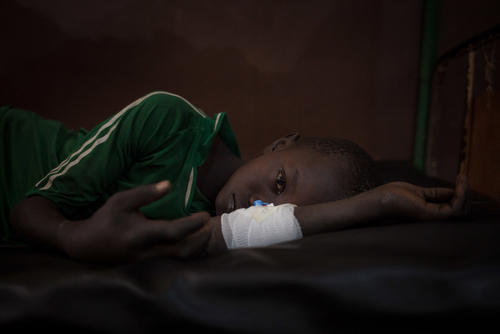
Nicsonne Dadjam, 13, is treated at Paoua Hospital, northwestern Central African Republic, supported by MSF. He was bitten by a snake while working in the fields in his village, 2 hours by motorbike from Paoua.
December 2017, Paoua, Central African Republic: Nicsonne, 13, is treated at Paoua hospital after being bitten by a snake while working in the fields in his village, two hours away by motorbike. Snakebite envenoming permanently disables hundreds of thousands of people and kills more than 100,000 each year all across the globe – more than any other neglected tropical disease – even though highly effective treatments exist.
Alexis Huguet
Gaza, 14 mai 2018, Manifestation contre l'ouverture de l'ambassade à Jérusalem à gaza, dans la zone de Malaka. 52 palestiniens ont été tués et environ 2410 blessés sont à déplorer.  Les blessés sont évacués.

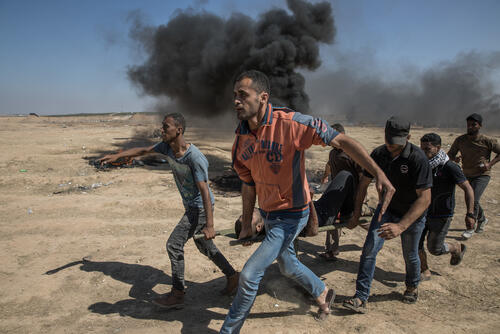
Gaza, in May 14th, 2018, Demonstration against the opening of the embassy in Jerusalem in Gaza, in the zone of Malaka. 52 Palestinians were killed and approximately 2410 wounded persons are to regret. The wounded persons are evacuated.
A wounded demonstrator is evacuated from the throng as tens of thousands gather at the border between Gaza and Israel on 14 May 2018, in the seventh week of protests. More than 1,300 Palestinians were shot and 60 killed at the fence that day, which marked the 70th anniversary of the declaration of the State of Israel and the day the US embassy in Jerusalem was inaugurated.
Laurence Geai
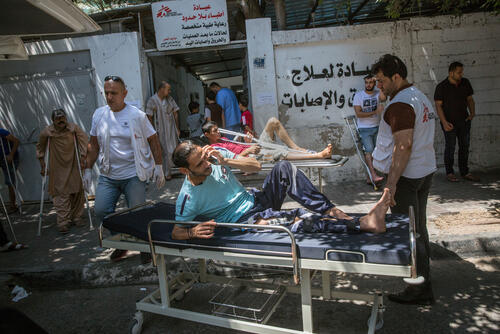
Palestinians who have been wounded from Israeli live ammunition as they arrive for post-operative care at the Médecins Sans Frontières (MSF) clinic in Gaza City on June 6,2018. According to Medecins Sans Frontieres (MSF) who operate in Gaza, the Israelis have been using ammunition that causes fist-sized wounds of “unusual severity”.The clinic also treats burn victims such as the little girl who is seen .
(Photo by Heidi Levine/Sipa Press).
On June 6, 2018, Palestinians hit by Israeli live-fire fire arrive for post-operative care at an MSF clinic in Gaza.
Heidi Levine/Sipa Press
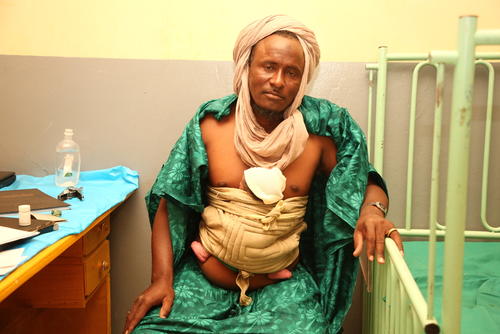
40-year-old Mahamadou Agaïri, a shopkeeper from Ansongo, wearing his 2-day-old baby in 'Kangourou' style, an unprecedented gesture in a place where men don't normally carry babies. His wife, who underwent an obstetric operation during the delivery, is still weak and recovering in bed in the hospital. Mahamadou's newborn was hospitalised in the neonatal unit in Ansongo.
December 2017, Ansongo, Mali: Mahamadou Agaïri, 40, wears his two-day-old baby 'kangaroo' style - an unprecedented gesture in a place where men don't normally carry babies - while his wife recovers from an obstetric operation she underwent during the delivery at the MSF-supported hospital.
Seydou Camara/MSF
Congo DR, Kasai Central, Lwemba, 16032018
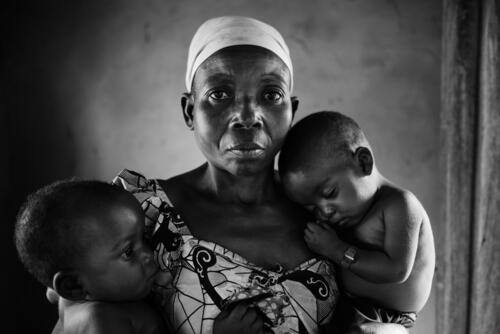
Mama Kawala and two children, Mbuyi Kasenga and Nkanku Kasonga, who just got checked up at the local CNTA (Therapeutic Nutritional Centres) in Lwemba
Léonard Pongo/Noor
March 2018, Kasai Central, Democratic Republic of Congo: Mama Kawala and her two children, who just had a check-up at the local therapeutic nutritional centre in Lwemba.
Léonard Pongo/NOOR
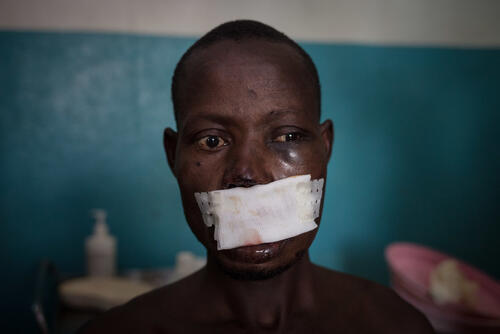
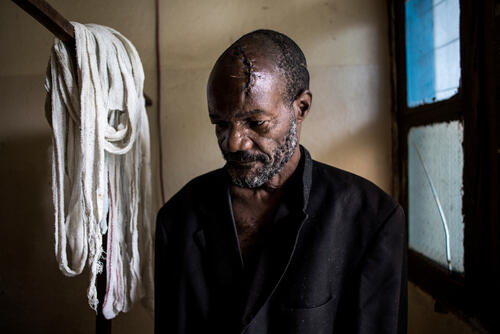
Bawma Yoame (56), recovers in a hospital room on 2 March 2018 in Bunia, after an attack on his village left him severely wounded with multiple lacerations to the head. Fighting in Ituri province has left thousands of Congolese displaced and some 100 have lost their lives.  PHOTO/JOHN WESSELS
March 2018, Ituri, Democratic Republic of Congo: Bawma Yoame, 56, recovers in a hospital room in Bunia, after an attack on his village left him severely wounded with multiple lacerations to the head. 
John Wessels
Sand fills the air as a thunderstorm blows into Bassikounou in the Hodh ech Chargui region of Mauritania on 9 August 2018. Located in Southeastern Mauritania, Bassikounou is the staging point for MSF operations in the Mbera refugee camp and the surrounding area.
Sand fills the air as a thunderstorm blows into Bassikounou in the Hodh ech Chargui region of Mauritania, August 2018.
Nyani Quarmyne
IDP camp site in Monguno
Internally displaced people find shelter in Monguno, northeast Nigeria, January 2018.
Maro Verli/MSF
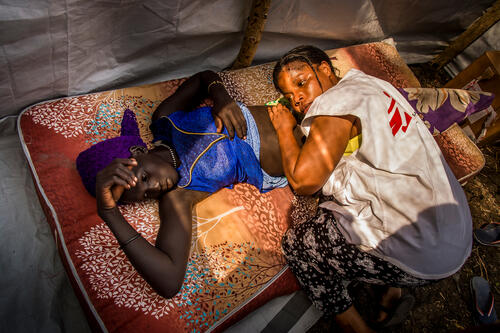
Nurse and midwife Furaha Bazikanya, examines a young pregnant woman in one of the two consultation spaces at a mobile clinic in the village of Kier.
December 2017, Kier, South Sudan: Nurse and midwife Furaha Bazikanya examines a young pregnant woman in one of the two consultation spaces at a mobile clinic in the village.
Frederic NOY/COSMOS
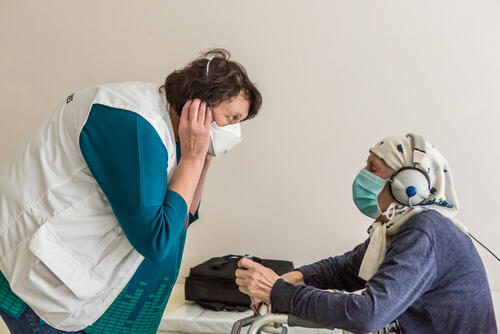
Olena Markova, an MSF nurse, explains to Lidiia Andriienko, 78, how to take the hearing test at the Zhytomyr Regional TB Dispensary. Certain drugs used in TB treatment can cause severe side-effects, including hearing loss. In 2018, MSF started providing treatment for drug-resistant tuberculosis (DR-TB) to patients in Zhytomyr Oblast, in partnership with the Zhytomyr Regional TB Dispensary. Zhytomyr region has one of the highest rates of TB in Ukraine.
Olena Markova, an MSF nurse, explains to 78-year-old Lidiia how to take the hearing test at the Zhytomyr Regional TB Dispensary in Ukraine, October 2018. Certain drugs used in TB treatment can cause severe side-effects, including hearing loss.
Oksana Parafeniuk
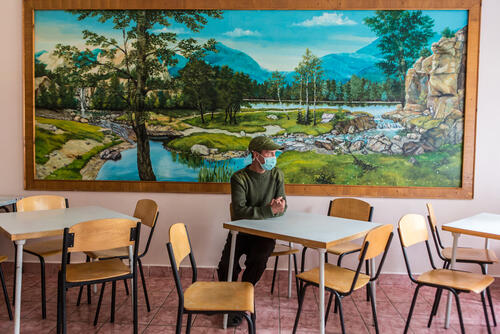
Mykola Cherkasov, 31, a patient with multidrug-resistant TB (MDR-TB), in the common area of the Zhytomyr Regional TB Dispensary. In 2018, MSF started providing treatment for drug-resistant tuberculosis (DR-TB) to patients in Zhytomyr Oblast, in partnership with the Zhytomyr Regional TB Dispensary. Zhytomyr region has one of the highest rates of TB in Ukraine.
Mykola, a 31-year-old patient with multidrug-resistant tuberculosis (MDR-TB), in the common area of Zhytomyr Regional TB Dispensary in Ukraine, October 2018. 
Oksana Parafeniuk
Local Red Cross volunteers are now providing some meals to people sheltering in and around the squat at Bihać, Bosnia, close to the border of Croatia.
July 2018, Bihać, Bosnia-Herzegovina: Local Red Cross volunteers are now providing some meals to people sheltering in and around the squat at Bihać, Bosnia-Herzegovina, close to the border with Croatia.
Kamila Stepien
Sanitation workers spray the hands and feet of Congolese refugees upon their arrival to Sebagoro, Uganda, on the shores of Lake Albert.  Cholera is endemic to this region of Uganda. Approximately 60,000 refugees arrived to Uganda on boats, fleeing the conflict in their home province of Ituri, Congo between December 2017 and March 2018. Sebagoro, Hoima province, Uganda. March 9, 2018. Copyright Diana Zeyneb Alhindawi
March 2018, Sebagoro, Uganda: Sanitation workers spray the hands and feet of Congolese refugees arriving on the shores of Lake Albert, in a region where cholera is endemic. Approximately 60,000 refugees arrived in Uganda on boat between December 2017 and March 2018, fleeing the conflict in their home province of Ituri, Democratic Republic of Congo.
Diana Zeyneb Alhindawi
Colette, a 14-year-old victim of sexual violence at the Castors Hospital. She was raped by her uncle and is receiving medical and psychological treatment offered by MSF.
January 2018, Central African Republic: Colette, a 14-year-old victim of sexual violence, at Castors Hospital. She was raped by her uncle and is receiving medical and psychological treatment offered by MSF.
Alberto Rojas
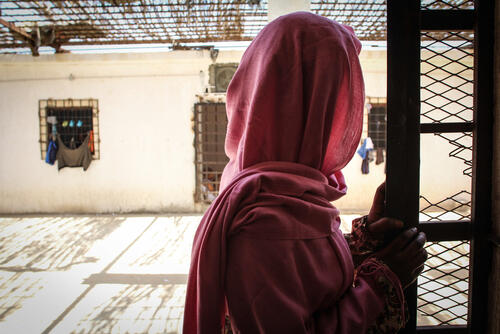
A woman in detention centre.
Her testimony: “We were abandoned at sea. People lost hope. Why did we let people die at sea? They have all the means to rescue us. We are all humans. If we try to go to Europe, it’s to have a better life. People will keep continuing taking journey by sea. There are people who are escaping war, others are escaping poverty; people should be rescued and later on each individual case is looked at. We are not in Libya to stay here, we want to go to Europe. We are not criminals”.
September 2018, Libya: A woman in a detention centre: “We were abandoned at sea. People lost hope. Why did we let people die at sea? We are not criminals”.
Sara Creta/MSF
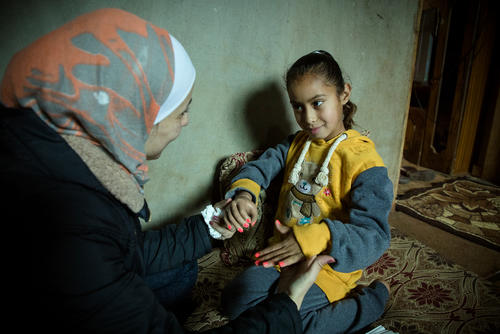
Une jeune patiente atteinte d'une maladie congénitale essaye à son domicile une nouvelle prothèse passive en présence de Samar Ismail, superviseur du projet Prothèses 3D de La Fondation MSF à Amman. Grâce à cette prothèse imprimée en 3D la petite fille a pu se vernir elle-même les ongles.

A young patient affected by a congenital disease tries in its place of residence a new passive prosthesis in the presence of Samar Ismail, supervisor of the project 3D Prostheses of The Foundation MSF in Amman. Thanks to this prosthesis printed in 3D the girl was able to varnish herself nails.
January 2018, Amman, Jordan: An MSF staff member helps a young patient affected by a congenital disease try out a new 3D prosthesis, thanks to which the girl was able to paint her own nails.
Hussein Amri/MSF