



2109 Results
 
msf-placeholder
Libya

Detainees tortured and denied medical care

MSF teams began working in Misrata’s detention centres in August 2011, to treat war-wounded detainees. Since then, MSF doctors were increasingly confronted with patients who suffered injuries caused by torture during interrogation sessions. The interrogations were held outside the detention centres. In total, MSF treated 115 people who had torture-related wounds and reported all the cases to the relevant authorities in Misrata. Since January, several of the patients returned to interrogation centres have even been tortured again. Press Release - 26 Jan 2012
 
msf-placeholder
India

Providing healthcare in the red forests

In the forests of central India, Maoist rebels called Naxalites are fighting government forces to control great swathes of the interior.
People living in dozens of tribal villages are caught up in the conflict, unable to reach the Health Ministry’s clinics in Chhattisgarh state.
Dr Rebecca Cuthbert describes how MSF takes the clinics to them.
Project Update - 25 Jan 2012
 
msf-placeholder
South Sudan

Patient testimonies

Wounded patients are still arriving at the Médecins Sans Frontières (MSF) hospital in Pibor, in the state of Jonglei, South Sudan, following inter-communal violence three weeks ago. Voices from the Field - 24 Jan 2012
 
msf-placeholder
South Sudan

'Even running away is not enough'

In the state of Jonglei, South Sudan, civilians continue to bear the brunt of inter-communal fighting. Wounded patients are still arriving at the MSF hospital in Pibor, three weeks after the violent attack on the town and outlying villages. Many were injured after having fled into the bush, where thousands have remained, afraid to come out of hiding. Press Release - 24 Jan 2012
 
msf-placeholder
Palestine

Interview with MSF surgeon Dr Stefan Krieger

Hand surgeon Dr Stefan Krieger spent three weeks on an MSF mission in Gaza. He treated burn injuries and shared skills with the local surgical teams at the Nasser hospital in Khan Yunis.
For Dr Krieger, this mission provided an opportunity to address the lack of specialised medical care in the Gaza Strip.
Voices from the Field - 23 Jan 2012
 
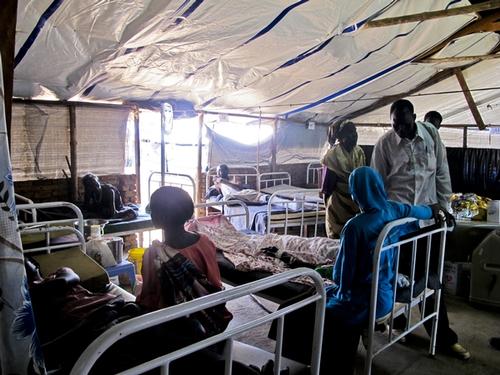
OPD ward in Agok. MSF is responding to the consequences of fighting in the Abyei region of Sudan following violent clashes that began on the night of Friday 20 May. Whole towns have been emptied and thousands of people are on the move in a bid to escape the fighting. The situation in the area remains extremely volatile. The population left their homes with few belongings, and travelling conditions are particularly harsh now that the rainy season has started and the roads are muddy.
South Sudan

Emergencies unfolding one after another

Six months after the birth of South Sudan as the world’s newest independent country, a series of emergencies are unfolding that require urgent humanitarian response. Médecins Sans Frontières (MSF) has scaled up into full emergency mode in Upper Nile State to respond to the sudden influx of thousands of refugees fleeing conflict in neighbouring Sudan. Press Release - 23 Dec 2011
 
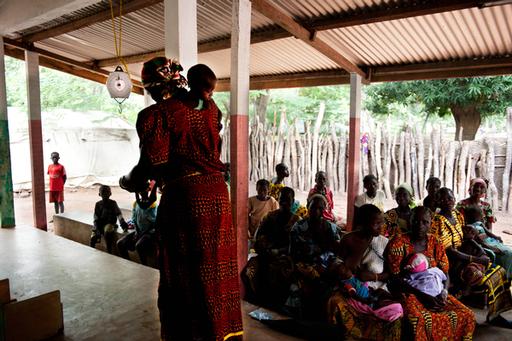
MSF is working in kabo hospital with all the illness and all the diferent patients that come to kabo hospital
 *** Local Caption *** Depuis 1999, MSF fournit des soins medicaux aux populations centrafricaines touchees par une tres grande pauvrete, la violence et l?insecurite, en particulier dans le nord de la republique Centrafricaine.
MSF travaille dans des hopitaux, des centres de sante en peripherie afin de fournir un acces aux soins aux populations, y compris celles qui vivent dans les zones les plus isolees, grace a des cliniques mobiles.
Central African Republic

Mortality rate in Central African Republic reaches an emergency level

The Central African Republic (CAR) is in the grip of a chronic medical emergency. Four mortality studies conducted by Médecins Sans Frontières (MSF) in the past 18 months reveal crude mortality rates in some regions are at three times the emergency threshold level, which is considered a humanitarian crisis. Report - 13 Dec 2011
 
msf-placeholder
Afghanistan

MSF treats victims of bomb blast in central Kunduz

Following a bomb blast in the capital of Kunduz province in northern Afghanistan on 10 December, MSF treated fourteen patients in the organization’s surgical hospital. Project Update - 12 Dec 2011
 
msf-placeholder
Libya

In aftermath of war, MSF's medical work still sorely needed

Médecins Sans Frontières (MSF) continues to provide medical care to migrants, internally displaced persons, and prisoners in the Libyan cities of Tripoli and Misrata. MSF teams are also running a mental health program after many months of violence in the country.
MSF expects mental health needs to increase over the next few months, with levels remaining high over the long term. According to MSF, only an early, focused treatment strategy will help prevent war-related trauma from becoming generally prevalent and therefore more difficult to treat.
Project Update - 29 Nov 2011
 
msf-placeholder
Egypt

MSF provides medical supplies to five hospitals

A team from Médecins Sans Frontières (MSF) has been visiting Tahrir Square on an almost daily basis, and is in contact with Egyptian healthcare professionals who are working in the field hospitals, as well as with the public hospitals which are receiving the bulk of the casualties. MSF has made some donations of drugs, medical and surgical items to four hospitals in Cairo. Press Release - 24 Nov 2011
Four mothers posing in a corridor of the Hospital in Bili. All four of them are staying in the hospital with their child, that's suffering from a severe case of malaria. Since the beginning of the project in 2016, the pediatric ward already treated more than 4.000 cases of complicated/severe form of malaria.
Médecins Sans Frontières (MSF)

Independent medical humanitarian assistance

We provide medical assistance to people affected by conflict, epidemics, disasters, or exclusion from healthcare. Our teams are made up of tens of thousands of health professionals, logistic and administrative staff - most of them hired locally. Our actions are guided by medical ethics and the principles of independence and impartiality. We are a non-profit, self-governed, member-based organisation.

Learn more