




3451 Results
 
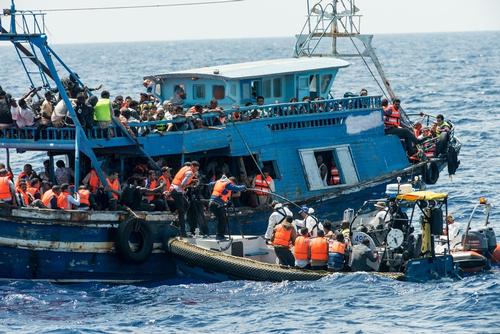
On the morning of 26 August,  the MY Phoenix, jointly operated by MSF and MOAS was asked to standby as the Swedish coast guard ship, Poseidon, rescued an estimated 450 people from a wooden boat. The MOAS crew handed out life jackets and the MSF medics were asked to assist directly on board as there were many critical cases. Dr Simon Bryant and nurse Mary-Jo Frawley went into the hull of the boat, where they were literally lifting people’s heads out of the water to check if they were alive. A critical patient suffering from suspected fuel inhalation was stabilized in the MSF clinic onboard the Phoenix and medevac'ed via helicopter for further treatment on land.
At that point a second wooden boat carrying 550 people appeared and the MOAS search and rescue team immediately commenced rescued operations. More than 415 people were brought on the MY Phoenix, bringing the boat to capacity the remained 125 people were taken on board the Poseidon. Whilst this rescue was still underway, a rubber dinghy with an estimated 100 people on board arrived on the scene. The MOAS crew transferred the men, women and children on board to an Italian naval vessel, which was also on the scene.
“ The deaths of these 52 people today show that search and rescue is just a bandaid. It is merely a temporary solution to Europe’s failures, and not even a truly effective one.  Despite the increase in SAR efforts since late April, the death count still keeps mounting.  The only way to actually put an end to these avoidable tragedies is to create safe and legal ways for people to migrate or seek asylum in Europe. People's desperation to flee and survive forces them into taking these dangerous boats, into the hands of people who profit from their willingness to risk it all in the search of safety of Europe. Today, just like yesterday, Europe’s policy makers have blood on their hands. It is time for a change, a radical rethink and we need it now” -  Will Turner – MSF Emergency Coordinator on the MY Phoenix
Mediterranean migration

Proactive search and rescue operations essential life-saver

“Increasingly, we see that we are required to carry out multiple rescues from multiple boats within a matter of hours”, said Lindis Hurum, MSF Emergency Coordinator on board of the Bourbon Argos. “Our teams have also encountered boats with people who had already died from dehydration or asphyxiation during the journey. To me this suggests that despite the EU response supposedly being ‘bigger and better’ than last year, there are not enough boats available and in the right spot to adequately respond to the needs of those crossing the Mediterranean.” Project Update - 20 Aug 2015
 
msf-placeholder

Flood victims vulnerable to dengue fever

“This is peak dengue season and we need to remain vigilant after the floods to prevent further spread,” says Liesbeth Aelbrecht, MSF Myanmar Country Director. “We will focus on helping treat the disease as well as training Ministry of Health staff and volunteers on how to fumigate potential breeding sites and to spread messages to communities about dengue prevention.” Project Update - 17 Aug 2015
 
msf-placeholder
Project Update

A month in focus: August 2015

Ebola: a hope-bringing vaccine; Lebanon: Lives ruined by the conflict; Tanzania: Cholera, a new threat to Burundian refugees; Malawi: In the over-populated prisons; Antivenom serums: In worrying shortage; Yemen: "You come and do the work!".

Project Update - 17 Aug 2015
 
msf-placeholder
South Sudan

On pace for a second, exceptionally severe malaria season

MSF stresses the need to be prepared for the possibility of another severe malaria season in South Sudan. While the medical needs in conflict-affected areas of the country are beyond critical, basic primary healthcare cannot be neglected anywhere in the country. Otherwise, a second devastating malaria season could result in an untold number of preventable deaths. Project Update - 14 Aug 2015
 
msf-placeholder
Greece

Greek authorities’ inaction turns into abuse of refugees in Kos

“MSF is very worried about how the situation is evolving in Kos.” says Brice de le Vingne, MSF Director of Operations. “What was previously a situation of state inaction is now one of state abuse, with police using increasing heavy handed force against these vulnerable people. The great majority of people arriving here are refugees fleeing war in Syria and Afghanistan. The Kos authorities have clearly stated that they have no intention of improving the situation for these people as they believe that this would constitute a ‘pull factor’. But the truth is that people fleeing war will keep on coming whether or not the authorities are trying to stop them from doing so.” Project Update - 12 Aug 2015
 
CENTRAL AFRICAN REPUBLIC, BOSSANGOA, 3 OCTOBER 2014
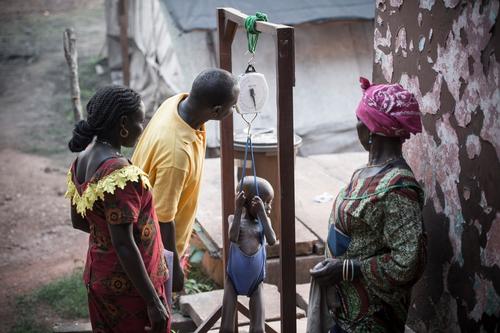
Bossangoa Hospital: an MSF-nurse makes notes about his patients in the nutrition ward where severely malnourished children are taken in. The hospital is run by Minister of Health and is supported by MSF.
Central African Republic

Local health worker killed near Bossangoa

Local health worker Pkecko Harly (also called Alfred), was killed by an unidentified individual during an armed robbery while he was on his way back from Bossangoa (Ouham prefecture) to Pama. Project Update - 7 Aug 2015
 
msf-placeholder
Myanmar

MSF assisting thousands as worst flooding in decades hits parts of the country

After days of severe rains across swathes of Myanmar in the wake of Cyclone Komen, MSF is working with local government authorities to provide medical and non-medical aid to thousands of people affected by flooding.“The entire township of Minbya is flooded – schools, hospitals, everything,” said MSF doctor, Dr. Zayar, who was part of a team sent to the town at the request of State Health Department, the Emergency Coordination Committee and other community groups. “All drinking water sources are flooded too.” Project Update - 4 Aug 2015
 
msf-placeholder
Democratic Republic of Congo

MSF has vaccinated over 287,000 children against measles in four provinces

“This is the most serious epidemic Katanga has seen since 2011. We are adapting our current activities, and drawing on our experience from 2011. In one year, we have vaccinated almost 1.5 million children and treated more than 50,000 cases in 31 of the 68 health zones in Katanga Province,” explains Jean-Guy Vataux, MSF Head of Mission in DRC. “But people have difficulty accessing treatment, and it is also likely that cases are under-reported, so the current epidemics may well be more serious than they appear. It is important to act as quickly as possible, so that we don’t end up in the same situation as in 2011, or an even more serious one.” Project Update - 3 Aug 2015
 
msf-placeholder
Guinea-Bissau

28,500 children vaccinated against measles

More than 28,500 children between six months and five years old have been vaccinated against measles by the country’s Ministry of Health and MSF. Project Update - 31 Jul 2015
 
msf-placeholder
Democratic Republic of Congo

The Rose of Masisi

A counselor at the Village d’Accueil gives us a tour of the MSF-supported Masisi general hospital in North Kivu, where women with high-risk pregnancies stay as they wait to give birth. Project Update - 27 Jul 2015
Four mothers posing in a corridor of the Hospital in Bili. All four of them are staying in the hospital with their child, that's suffering from a severe case of malaria. Since the beginning of the project in 2016, the pediatric ward already treated more than 4.000 cases of complicated/severe form of malaria.
Médecins Sans Frontières (MSF)

Independent medical humanitarian assistance

We provide medical assistance to people affected by conflict, epidemics, disasters, or exclusion from healthcare. Our teams are made up of tens of thousands of health professionals, logistic and administrative staff - most of them hired locally. Our actions are guided by medical ethics and the principles of independence and impartiality. We are a non-profit, self-governed, member-based organisation.

Learn more