


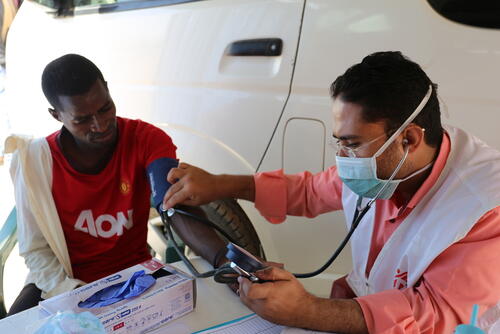
Dotted across Marib governorate, in northeast Yemen, are 134 camps – temporary home to Yemenis displaced from their homes by the six-year-long conflict, African migrants stranded in Yemen, and members of a vulnerable minority group from Yemen known as Al-Muhamasheen.
Before the start of the conflict, Marib was home to almost 400,000 people, according to local authorities. Now, it hosts nearly 2.7 million people, including those displaced from elsewhere, all looking for a safe haven.
Marib no longer a safe place to be
However, Marib is no longer a safe place to be. In recent weeks, the frontlines of the conflict have moved eastwards into the governorate. On 8 February, fighting escalated in Sirwah district, to the west of Marib city, causing large numbers of injuries and forcing some 10,000 people to flee, and about 600 families have settled in a camp about 20 kilometres outside of town. Teams from Médecins Sans Frontières (MSF) donated essential drugs to hospitals in Marib to help them cope with the influx of wounded, and have started providing basic healthcare to the newly displaced people.
As the frontlines approach Marib city, MSF is concerned that people sheltering in the area may find themselves with no place else to go.
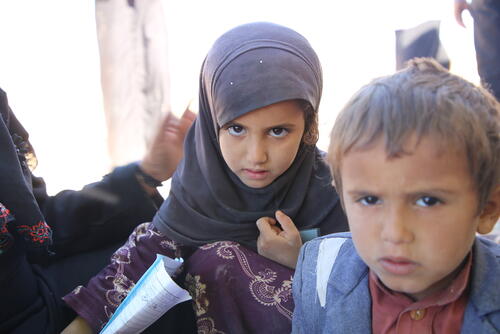
Um Marzouk is a 30-year-old mother of five from Nehim, in Sana’a province. Displaced multiple times by the conflict, she and her family now live in Al-Sweida camp, five kilometres from Marib city.
“We have been displaced five times because of fighting,” says Um Marzouk. “It is difficult now even to think of returning to our home in Nehim because it was completely destroyed. Two of my children were born in different camps and it was so hard – I gave birth to one child with no medical care at all.”
Um Marzouk’s family is just one of thousands who have sought refuge in Marib over the past six years, mostly from the provinces of Al-Jawf, Saada, Hajjah, Hodeidah and Sana’a. Um Marzouk’s three-year-old daughter Jadel was born in Al-Sweida camp. Life in a camp, with no running water or electricity, is all she has ever known. When shown a drawing of a house, she looks blank, but a drawing of a tent immediately brings a smile of recognition to her face.
People receiving long-overdue care from MSF mobile clinics
MSF’s team in Marib runs two mobile clinics, which regularly visit eight different sites around Marib city, providing people with basic healthcare, reproductive healthcare, vaccinations, treatment for malnutrition and mental health services. We also refer to hospital children with malnutrition and respiratory tract infections and women in need of emergency obstetric care.
“The needs are clearly visible wherever we go with our mobile clinics,” says MSF nurse Jethro Guerina. “The number of patients in our mobile clinics is increasing day by day. Some people here haven’t had a chance to see a doctor in a long time, if ever.”
The number of patients in our mobile clinics is increasing day by day. Some people here haven’t had a chance to see a doctor in a long time, if ever.Jethro Guerina, MSF nurse, Yemen
Another site visited by our mobile team is Bin Muili camp, home to migrants from various African countries. Most of the estimated 6,000 African migrants in Marib come from Ethiopia and were heading for Saudi Arabia before being stranded in northern Yemen. Some have been stranded for several years due to conflict in the border area; others became stranded a year ago when the border was shut due to COVID-19.
“When my wife and I left Ethiopia, we were planning to go to Saudi Arabia and earn some money,” says 21-year-old Hussein Awal. “Right now, we are stuck in Marib looking for a way to support ourselves.”
“If I don’t find work, I can’t feed myself and my wife,” says Hussein. “There are four of us now, after my wife gave birth to twins, so I feel I have a big problem when I think of providing for them all.”
Like Hussein and his wife, most migrants in Marib live in overcrowded conditions, with poor sanitation and limited access to basic services. Fears around the spread of COVID-19 have heightened their risks of being stigmatised, arrested and detained. Their movements are often restricted, and they have few job opportunities. The ongoing fighting in Marib could only exacerbate these vulnerabilities and worsen what is already a precarious situation.
Teams providing care to socially excluded groups
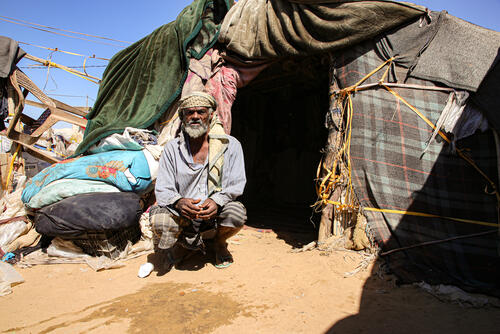
MSF’s mobile team also provide healthcare in Hareeb Junction, a slum area on the outskirts of Marib city, home to Al-Muhamasheen – ‘the marginalised ones’ – a minority group who suffer discrimination, poverty and social exclusion, and whose ancestors were usually of African descent. Like most of the areas where Al-Muhamasheen live, Hareeb Junction has no running water, proper sanitation or rubbish collection. Its residents have few economic opportunities and receive very limited assistance from aid agencies.
“We used to feel safe in our homes and we did not know the meaning of misery, but that’s what we are experiencing now with the lack of basic services,” says 60-year-old Zabeidi Rashid, who lives in Hareeb Junction. “We are like birds that go to look for food to feed their children: if they don’t go out looking for food one day, their children will not eat that day.”
Zabeidi was displaced from his home elsewhere where he was living a relatively a better life.
“I cannot control my feelings whenever I recall how we used to live in the past,” Zabeidi says, his eyes full of tears. “If you could see the nice house where I used to live, you wouldn’t believe that this black man was living there.”
We used to feel safe in our homes and we did not know the meaning of misery, but that’s what we are experiencing now with the lack of basic services.Zabeidi Rashid, displaced man in Hareeb Junction
With families in Hareeb Junction having an average of five children each, most of the people are children. With no school in the area, they receive no education and their parents cannot afford to buy them shoes, nappies or clothes. If they fall sick, there is no money to take them to see a doctor.
Our medical services are free of charge, so when the mobile team arrives, they are always greeted by a queue of people waiting for a consultation. One of the most common medical conditions is diarrhoea, related to the area’s poor sanitation and lack of clean drinking water.
Noticing that some of the children had experienced traumatic events related to the six years of war and displacement, the MSF team organises recreational activities, such as drawing sessions and games of football. These games play an important role in their development, say MSF mental health activity manager Lisa La Gattuta.
“These activities are very important as recreational activities for MSF teams to engage with the community, but above all to promote social interaction and mental health development,” La Gattuta says.
Coronavirus COVID-19 pandemic
COVID-19 support desperately needed as second wave overwhelms Yemen
Press Release
25 Mar 2021