


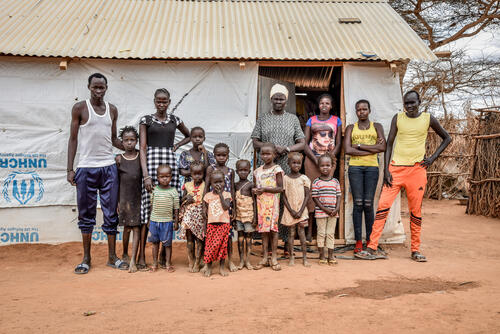
Dimming prospects of lasting solutions amid continued insecurity in Somalia and ever-shrinking resettlement slots have locked refugees in Kenya's Dadaab camps in conditions of vulnerability and dependency.
With severe mobility constraints and limited livelihood options, humanitarian assistance continues to be a vital lifeline for refugees. But surviving on a bare minimum of assistance means many have been living on the threshold of an emergency for close to three decades now. Their needs far outstrip what dwindling humanitarian assistance can provide for in the face of waning donor funding.
I got married, bore children here and we all live together in this compound. Life was better when we first came to the camp.Janai Issack, a refugee in Dadaab since 1991
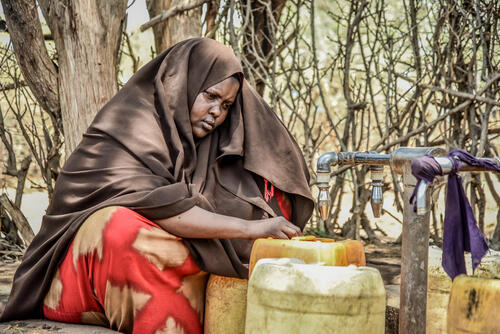
Janai Issack was 10 years old when she moved to the camp with her family in 1991, fleeing violence in Somalia.
“A lot has changed over the years: I got married, bore children here, and we all live together in this compound,” she says. “Life was better when we first came to the camp. The safety we found in this place was a great relief compared to what was happening in Somalia, and the support from the aid organisations was good.”
Janai laments that, over the years, the quantity and quality of services offered to refugees has diminished.
“The food rations provided have reduced. Now we are given very little food that barely lasts a couple of weeks,” she says. “The classes in schools where our children go to are overcrowded, unlike those days when I used to go to school.”
“I think UNHCR is fatigued. I don’t know why they keep asking us if we want to go back to Somalia, yet our answer is always the same: No. Resettlement has also changed over the last year, it’s like no one goes anymore.”
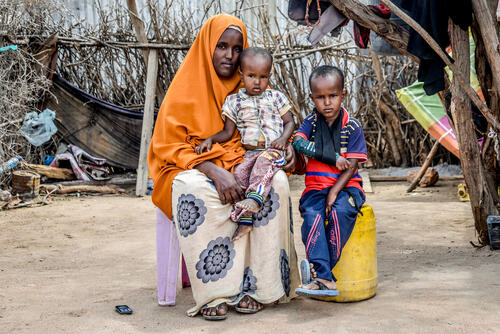
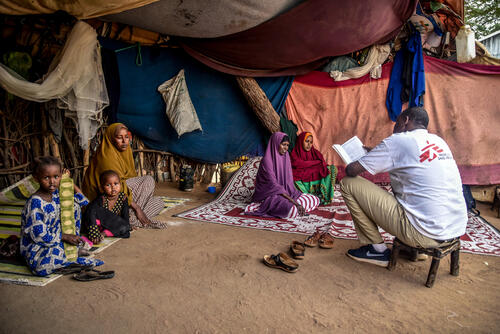
Many refugees in Dagahaley – one of three camps that collectively constitute the Dadaab refugee complex, with a population of about 75,000 – share similar stories. They complain of the declining humanitarian support, notably food rations.
For most people, life in the camps is all they know.Dana Krause, MSF country representative in Kenya
In September, the World Food Programme was forced to further reduce the general food distribution in the refugee camps to 70 per cent of the normal rations, due to severe funding constraints. This will most likely adversely impact the health condition of the refugees, as Médecins Sans Frontières (MSF) has witnessed in past years.
“For most people, life in the camps is all they know,” says Dana Krause, the country representative for MSF in Kenya. “But living in camps for three decades with little food, lack of specialised healthcare and no jobs, or measly remuneration for work done, is nothing short of an assault on human dignity.”
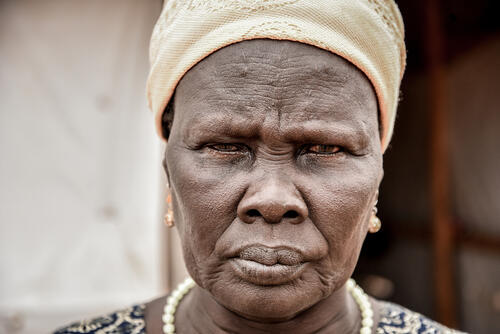
For 65-year-old Abdia, who fled Somalia for Dadaab in 1991, life in the camps has worsened over the years.
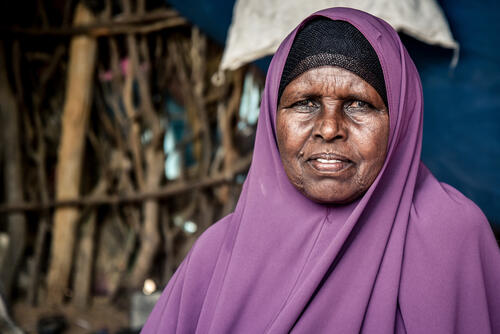
“If I compare my life now to the way it was two decades ago, things were much better then. The food rations are very small so if you’re someone my age with no one to take care of you, you’ll find life very difficult,” she says. “Our movement is restricted, and the services have immensely reduced.”
For undocumented refugees, the struggle to access basic services in the camps is even more daunting. According to UNHCR, there are at least 15,000 unregistered asylum seekers in the Dadaab complex and only around half of them receive food assistance based on a vulnerability assessment.
Although unregistered refugees can access MSF health services in Dagahaley, for most other basic needs, including shelter and clothing, they are largely left to fend for themselves.
Deteriorating mental health and the struggle for specialised healthcare
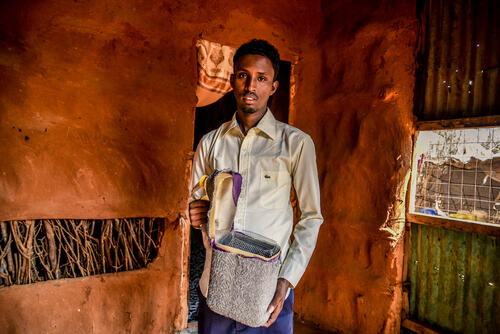
Others, like 42-year-old Abdo Mohamed Geda, who came to Dadaab in 2011, have taken to doing menial jobs to supplement what little food rations they receive. Abdo fetches firewood on donkey carts to support his family of eight children.
“Children need milk, food and clothing,” he says. “Every morning I go out to search food for my family. But when there is nothing, it stresses me. I can’t sleep.”
Abdo is currently undergoing treatment for depression in the MSF hospital in Dagahaley.
![Abdo fled his country Ethiopia in 1997 due to political tensions, settling in Somalia. He stayed in Somalia until 2011. He met his wife, Muhaba Abdulrashid during his time there, and they sired four children. He was a farmer there but he says life became increasingly difficult there due to frequent fights, which sometime came even near his home. He fled Somalia in 2011 with his family, settling in Dagahaley camp. Since 2011, Abdo and his wife have sired four more children, all born in Dagahaley.
In Dagahaley, he does menial jobs to supplement the food rations provided by the World Food Programme (WFP) to sustain his family, which he says is difficult. “I usually fetch water from the tap stands, which I sell at the market, which yields me about Ksh 100/- (1 USD) on a good day,” he says.
He also fetches firewood on donkey carts, a process that often takes a week away from home, which he sells for Ksh 3,000/- (30 USD) at the market, mostly to hotels. “Yes, it does seem like a lot of money, but then it’s not always easy since to get these, it means we have to go tens of kilometres away from home, staying in the middle of nowhere for a whole week, surviving on very little and risking attacks by bandits. For this reason, we often go in groups. We also hire the donkeys from their owners, with whom we share half of the proceeds,” he says.
“Back then we could get casual jobs, even then, when you spoke to UNHCR, they could find a way to help, but these days, you can’t even access their compound.”
“WFP (The World Food Programme) these days gives rations that are supposed to last for two months, and if you look at it, it can hardly go for three weeks. Then, they give us these lentils, who eats these?” Abdo says, picking a handful of the pulses out of the sack. “We used to get white flour, these days it’s yellow.”
Abdo says he’s depressed. His wife says he would hardly sleep at night until he takes some sleeping pills. “The [MSF] hospital said he does not have a physical medical condition, but has been undergoing mental health reviews,” says Abdo’s wife.
Abdo says the responsibilities on his shoulder are immense, and sometimes when things don’t go well and he’s not able to sell, he gets stressed. “Children need milk, food and clothing. I leave the house in the morning to search for food for my family, when I get back, my wife is there waiting to see what I’ve brought back home. When there’s nothing, it stresses me up, I can’t sleep, just thinking about my family.”
“We are grateful that our kids are going to school in the camp here, but then we feel more hopeless if things were to stay the same. It’s not our wish to go back to our countries, but we feel like we are being arm-twisted indirectly through some of these difficulties in the camps so that we leave. To be honest, if things stay the same, we may actually be forced to leave. We are hoping that someday our country will be safe again and we’ll be able to go back. If not, then get resettled to a third country,” says Abdo.
Interestingly, Abdo and his family were already shortlisted for resettlement to Australia, but they’ve missed the chance because he missed appointments twice. Their application was put on hold despite his wife and kids presenting themselves, without him. “In both instances, I was out looking for firewood, which takes at least a week. They (UNHCR) would say they will call you, but don’t tell you when. So, you have to just sit and wait for them to call, not knowing when it would come. How am I supposed to feed my family? In both instances, I went to their offices immediately I came back, in fact the last time I was only two days late. That was in February this year. The Field Officer said they would call in a week, I dropped everything since I did not want to miss it this time. Now we are in September, still waiting for that call,” he says.
Other families in Abdo’s cohort have been confirmed and have already undergone through the medical and documentation processes, and are just waiting to receive their flight tickets. “I think this is one of the things that stresses him up, and in as much as I’d like to hate him for that, he missed the interviews while fending for us, we know something will come again,” Abdo’s wife says.](https://img.msf.org/AssetLink/81h8n48g3kqg4k77c2840oc4dptm1ess.jpg "Abdo and his family in their home in Dagahaley camp")
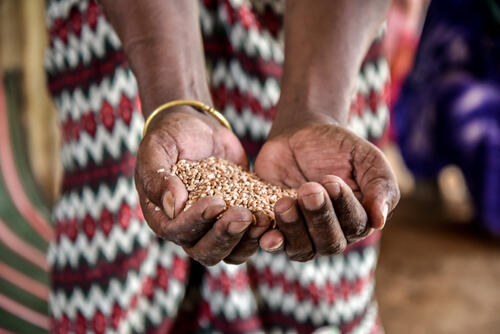
Drawn-out encampment has blunted people’s hopes of leading healthy and meaningful lives.
A more insidious impact manifests itself in the form of acute mental health conditions. On average, in Dagahaley alone, MSF teams assist some 5,500 mental health consultations each year. During moments of extreme anxiety, this figure often shoots up, such as in 2016, when threats to shut down the camps loomed large.
In October this year, MSF treated two patients who had attempted to commit suicide in Dagahaley camp.
One of them, a 43-year-old unregistered refugee from Somalia, tried to hang himself before being rescued. He had been surviving on handouts since his ration card was blocked in 2018. But as the amount of food rations people receive in the camp has reduced in recent months, neighbours are increasingly being forced to scrimp what little food they receive.
Both patients are now undergoing treatment and receiving psychosocial support.

Policies that favour refugees’ freedom of movement and access to basic services, when accompanied by donor investments in local capacities, will allow refugees to lead dignified lives, while benefitting host populations.Dana Krause, MSF country representative in Kenya
Specialised healthcare also remains out of reach for most refugees. Although MSF provides basic primary and secondary healthcare services in Dadaab, advanced or specialised treatment requires referrals outside the camps.
But with such movements restricted, only those requiring urgent, lifesaving treatment are allowed and supported to seek care in the regional hospital of Garissa or in Nairobi. So, the number of people with specialised healthcare needs has been accumulating each passing year, creating a heaping backlog of patients waiting for treatment.
In Dagahaley alone, more than 1,100 people are waiting for elective surgeries and other specialised health services.
Urgent need to find solutions
“If the commitments to improve refugee self-reliance, enshrined in the Global Compact on Refugees, are to be realised, it is time the Kenyan government and the international community took meaningful action to find sustainable pathways for refugees out of the camp,” says Krause.
“Policies that favour refugees’ freedom of movement and access to basic services, when accompanied by donor investments in local capacities, will allow refugees to lead dignified lives, while also benefiting host populations.”
By making it difficult to live in the camp, we feel like we are being arm-twisted to return. We hope that some day, our country will be safe again so we can go back.Geda, a refugee
So far, the proposed response to this seemingly interminable displacement crisis has been to wind down the camps. But most refugees are unwilling to go back to Somalia. Among those who did return, many have come back to Dadaab citing continued insecurity and lack of basic services in the country. Resettlement to third countries has almost ground to a halt.
“By making it difficult to live in the camp, we feel like we are being arm-twisted to return”, says Geda. “If things stay the same, we may be forced to return. We are hoping that someday our country will be safe again, so we can go back. If not, we hope to get resettled to a third country”.
Others express hope that they will be allowed to settle in the region.
“If resettlement could resume, that would be the best thing,” says 56-year-old Amphile Kassim Mohamed. “If not, some livelihood support could suffice or even integration locally. Free movement should also be encouraged to enable us to trade easily with other people.”
What about local communities?
With Dadaab’s camp population once peaking at almost half a million, attention has inevitably focused on refugees. Even today, almost one in four people in Garissa county – which hosts the camps – is a refugee. But Garissa’s social development indicators count among the lowest in Kenya, and even local communities struggle to access basic services.
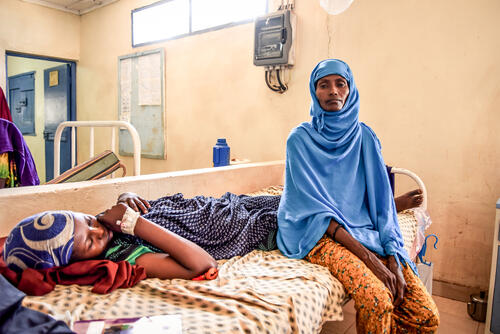
Recently, Khadijo Abdul Malik, was sitting with her son in an MSF paediatric ward in Dagahaley. She had travelled two hours in a matatu (private minibus) from a neighbouring village in Wajir County. She says she has been to the clinic before, and that many others from her village also use the heath facilities in the camp frequently. MSF's health data suggests that local communities account for roughly one in five of our primary health consultations in Dagahaley.
The draw of meagre humanitarian assistance in the camps only underscores the penury of critical basic infrastructure in the region. Many locals have come to rely on camp services over the years, so camp closures and a drastic rollback of international assistance will significantly impact surrounding villages too.
“It is vital that both refugees and host communities remain active participants in resolving the Dadaab displacement crisis,” says Krause. “Refugees will need to be accompanied and will require continued support in the search for lasting solutions. And this will need to go in parallel with scaling up access to basic services for local communities.”
MSF has provided healthcare to refugees in Dadaab for most of the camp’s complex existence, having set up activities in the camp for the first time in 1991. Our current programmes are focused in Dagahaley camp, where we provide comprehensive healthcare to refugees and host communities including primary and secondary care through two health posts and a 100-bed hospital. Our medical services include sexual and reproductive healthcare including emergency obstetrical surgeries, medical and psychological assistance to survivors of sexual and gender-based violence, mental health, home-based insulin care and palliative care. In the last ten years, we have also responded to 12 emergencies in Kenya’s North-East Region including two cholera outbreaks in the camps.
In 2018, MSF held an average of 14,000 outpatient consultations and around 860 inpatient admissions every month in Dagahaley. We also assisted 2,584 births throughout the year.
Coronavirus COVID-19 pandemic
COVID19 and lack of protective equipment threaten lifesaving care in Kenya.
Project Update
15 May 2020
Coronavirus COVID-19 pandemic
“Diseases will not wait” for COVID-19 in Kenya
Voices from the Field
5 May 2020
HIV/AIDS
AIDS death toll stagnating due to lack of testing at community level
Press Release
1 Dec 2019