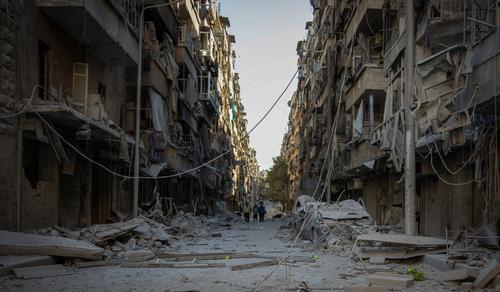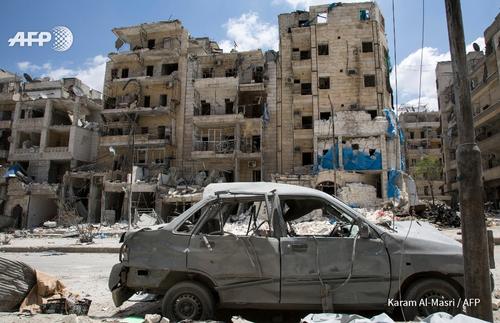
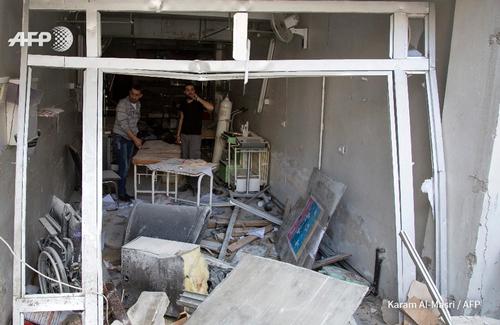
On 27 April 2016, amidst the Syrian government-led coalition’s offensive on East Aleppo, Basel Aslan (Al Quds) hospital was attacked and severely damaged by two airstrikes.
According to interviews with staff present at Al Quds hospital during the attack, at exactly 9.37pm, a building across from the hospital, identified as Ain Jalout school, was struck by an airstrike. Following the first strike, Al Quds medical staff retrieved the wounded to transfer them to the hospital for medical care. Soon after, the Al Quds staff residence, located a few buildings down from the hospital, was hit by a second strike.
Witnesses said that minutes later, a third strike assaulted the entrance of the hospital’s emergency room. This strike killed and injured Al Quds medical staff ushering patients into the emergency room, including those wounded from the first strike. According to medical staff, five minutes later a fourth strike hit the hospital, strongly impacting the emergency room and destroying the two top floors.
Quantifying the attack’s exact number of victims was hindered by the difficulty of recovering bodies from deep under the rubble caused by the attack.
A clear trend of attacks on medical missions has been recognized and recorded since the beginning of the conflict by MSF, as well as many local and international actors. To MSF’s knowledge, the bombardment of Al Quds on 27 April was the seventh attack on a health structure in April 2016 in opposition-held areas of Aleppo governorate.
Following the 27 April 2016 attack, MSF is producing this report with the objective to describe the bombardment on Basel Aslan (Al Quds) hospital and illustrate the humanitarian consequences on the population in the wake of the long-term trend of attacks on medical facilities in East Aleppo.
MSF has maintained a close working relationship with Al Quds hospital since December 2012 as part of a broader network of health facilities and medical actors in Aleppo’s opposition areas providing impartial access to quality healthcare to the population. MSF has provided Al Quds and health facilities in Aleppo’s opposition-held zones with regular support in the form of training, medical donations, drugs, medical equipment and small sums of cash for operational costs. Apart from supporting Al Quds and many other health centers in Syria, MSF has directly managed two medical facilities (now reduced to one) in Aleppo and served as an active participant in the medical referral system in Aleppo governorate and to Turkey.
Syria
MSF urges Syrian government and its allies to stop indiscriminate bombing in Aleppo
Press Release
30 Sep 2016