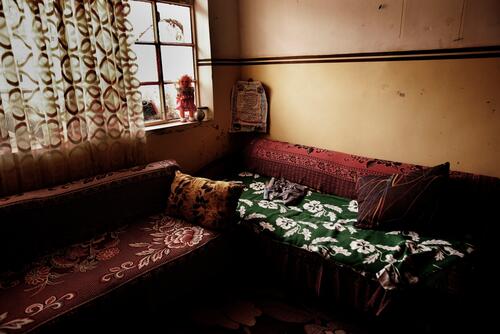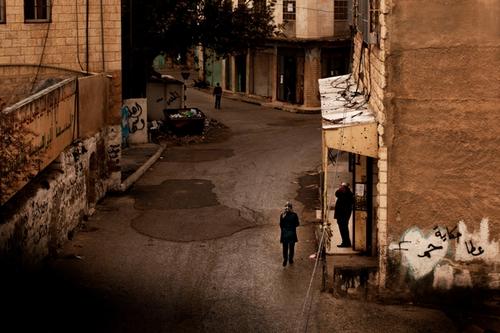
In the Hebron countryside, in the midst of arid, rocky hills, I met Mariam. She was nearly 20 years old and lived with her father and the rest of her family (15 brothers and her father’s two wives, just a few years older than her) in a cave in the south of the district, in hostile, humid conditions, deprived of any basic services whatsoever.
Mariam’s father is a shepherd who never dares to go too far from his land for fear of losing it. His land is not far from a settlement and his neighbours have often tried to convince him to leave.
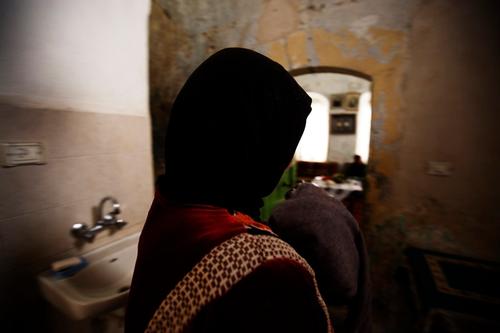
Mariam has had a very difficult life. On the fringes of Palestinian society, marked by the conflict but also by socio-cultural and religious restrictions, Mariam has not had access to basic education, consigned to oblivion behind a dark veil through which only her eyes can be seen – eyes full of brightness and injustice.
Mariam welcomed me and the Palestinian social worker as if she were the head of the household, inviting us to sit on a mattress they use to sleep on at night and offered us a glass of tea prepared on the smoky stove inside the cave. And then she started to tell her story, surrounded all the time by her brothers and the other women, also veiled. She told us of her suffering when she and her father were beaten up by the soldiers that the settlers, her neighbours, had called when they saw they were building a water tank financed by an international organisation, but located within an area under Israeli control and thus unauthorised.
Mariam spoke of her fear and despair when her father, the pillar of her family, was arrested, and the hopelessness and confusion she felt while they were unaware of his whereabouts. She told us of the anxiety at feeling responsible for her siblings without having the means or the knowledge to help them. Of the fear that the soldiers might come back and also take her away.
The helplessness she felt, however, did not stop her from trying to protect her father at the moment of his arrest. Despite her desperation when telling us her story, she stood tall and proud in the midst of such degradation and poverty. Before leaving, we suggested an appointment with one of our psychologists who could help her cope with her emotions. Mariam accepted with a smile in her eyes and, forgetting for a moment our diverse origins and differences, we hugged goodbye, from woman to woman.
Mariam started her therapy with the psychologist a few weeks after our visit and the outcome is very positive. Now, she has moved to live in Yatta town, a few kilometres away from her cave, has begun a literacy course and has got married.
Occupied Minds is a series of stories about Médecins Sans Frontières (MSF) patients affected by the Israeli-Palestinian conflict, people receiving assistance from MSF mental health teams in Hebron and in East Jerusalem. The stories are collected by the MSF teams. Occupied Minds seeks to reflect the reality of daily life under occupation for MSF patients and the people who treat them