- Médecins Sans Frontières (MSF) is receiving unprecedented numbers of malnourished children in therapeutic feeding centres in northeast Nigeria.
- A catastrophe will follow if prevention and treatment activities are not scaled up immediately.
Maiduguri/Abuja – Unprecedented numbers of malnourished children in need of lifesaving treatment have been brought to therapeutic feeding centres run by Médecins Sans Frontières (MSF) in Maiduguri, the capital of Nigeria’s Borno state, in northeast Nigeria. MSF warns of an impending catastrophe if immediate action is not taken.
The number of malnourished child admissions since the start of 2023 is the highest ever recorded by MSF teams in Borno state for the period preceding the annual ‘hunger gap’, when food stocks from the previous harvest traditionally run out and malnutrition levels peak.
“The massive increase in malnourished children calls for malnutrition prevention and treatment activities to be scaled up immediately to avoid a catastrophic situation when the hunger gap arrives,” says Htet Aung Kyi, MSF medical coordinator in Nigeria.
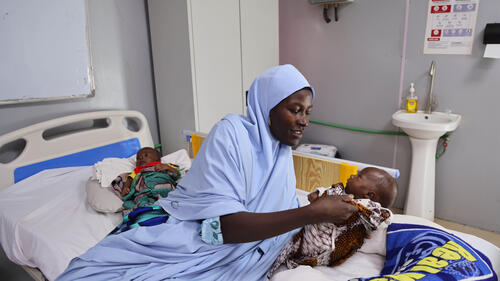
Our teams at the MSF Nilefa Kiji therapeutic feeding centre in Maiduguri have seen a surge in admissions for both moderate and severe acute malnutrition. In January, around 75 children were admitted every week for severe malnutrition – approximately three times the average for the same period in the past five years. By early April, the weekly figure had risen to close to 150 children per week, twice that of the same time last year.
“We have not seen anything like this since we started running malnutrition activities here in 2017,” says Kyi. “The number of weekly admissions is two to three times higher than that of the same period over the past five years – and it’s still rising.
“Last June, we sounded the alarm when admissions skyrocketed at the start of the hunger gap, but this year we are already seeing alarming numbers while we are still weeks away from the pre-harvest shortage period. The clock is ticking. There needs to be action if we want to avoid a catastrophe,” says Kyi.
The clock is ticking. There needs to be action if we want to avoid a catastrophe.Htet Aung Kyi, MSF medical coordinator in Nigeria
Immediate action needed
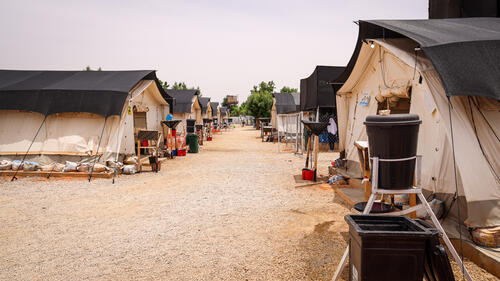
Malnutrition is not new in Maiduguri, where years of conflict and insecurity have caused a critical humanitarian situation. Many people have been displaced from their homes and now live in precarious conditions in informal sites, with host communities, or in detention camps.
The number of patients treated by MSF for severe malnutrition exploded in 2022, with over 8,000 children hospitalised for intensive nutrition care. One in seven patients came from the Hajj detention camp, where former members of armed opposition groups, their families and those who lived under their control stay. Many arrived in this camp in an already precarious state of health, which further worsened due to the harsh living conditions there.
To make matters worse, late 2021 saw the closure of official camps for displaced people and cuts to humanitarian and food aid. As a result, living conditions have become extremely harsh for those who are displaced, while some face movement restrictions, preventing them from earning a living or growing crops.
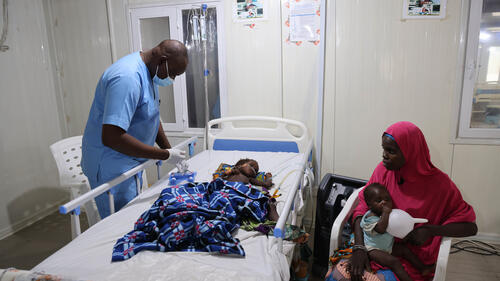
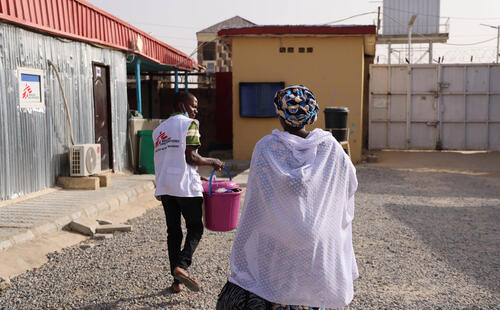
Our teams are providing inpatient and outpatient treatment for malnourished children, and targeted feeding for children with moderate malnutrition to prevent their condition from deteriorating. Our mobile teams also run clinics providing basic healthcare to people living in Hajj camp and Muna and Maisandari informal sites.
Food aid alone will not be enough
“Authorities and aid organisations need to immediately ramp up malnutrition-related activities and increase bed capacity in intensive therapeutic feedings centres,” says Gabriele Santi, MSF project coordinator in Maiduguri.
“They also need to improve living conditions in transit camps and expand people’s access to healthcare,” says Santi.
“This must be backed by a swift scale-up of donor funding and strong coordination of these funds to make sure that food reaches those most in need. At this stage, only 16 per cent of the funds requested by the nutrition cluster have been secured. This is alarming,” he says.
From early January to 20 April 2023, 1,283 malnourished children were admitted for intensive hospital care at the MSF feeding centre – about 120 per cent more compared to the same period last year.
In addition to the nutrition emergency in Maiduguri, MSF teams are responding to large-scale health and malnutrition crises elsewhere in northwest Nigeria, working in 32 outpatient therapeutic feeding centres and 10 inpatient therapeutic feeding centres in Kano, Katsina, Kebbi, Sokoto and Zamfara states. Last year we treated 147,860 children with severe acute malnutrition across northwest Nigeria.
Nigeria
Urgent response needed to curb Nigeria’s worsening diphtheria outbreak
Press Release
19 Sep 2023

Women's health
Abortion: Women more at risk of death in fragile and conflict-affected settings
Project Update
5 Sep 2023