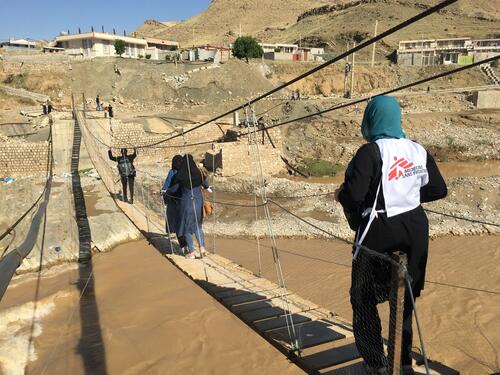
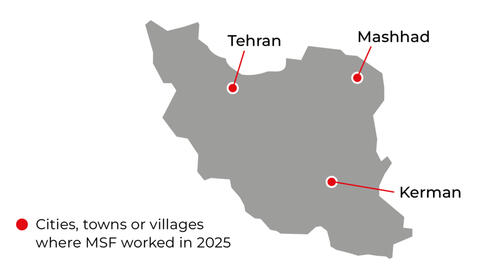
In South Tehran, Mashhad, and in Kerman province, MSF teams supported Afghan refugees, migrants, people who use drugs, and other marginalised groups facing major barriers to care. MSF delivered general healthcare consultations, including mental health support, assistance with the management of non-communicable diseases (NCDs), screening for infectious diseases, treatment for hepatitis C, nursing care, and referrals to specialised health services.
The UN refugee agency, UNHCR, estimates that around 2.5 million forcibly displaced people of varying documentation statuses were living in Iran in 2025, including approximately 770,000 registered refugees, the majority of whom are Afghan.* Many refugees, other forcibly displaced people, and migrants face stigma, economic barriers, and obstacles to accessing healthcare, as well as the fear of deportation.
In South Tehran, MSF provided general healthcare through fixed and mobile clinics. Our activities included consultations for general and mental health care, sexual and reproductive health services, and hepatitis C screening and treatment. We ran mobile clinics in select locations despite the security constraints surrounding working with marginalised and excluded communities, and expanded hepatitis C activities in government-mandated drug rehabilitation camps.
In Mashhad, near the Afghan border, MSF worked with refugees and marginalised communities through a fixed clinic, mobile clinics, and in government-mandated drug rehabilitation camps, offering medical and psychological consultations, follow-up for NCDs, referrals, and hepatitis C services for high-risk groups, such as people who inject drugs, as well as community health promotion.
In Kerman province, to the southeast, MSF focused on improving access to general and specialised care. We continued to provide healthcare activities at the Vahdat clinic, in collaboration with a local partner, and offered financial support for uninsured patients requiring specialist care. In December, we inaugurated a new MSF-supported clinic to increase provision of treatment for communicable and non-communicable diseases, sexual and reproductive health services, and mental health support.