Gaza
In 2025, Israel continued its ruthless campaign in Gaza, not only through brutal and incessant violence, but also through months of blockade, denying people their most basic needs for survival, such as food and water, culminating in famine conditions in some areas in August. By 31 December, 71,266 people had been killed by Israeli forces since the start of the war,* while civilian infrastructure and the health system in the Gaza Strip had been systematically decimated.
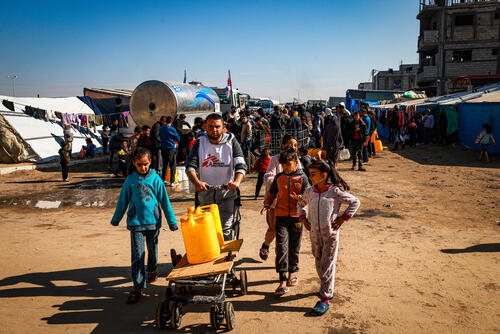
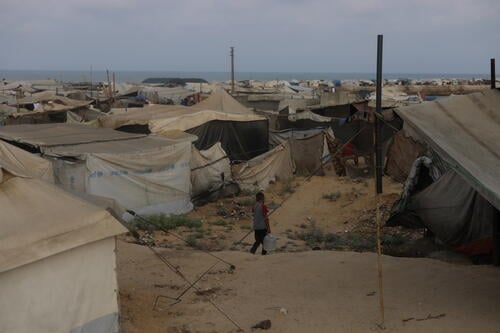
Throughout the year, Palestinians were forcibly displaced and pushed into an ever-shrinking geographic area. MSF teams supporting emergency departments responded to multiple mass-casualty incidents, receiving hundreds of patients killed or injured by Israeli strikes in southern Gaza. We also witnessed how the Israeli authorities increasingly suppressed humanitarian space, including by dismantling the UN-led response and replacing it with a militarised food distribution scheme run by the Gaza Humanitarian Foundation (GHF). This led to violence and killings at food distribution sites. MSF’s clinics were overwhelmed by patients with gunshot wounds, lacerations, and crush injuries, many of them children, as people were shot at or injured in the chaos as they tried to get food. Across the Strip, our teams treated a growing number of children with moderate and severe malnutrition until the ceasefire came into effect on 10 October.
MSF called on the Israeli authorities to end the violence, allow humanitarian aid to enter at scale, and dismantle the GHF sites (which stopped functioning after the October ceasefire). Meanwhile, the Israeli authorities introduced a new registration system for international NGOs with restrictive and politicised rules, fundamentally jeopardising the continuation of humanitarian action in Palestine.
At the end of August, the Israeli forces launched a large-scale offensive on Gaza City, destroying entire neighbourhoods and forcibly displacing hundreds of thousands of people into the middle of the Strip. As a result, MSF had no option but to relocate teams and suspend all medical activities in the city at the end of September.
After a second ceasefire came into effect in October, Palestinians returned to the north, and MSF teams relaunched activities. We returned to public hospitals, resuming paediatric services, burns treatment, and physiotherapy, and helping to repair facilities that were filled with rubble. We also opened multiple medical points to deliver general healthcare in areas where the Israeli forces had destroyed all the health facilities. In spite of the ceasefire, the flow of humanitarian aid into Gaza remained critically inadequate, and Israel continued to block essential items, such as shelter materials and so-called dual use items,** exacerbating the dire winter living conditions.
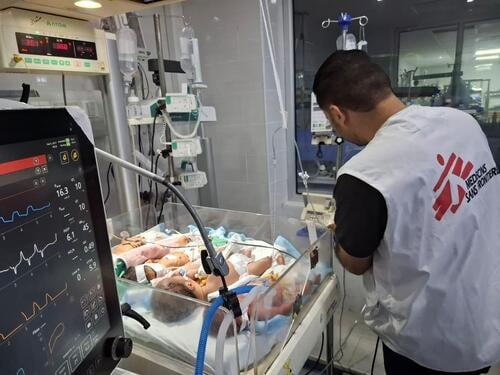
In response to the immense needs, we expanded our medical and water and sanitation activities throughout the year. MSF continued to be one of the largest providers of services such as comprehensive care for patients with burns and trauma injuries, which included physiotherapy, dressing wounds, surgery, and maternal and neonatal healthcare. By the end of the year, our teams were supporting six hospitals and seven healthcare centres. We were also running two field hospitals, two clinics, and an inpatient feeding centre, as well as providing clean water to hundreds of thousands of Palestinians in Gaza.
In 2025, six more MSF colleagues died in Israeli airstrikes or targeted attacks, taking the total number of MSF staff killed in Gaza to 15. To date, our official request for an independent investigation into these killings has not officially been answered by the Israeli authorities. We have made repeated calls for a sustained and immediate ceasefire, urgent and unhindered access for humanitarian aid, medical evacuations, and an end to the genocide.
The West Bank
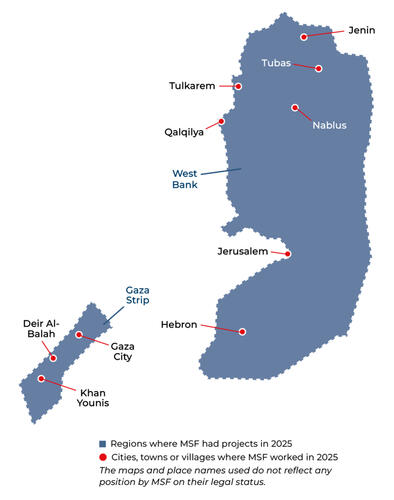
In the West Bank, MSF teams continued to witness the consequences of policies and practices of ethnic cleansing, aimed at forcibly transferring Palestinians from their land and preventing any possibility of return. This included a sharp increase in violence by the Israeli military and settlers, who killed and injured many Palestinians. While not new, we witnessed a clear expansion of Israeli settlements and policies aimed at displacing Palestinians in 2025. The ongoing Israeli Iron Wall military operation, which began in January 2025, forcibly displaced 40,000 people in the northern West Bank within a month, according to UNRWA, the United Nations Relief and Works Agency for Palestine Refugees.*** Three refugee camps were violently raided and emptied. Homes and civilian infrastructure – including schools and healthcare centres – were demolished, increasing the likelihood that the displacement will become permanent. MSF operated mobile clinics to deliver general healthcare to thousands of people displaced by the military operations in the north, particularly in Jenin and Tulkarem, and distributed hygiene kits, food parcels, and clean water.
In Hebron, Nablus, Qalqilya, and Tubas, our operations focused on offering medical and mental health support to people affected by settler attacks, demolitions, and displacement, through both mobile and fixed clinics. The constant fear regarding longer and unpredictable incursions and attacks by both Israeli forces and settlers is taking a significant toll on people’s mental health, increasing feelings of hopelessness and anxiety, as observed by our mental health teams. MSF also conducted training for Palestinian Red Crescent Society volunteers, and supported healthcare facilities with training and donations of supplies, including water and fuel.
MSF’s registration beyond 2025
Throughout the year, MSF faced severe operational uncertainty, due to Israel’s attempts to control and restrict the activities of humanitarian organisations by demanding they re-register to work in the country and submit private information about Palestinian staff. MSF had considerable and legitimate concerns about sharing this data, and therefore, in August, we provided all information requested, except personal details of our staff, which we refused to provide to the Israeli authorities without guaranteed safeguards. Without registration, which expired on 31 December, MSF is unable to send supplies or international staff into Palestine, but our Palestinian teams remain committed to providing assistance for as long as possible.