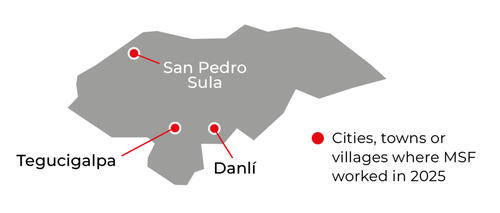
Following the reduction in the number of people attempting to reach Mexico and the United States, we closed our project in Danlí, near the Nicaraguan border. For four years, we had offered medical, psychological, and social support, as well as health promotion activities, for people on the move through the country.
After releasing mosquitoes carrying Wolbachia* – an arbovirus** prevention strategy implemented in collaboration with the World Mosquito Program, the Ministry of Health, and the National Autonomous University of Honduras – near the capital, Tegucigalpa, in 2024, we completed a study on the results. The study suggests that Wolbachia contributed to a significant reduction in dengue incidence during 2024, specifically in the area where the mosquitoes were released. As a result of these findings, we set up community groups against dengue, and a community‑based epidemiological surveillance system. We also completed two chemoprevention activities for arboviruses – residual wall spraying and the installation of larvicide traps – in the La Joya, El Edén, and El Manchén neighbourhoods, in collaboration with the Honduran authorities and the communities.
Throughout the year, we continued to run our sexual and reproductive health services for adolescents in health centres and educational institutions in San Pedro Sula. In this city, we also work to ensure access to comprehensive healthcare for people who engage in sex work and LGBTQI+ individuals, including psychosocial and basic psychiatric care, health promotion, screening and treatment for sexually transmitted infections, human papillomavirus vaccinations, screening for cervical cancer, family planning, pre‑exposure prophylaxis to prevent HIV, and treatment for sexual violence.
* Wolbachia is a bacterium that prevents mosquitoes from carrying dengue.
** Arboviruses are a group of viral diseases that are transmitted to humans by arthropods, mainly mosquitoes. Common examples include dengue, Zika, chikungunya, and yellow fever.