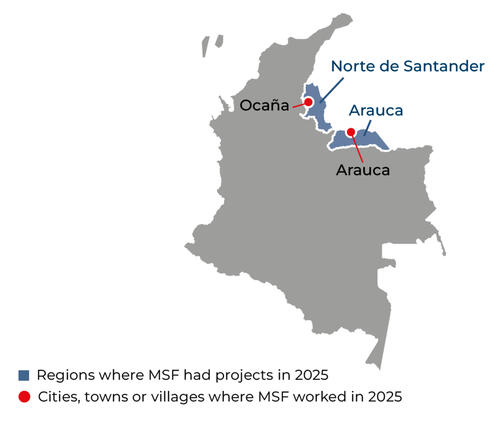
In 2025, Colombia experienced its highest level of violence since the peace agreement was signed between the state and the Revolutionary Armed Forces of Colombia (FARC) in 2016. MSF teams launched responses in two eastern regions suffering the impacts of conflict: Norte de Santander and Arauca, where people struggle to obtain healthcare and public services are weak.
According to the Office of the Ombudsman, the current conflict involves at least 10 armed groups, ranging from historical organisations to more recent criminal groups.1 Mass displacement and confinement of communities, kidnappings, armed strikes, bomb attacks on police infrastructure, and violence against civilians were reported in several regions, including Norte de Santander, Arauca, Cauca, Chocó, and Guaviare.
The Catatumbo subregion of Norte de Santander was severely affected, with 101,000 people displaced,2 and around 25,000 experiencing restrictions on their movements3. MSF initiated an emergency response to bring care to confined and isolated communities with extremely limited access to health facilities, due to closures, restrictions imposed by armed groups, or the risk of landmines and stray bullets. As well as delivering general healthcare, mental health support, and sexual and reproductive health services, our teams distributed water filters and mosquito nets.
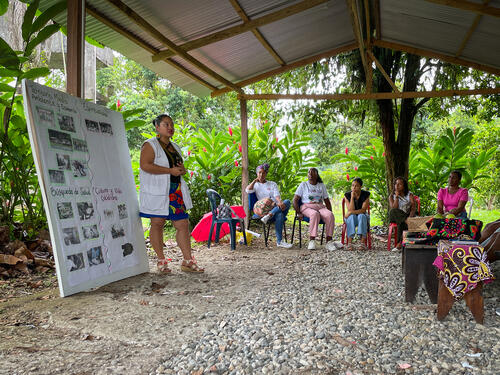
From March to December, MSF ran a project in Arauca for communities who face barriers to accessing healthcare. In the city of Arauca, our teams assisted Venezuelan migrants, Indigenous people, and Colombian returnees living in precarious conditions in informal settlements. In rural areas of Tame, Arauquita, and Puerto Rondón, we provided medical and mental health care to people affected by armed conflict. In addition to healthcare programmes, MSF conducted activities to improve water supply, such as rehabilitating wells and distributing water filters.