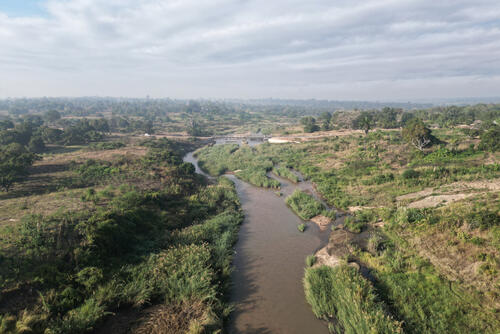
The Meluli River, which flows alongside the town of Nametil in the Mogovolas district of Nampula province, is the main water source of the region. People come here to wash themselves, their clothes and sometimes even their cars and motorcycles. By doing so, people can contract schistosomiasis. They become infected when larval forms of the parasite – released by freshwater snails – penetrate the skin during contact with infested water. Transmission occurs when people suffering from schistosomiasis contaminate freshwater sources with faeces or urine containing parasite eggs, which hatch in water.
© Pierre-Yves Bernard/MSF

Climate Emergency: Is humanitarian action fit for purpose in a rapidly warming world? (in-person panel discussion)

The Meluli River, which flows alongside the town of Nametil in the Mogovolas district of Nampula province, is the main water source of the region. People come here to wash themselves, their clothes and sometimes even their cars and motorcycles. By doing so, people can contract schistosomiasis. They become infected when larval forms of the parasite – released by freshwater snails – penetrate the skin during contact with infested water. Transmission occurs when people suffering from schistosomiasis contaminate freshwater sources with faeces or urine containing parasite eggs, which hatch in water.
© Pierre-Yves Bernard/MSF
Ebola disease in DRC: find out how we're responding
Learn more

SAVE THE DATE!


CLIMATE EMERGENCY: IS HUMANITARIAN ACTION FIT FOR PURPOSE IN A RAPIDLY WARMING WORLD?

26 JUNE 2024 | 5:30 P.M.- 7:15 P.M,

PANEL DISCUSSION

ROUTE DE FERNEY 140, 1202 GENEVA


For more information, please contact Alexandra Malm: [email protected] 

CLIMATE EMERGENCY: IS HUMANITARIAN ACTION FIT FOR PURPOSE IN A RAPIDLY WARMING WORLD