HIV continues to be the leading cause of death in Eswatini.1 It is estimated that one-quarter of the population, and nearly one-third of women aged 15-49, live with the disease.2
In 2025, our teams rolled out a new HIV prevention tool, CAB-LA (cabotegravir long-acting), an injectable pre-exposure prophylaxis (PrEP), which provides protection for two months. Along with other long-acting PrEP medications, such as lenacapavir, it could be a game changer in controlling the HIV epidemic if access is ensured for those who need it most.
It has become increasingly difficult for people to obtain innovative preventive treatments, such as long-acting PrEP, in Eswatini, due to the health ministry’s over-reliance on external funds. In addition, in 2025, funding from programmes, such as PEPFAR,3 became uncertain. For this reason, we supported the integration of CAB-LA within the PrEP regimens in our Sitsandziwe sexual health clinic by securing a number of doses of the medication.
The initial uptake of CAB-LA was promising, with a majority of patients who began using it continuing to do so at the end of 2025, expressing appreciation for the ability to take it discreetly.
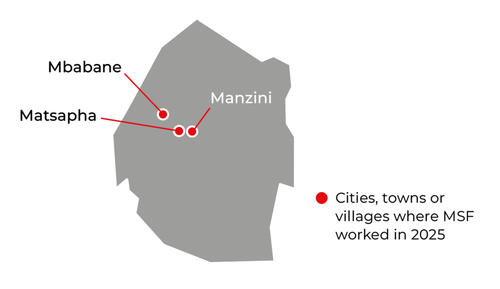
We also continued to run our other HIV counselling, testing, prevention, and treatment activities in Sitsandziwe. The clinic also offered family planning consultations, comprehensive care for sexually transmitted infections and sexual and gender-based violence, mental health support, and vaccinations, as well as screening and treatment for cervical cancer and chronic hepatitis. In Manzini city, the capital of Manzini district, an MSF team runs the high-dependency unit in the government hospital, providing care for people with non-communicable diseases.