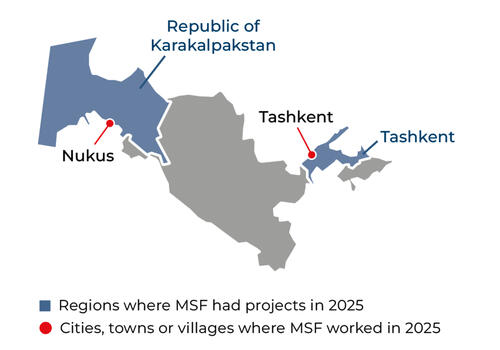
In the capital, Tashkent, MSF concentrated on supporting diagnosis and treatment for HIV and co-infections. In June 2025, we successfully concluded our HIV outreach project, which engaged people from high-risk groups to offer testing, diagnosis, and information on infection prevention. We handed over our mobile clinic to the Ministry of Health.
In September, we ended our long-running collaboration with the Karakalpakstan Tuberculosis Programme. The closing ceremony, attended by MSF staff, national health authorities, and representatives of the expert community, marked almost three decades of joint efforts to strengthen TB care in Karakalpakstan.
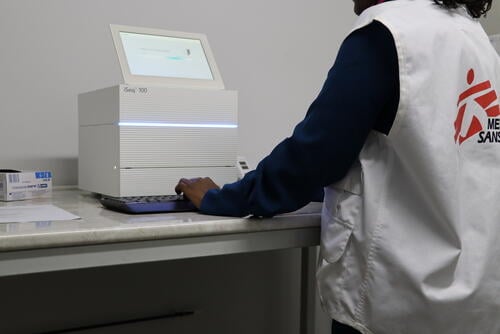
Since 1998, MSF had focused on improving TB diagnosis and treatment, transforming the regional TB care system, and promoting shorter, less toxic treatment regimens. We also worked to build the capacity of local providers so that TB care continues after our departure. In addition, we handed over a state-of-the-art mycobacteriology laboratory, now one of the most advanced facilities of its kind in Central Asia. This lab plays a critical role in diagnosing both drug-sensitive TB and multidrug-resistant TB, providing high-quality testing services across the region.
In April, our team travelled to Almaty, Kazakhstan, to co-host a TB workshop with the aim of accelerating the adoption, uptake, and effective implementation of the World Health Organization’s latest policies on TB diagnostics, prevention, screening, treatment, and nutrition across countries in the region with a high TB burden, including Uzbekistan.
With our two long-standing projects concluded by the end of 2025, we began looking at what medical and humanitarian needs MSF could address in Uzbekistan in the future.