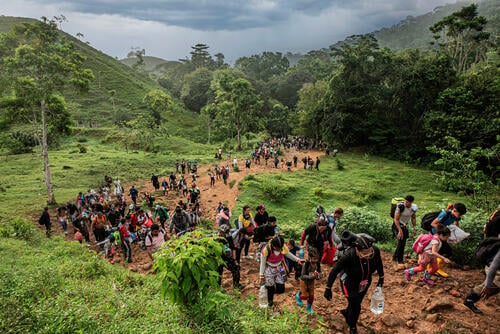
In 2025, the number of people crossing the Darién Gap — the dense jungle border between Colombia and Panama — fell by 99 per cent compared to 2024.* This decline was mainly linked to stricter migration policies in the United States (US), affecting people transiting through Central America to reach North America. In March, Panamanian authorities declared the Darién route closed, leading to a significant reduction in reception infrastructure for migrants. As well, bilateral cooperation between Panama and the US saw people returned to Panama.
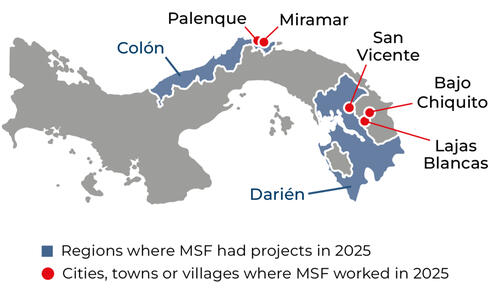
Between February and May, MSF teams worked at the San Vicente temporary migrant reception station, where dozens of people from different countries, most of whom had been deported from the US, gathered. There, MSF’s work focused mainly on mental health care, as people needed assistance managing their high levels of stress, psychological trauma, and uncertainty about their futures.
Following the closure of the Darién route, in June, we launched a three-month emergency response in Colón province, in northern Panama, to support people moving down from North America. Through this work, we primarily assisted Venezuelans who, unable to continue north, were returning to South America by sea.
During this response, our teams treated people with dehydration, some of whom consumed unsafe water, and people with mental health conditions stemming from uncertainty and prolonged exposure to traumatic experiences. We also distributed clean drinking water and hygiene kits to help meet basic needs.
Following the significant drop in people travelling through Panama, MSF ended all activities during the first week of September, after nearly four and a half years of presence in the country.