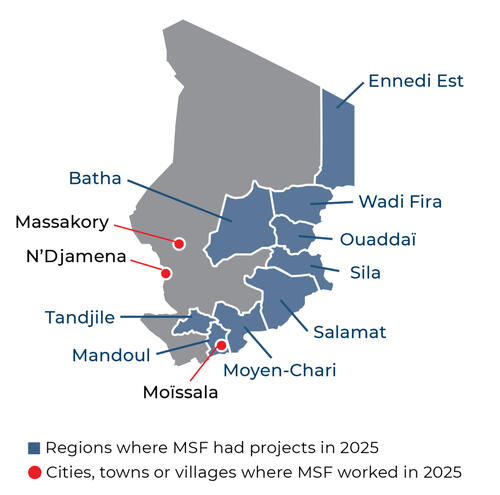
People in Chad faced recurrent outbreaks of cholera, diphtheria, and measles, as well as the continued threat of malaria and worsening malnutrition during 2025. The country’s low vaccination rates drive epidemics in places where people have difficulties reaching healthcare, whether because of the associated costs, or the lack of functioning and well-staffed facilities. Meanwhile, cuts in international aid further reduced the fragile health system’s ability to meet people’s needs. In response, MSF ran a range of activities, maintaining support to hospitals, general healthcare centres, and community-based health systems, and sending teams to assist in emergencies. We worked to deliver lifesaving care and reinforce local capacity in some of the most isolated communities.
Providing care to Sudanese refugees and host communities in eastern Chad
As of 31 December, an estimated 1.26 million people had crossed into Chad since the conflict in Sudan began, of whom 356,000 are Chadian returnees.* As transit sites filled rapidly, people were relocated to extensions of long-standing camps, such as Iridimi and Toulum. In Toulum, MSF provided antenatal consultations, psychological support, treatment for malnutrition, vaccinations, and specialist referrals. In April, after the Sudanese Rapid Support Forces took over Zamzam camp in North Darfur, Sudan, and more than 60,000 people arrived in Tiné, Chad, in one week, MSF distributed therapeutic food to children under five years old and pregnant and breastfeeding women. We also supplied essential relief items, such as cooking equipment and hygiene kits, and built latrines in Touloum camp. To accommodate the new arrivals, we began providing comprehensive general healthcare in two new camps in Iridimi and Goudrane.
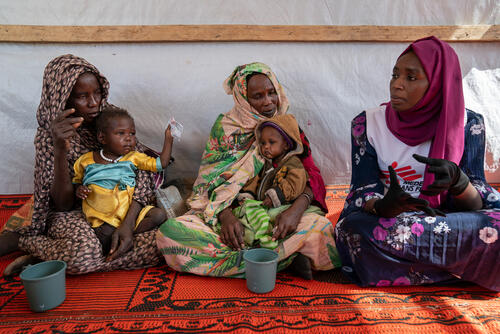
Throughout the year, we delivered general healthcare to refugees in Tiné and Ouré Cassoni, including antenatal consultations, treatment for sexual violence, routine immunisations, nutritional support, and mental health care. We also conducted health promotion, and water, sanitation, and hygiene activities. In August, MSF started to run a fixed clinic and mobile clinics in Ouré Cassoni, and carried out water trucking and latrine construction to meet urgent needs in the densely populated camp.
In the town of Adré, we maintained our integrated general and specialist healthcare at the health centre and hospital. Our teams carried out paediatric and reproductive health consultations at our health centre, and vaccinated children as they arrived at the border. At the hospital, we assisted with deliveries, admitted children for severe acute malnutrition, and provided neonatal and paediatric inpatient care.
In Metché camp, we continued to run our hospital, serving both refugees and host communities with emergency care, surgery, maternal and neonatal health services, mental health support, and treatment for malnutrition. To ensure adequate access to safe drinking water and to reduce the risk of epidemics, our teams rehabilitated boreholes and extended water distribution systems in the camp. In Aboutengue camp, we offered both inpatient and outpatient care, and treated patients with moderate acute and severe acute malnutrition. Our team also supported treatment of chronic diseases and mental health conditions, and collaborated with the Ministry of Health to run vaccination campaigns.
Responding to epidemics
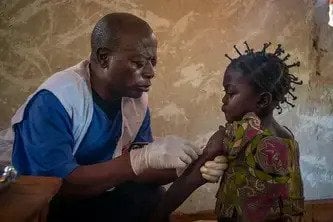
Tackling epidemics remained a key activity for MSF in 2025. Northeast of the capital, N’Djamena, we responded to a diphtheria outbreak affecting multiple districts in Bahr El-Gazel and Batha provinces, by providing both inpatient and outpatient care. To contain further outbreaks, our teams, supported by community health workers, launched vaccination campaigns in Bahr El-Gazel, and in Iridimi camp in Wadi Fira province.
MSF’s Chad emergency response team supported surveillance and vaccination efforts in several provinces, including Batha, N’Djamena, and Salamat. We also assisted with an emergency response to malnutrition in Am Timan during the lean season – the period between harvests when food stocks are depleted – treating severely malnourished children and boosting hospital capacity.
In N’Djamena’s 9th district, we responded to a measles outbreak by providing outpatient care and donating treatment kits to health centres.
During the rainy season, we launched activities in Ouaddaï, Sila, and Hadjer Lamis provinces to tackle cholera outbreaks. In Hadjer Hadid district, Ouaddaï, we set up cholera treatment units and oral rehydration points, and improved water distribution, and infection prevention and control measures. We also supported the Ministry of Health’s response to a meningitis outbreak in five districts of Ouaddaï, by administering vaccinations and treating severe cases at Abéché regional hospital. Through vaccination campaigns, strengthened surveillance, rapid response, and close collaboration with health authorities, we helped to contain multiple outbreaks.
Supporting chronic needs
In addition to our emergency responses, we maintained long-term projects focusing on malaria, malnutrition, and improving access to healthcare. In Moïssala, in Moyen-Chari, MSF partnered with the Ministry of Health to conduct seasonal malaria chemoprevention across 37 health zones. Our teams also conducted paediatric consultations and assisted births in hospitals in Moïssala.
Food insecurity is a major problem in Chad, exacerbated by issues such as displacement, climate shocks, and the poor economic situation. In Massakory district, Hadjer Lamis, MSF supported 21 community sites offering treatment for malnutrition alongside other health services, such as sexual and reproductive healthcare, as well as the hospital’s malnutrition unit. MSF teams helped run paediatric outpatient therapeutic feeding programmes, while MSF-trained community health workers screened children for malnutrition and organised referrals when necessary. We also rehabilitated water distribution systems, and conducted health promotion activities to address underlying drivers of malnutrition.
In Sila, we continued our community-based healthcare model across 91 villages, in which community members participate in decision-making about activities. MSF teams conducted general health consultations and assisted with maternity referrals and vaccinations. This project seeks to reinforce existing health facilities, with the aim of ensuring the continuation of services beyond MSF’s presence in the province.