


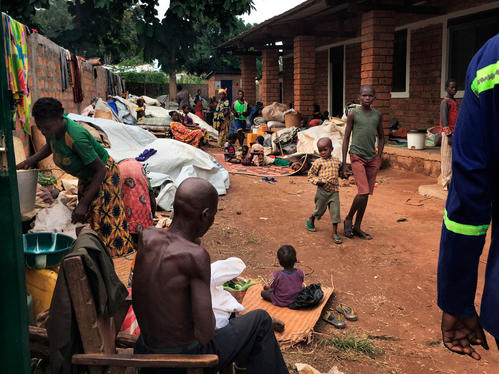
Some 10,000 people are sheltering in the grounds of Batangafo hospital more than 10 days after violence broke out between rival groups in this northern city of Central African Republic (CAR).
With clashes taking place between members of the former Seleka coalition and so called self-defence groups, Batangafo has once again been plunged into chaos, with a wave of killings and lootings. A number of aid organisations were robbed, including MSF, while a large part of the city’s camp for displaced people was looted and burned, forcing people to seek shelter elsewhere.
The camp for displaced people, which was established three years ago, needs to be rebuilt as soon as possible, says MSF, and all conditions met to allow people to return to it safely. In the meantime, MSF is providing basic water and sanitation services to people sheltering in the grounds of the hospital, which is supported by MSF.
“The people taking refuge in the hospital, and in other locations around Batangafo, are still unable to rebuild their shelters in the camp from which they were forced to flee,” says MSF project coordinator Carlos Francisco.
“As a stopgap, we are strengthening the water supply system in the hospital grounds as well as providing latrines and improving hygiene. But people must be allowed to rebuild their homes as soon as possible and return to the camp in safety.”
Most people sheltering in Batangafo hospital leave the grounds during the day and return to sleep there at night. But in CAR, not even hospitals are places of safety. In recent weeks, hospitals in both Bangassou and Zemio have been forcibly entered by armed groups. In incidents condemned by MSF, armed men in Bangassou escorted away two patients, who were later found dead, while in Zemio, armed men shot and killed a child in its mother’s arms.
“Much of the general population is in a state of complete helplessness,” says Francisco. “Imagine what the situation must be like when people think that the only safe option left to them is a hospital, knowing that not even hospitals are safe.”
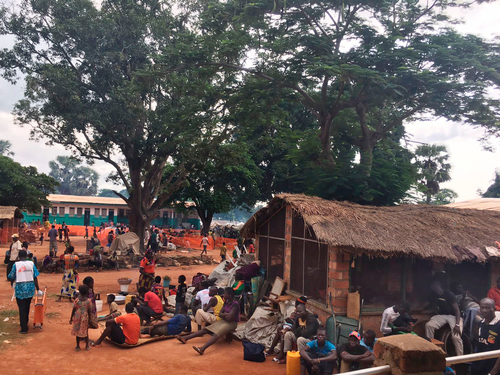
Two waves of fighting have enveloped Batangafo in the past 10 days – the first on Saturday 29 July, the second on Tuesday 1 August – resulting in 24 dead and 17 wounded. Some of the wounded were treated in Batangafo hospital and included combatants from both groups.
Hospital services were interrupted by the recent fighting, with general consultations being put on hold and extra support provided to the emergency room, but have since been re-established.
The atmosphere in Batangafo remains tense, despite the fact that the leaders of the rival groups claim to have reached an agreement to prevent a resurgence of the conflict.
Since last November, CAR has seen a worsening of the conflict which started in 2013/14. In recent months, more than 180,000 people have fled their homes. The number of displaced people has risen to more than 400,000, while around 500,000 people remain refugees in neighbouring countries, out of a total estimated population of just over 4.5 million people.
MSF has been working in Central African Republic since 1996 and currently has more than 2,400 Central African staff and 230 international staff working in the country. Since 2013, MSF has doubled its level of medical support in response to the crisis. At present, MSF runs some 20 projects across the country, with medical teams providing free healthcare, including paediatric care, routine vaccinations, maternal healthcare and surgery, as well as treatment for diseases such as HIV and tuberculosis.