



Ebola disease in DRC: find out how we're responding
Learn more
125 Results For "leishmaniasis"
 
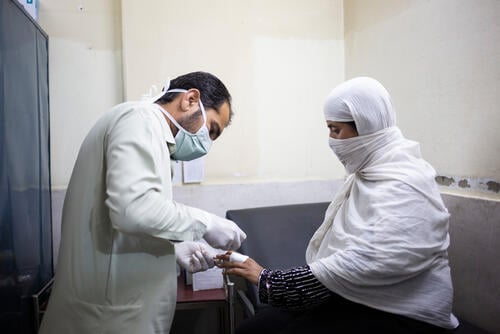
An MSF medical technician is applying a bandage on the lesion of Gulnaz’s finger. The bandage will keep the lesion clean and protected. She is receiving treatment for cutaneous leishmaniasis (CL) skin disease at MSF’s CL centre at treatment for Naseerullah Khan Babar Memorial Hospital in Peshawar, Khyber Pakhtunkhwa province Pakistan, on 26 May 2022.
Pakistan

MSF calls for sustainable access to treatment for cutaneous leishmaniasis in Pakistan

MSF calls on the authorities and donors to ensure uninterrupted and sustainable access to a drug used for treating cutaneous leishmaniasis in Pakistan. Press Release - 30 Jan 2026
 
Overcrowded housing in the informal settlement of Machar Colony in Karachi, Pakistan.
Pakistan

Turning the tide of hepatitis C treatment in Machar Colony

While hepatitis C remains a challenge in Machar Colony, Pakistan, the alarming spread has been curtailed, thanks to widespread awareness and early detection. Project Update - 30 Jan 2025
 
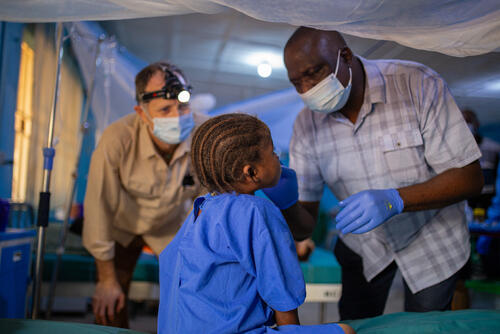
Dr. Kefas and Dr. Dave examine a young girl with noma who underwent life-changing reconstructive surgery.
Neglected diseases

Four diseases you’ve probably never heard of

These are four neglected tropical diseases that we see in communities we serve. Project Update - 30 Jan 2025
 
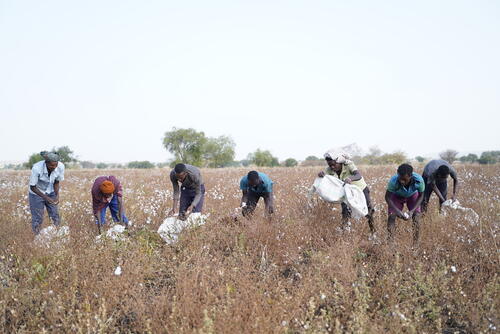
Farmers pick cotton on a farm land near Abdurafi. Workers who often work at night and will sleep in the fields are more exposed to the risks of kala-azar and snakebite. This young mostly male population is affected by a relatively high prevalence of HIV infection. The combination is a further challenge for effectively treating patients, and is almost impossible to cure. While a patient with a healthy immune system treated for kala azar will develop an immunity against the disease that will last for many years, HIV co-infected patients cannot generate this immunity so they will keep relapsing and eventually become unresponsive to treatment and die.
Ethiopia

Two decades of combatting the world’s most neglected diseases

In Ethiopia, our teams have been responding to two of the world's deadliest and most neglected diseases for 20 years. Here are nine quick facts about our lifesaving work in the region. Project Update - 26 Sep 2023
 
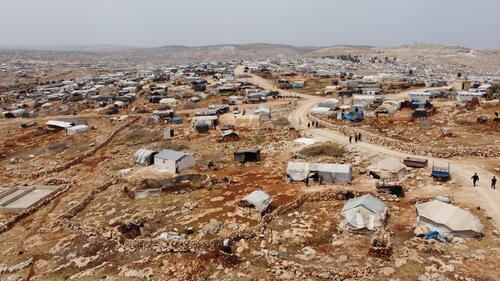
WASH Assessment Idlib Camps
Syria

Inadequate water and sanitation pose health threats in Syria

Displaced people in northwest Syria face the health consequences of 12 years of war and the recent earthquakes. Our teams are responding to people's needs by distributing water and hygiene kits and building latrines. Project Update - 16 Jun 2023
 
Mesfin Teshome calls the team at the base to let them know they will refer patients to the hospital.
Ethiopia

People in Omo Valley at high risk to kala azar 

MSF teams are providing medical assistance to the Mursi tribe, an indigenous group in Ethiopia’s Lower Omo Valley, where an alarming number of kala azar cases have been identified.  Project Update - 28 Mar 2023
 
Dr Sajjad checking on a pre-term baby in MSF’s neonatal ward at the district headquarters hospital, Chaman.
Pakistan

Pakistan annual report 2021

The 2021 MSF Pakistan annual report provides an overview on all MSF activities in Pakistan during the year. Report - 16 Aug 2022
 
As winter approaches in northwest Syria, the already harsh living conditions of more than two million displaced people are becoming even more difficult to deal with. People living in camps across the region face the prospect of leaking tents, mud-filled streets and freezing temperatures. Whenever it rains, the roads in the camp become rivers of mud, making it difficult for people to leave their tents, either on foot or by motorbike, to buy groceries, get to work or see a doctor. 
Teams from Médecins Sans Frontières have started distributing ‘winter kits’ of warm clothes, tarpaulins, mattresses and blankets to around 14,500 families living in more than 70 camps for displaced people across northwest Syria, to help improve their living conditions over the coming winter. These distributions are accompanied by health promotion awareness sessions on winter diseases and ways to prevent being sick in settings such as this.
Syria

Millions of Syrians will lose access to vital aid if northwest border closes

The potential closure of the northwest Syrian border, Bab Al-Hawa, could be extremely harmful to the millions of people reliant on aid there. Project Update - 8 Jul 2021
 
SeaWatch4 already has 201 survivors on board, denied a place of safety until date release of this photo. Yet as EU & maritime authorities again turn a deaf ear to the cries of  people in distress at sea - and despite still being over 6hrs away - the ship has altered course toward MVLouiseMichel.
Activity Report

Year in Review 2020

Read the Operations Directors' review of MSF activities in 2020. Project Update - 17 May 2021
 
Kala azar sufferer Ruai Puot Malow (56 years) is assisted by his wife Yakuony Jock Deng (right) and a relative at a Médecins Sans Frontières / Doctors Without Borders hospital in Lankien, South Sudan, Tuesday, 13 Jan 2015.  Ruai was brought to the hospital by relatives who carried him for five hours through the bush to the MSF hospital after he suffered yet another outbreak of the disease. The conflict that erupted in South Sudan little more than a year ago has left people more vulnerable to a deadly tropical disease known as kala azar (visceral leishmaniasis). The risk of infection increases as people are displaced by fighting into areas where the disease is prevalent and malnutrition lowers their ability to fight the infection. With many health facilities not functioning in conflict areas, getting treatment is more difficult. Last year, MSF treated over 6,700 cases of kala azar in South Sudan, more than double the number of cases it treated the year before (2714 cases treated in 2013). The majority of people treated were in Lankien, a dusty settlement in the conflict affected state of Jonglei. Kala azar is a tropical, parasitic disease transmitted through bites from certain types of sand fly. It is endemic in 76 countries, and of the estimated 250,000–300,000 annual cases, 90 per cent occur in Bangladesh, India, Nepal, South Sudan, Sudan and Brazil. Kala azar is characterised by fever, weight loss, enlargement of the liver and spleen, anaemia and immune-system deficiencies. Without treatment in a place like South Sudan, kala azar is always fatal. Photo/Karel Prinsloo for MSF
Neglected diseases

No more neglected diseases, no more neglected patients

As we release a new report on neglected tropical diseases, International President Dr Christos Christou urges countries not to reverse the gains made on eliminating them. Press Release - 27 Jan 2021
Four mothers posing in a corridor of the Hospital in Bili. All four of them are staying in the hospital with their child, that's suffering from a severe case of malaria. Since the beginning of the project in 2016, the pediatric ward already treated more than 4.000 cases of complicated/severe form of malaria.
Médecins Sans Frontières (MSF)

Independent medical humanitarian assistance

We provide medical assistance to people affected by conflict, epidemics, disasters, or exclusion from healthcare. Our teams are made up of tens of thousands of health professionals, logistic and administrative staff - most of them hired locally. Our actions are guided by medical ethics and the principles of independence and impartiality. We are a non-profit, self-governed, member-based organisation.

Learn more