


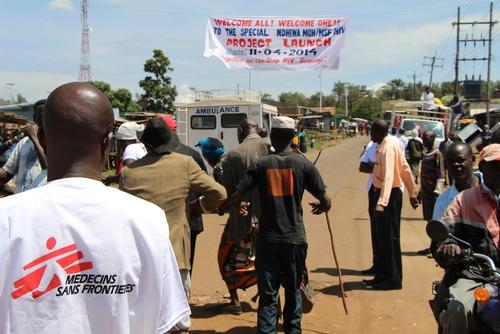
Nairobi, 11 April 2014 – An ambitious new project in western Kenya aims to drastically reduce the number of people infected by HIV, while helping those living with the disease to live long and healthy lives. Over four years, teams from the international medical organisation Médecins Sans Frontières (MSF), working with County and Sub County health authorities in Ndhiwa sub-county, Homa Bay county, will encourage people to take regular HIV tests, while providing life-saving antiretroviral (ARV) treatment to those who need it.
The MSF/Ministry of Health programme and partners will make HIV tests widely available and promote regular testing. Those who test positive will be put on ARV treatment as early as possible to reduce their risk of transmitting the virus to others. Ongoing support will help them stick to their treatment, which involves taking ARV drugs daily for the rest of their lives.
The programme will also simplify the way healthcare is provided to patients, by adapting medical protocols and including non-medical workers in the provision of care. Pregnant women will be systematically screened for HIV, with ARV treatment provided to all those who test positive to minimise their risk of transmitting the virus to their babies during pregnancy or childbirth. HIV testing will also be integrated into routine immunisation programmes for young children.
“The programme will gather local, national and international partners to work together in an integrated way to provide care for people living with HIV,” says William Hennequin, MSF representative in Kenya. “It is crucial that we increase the number of people being regularly tested for HIV, and that we follow up every person receiving ARV treatment closely so we ensure an optimal adherence to treatment and people remain healthy. We will also focus on involving communities so that people can receive care earlier and closer to their homes.”
Despite significant steps being made in the battle against HIV in the past decade by the Ministry of Health and its partners, HIV still represents a major public health problem in Ndhiwa. According to a study in 2012 by Epicentre – the research arm of MSF – 24.1 percent of the population of Ndhiwa sub-county is HIV-positive, while the number of new infections remains a concern, with two adults in every 100 contracting the disease each year. This is significantly higher than elsewhere in Kenya, where the national percentage of people living with HIV was 6.3 percent in 2009 and the provincial average was 14.9 percent.
“We have a very precise picture of the HIV situation in the Ndhiwa area,” says Pamela Olik, a nurse with MSF. “This will allow us to compare it with the situation in four years’ time, so enabling us to measure the impact of the project – which is a rare opportunity in HIV programmes.”
MSF has been working in Kenya since 1987, and started its first HIV programme in Homa Bay, western Kenya, in 1996. In 2013, MSF provided care to 4,369 people living with HIV. MSF currently runs medical activities in four locations across the country: Kibera, Mathare, Dadaab and an emergency intervention for refugees in Nadapal.