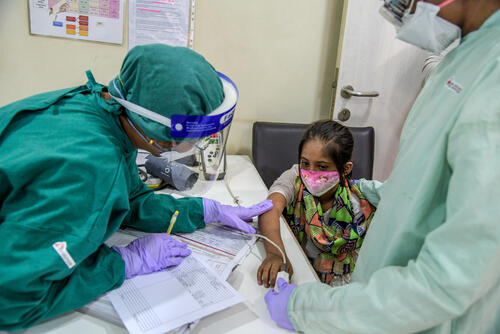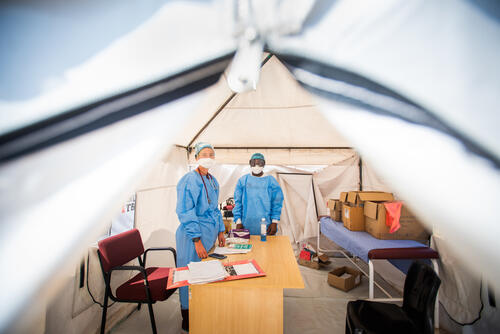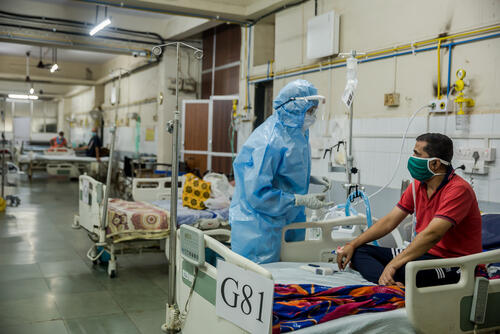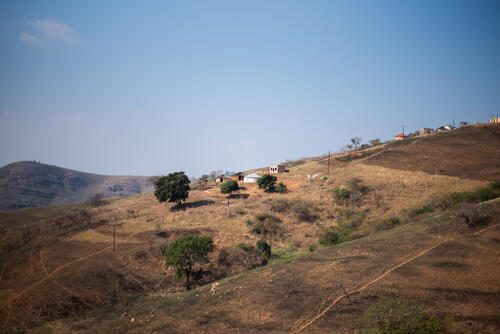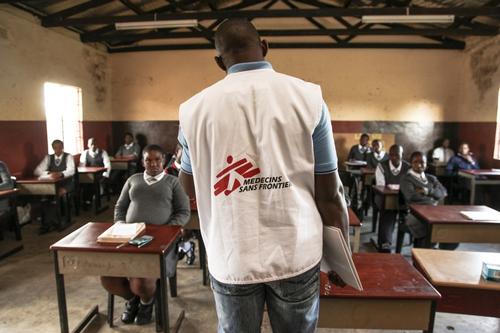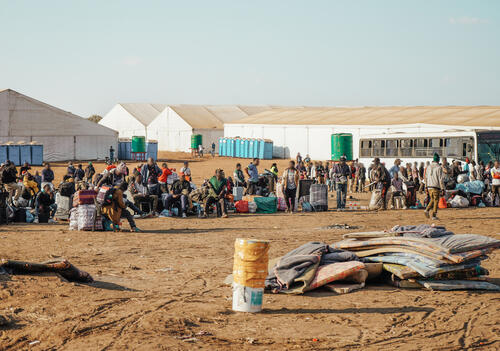
The composition of the cholera hygiene kits MSF donated to families in the community of Kanana in Hammankskraal, South Africa, is derived from a study MSF conducted with London School of Hygiene & Tropical Medicine, which showed that these items can bend the curve of a cholera outbreak when given to patients who are discharged.

South Africa

An MSF team responds to a cholera outbreak in Tshwane. South Africa, June 2023.  
© Bafana Ngwenya/MSF
In South Africa, we respond to disease epidemics, non-communicable diseases, and assist migrants with access to healthcare.

In October 2023, in partnership with the Eastern Cape Department of Health, we launched a project to improve the identification and management of non-communicable diseases (NCDs) in the Amathole District, which is MSF's first NCD project in South Africa.  We aim to apply lessons from two decades of working on HIV and tuberculosis (TB) in South Africa to enhance NCD care in rural settings.

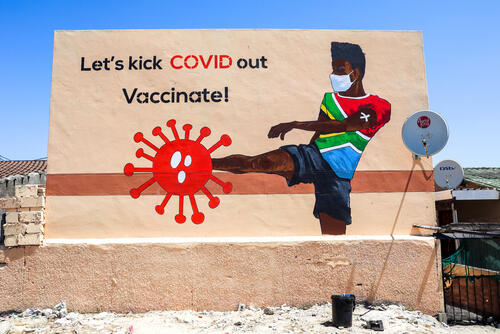
We also work with undocumented people and migrants in Tshwane, where we run a project that provides access to vaccines for these underserved communities.

Having achieved the UNAIDS 90-90-90 target in 2018 in Eshowe, KwaZulu-Natal, we redirected our approach to tackle the TB epidemic and reduce the number of cases in the area.

After 22 years of activities and campaigning, we closed our HIV and TB project in Khayelitsha, Western Cape in 2020.

Our activities in 2025 in South Africa

Data and information from the International Activity Report 2025.

MSF in South Africa in 2025 In South Africa, Médecins Sans Frontières assisted foreign nationals physically blocked from accessing public health facilities by anti-migrant groups, while continuing to run a non-communicable diseases (NCDs) project in Butterworth.
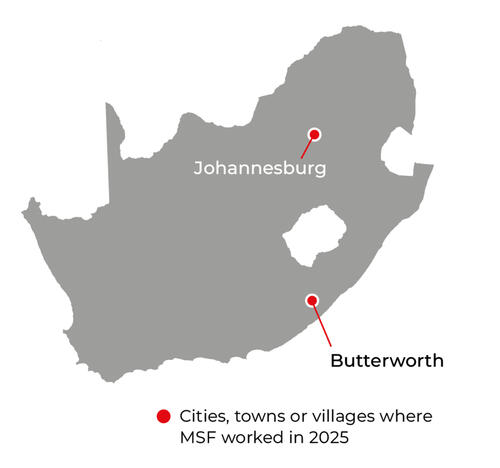
Country map for the IAR 2025.
© MSF

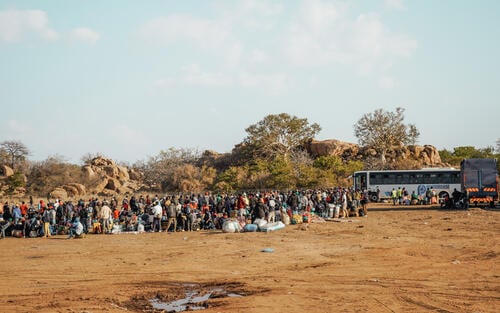
From July through September, anti-migrant groups camped outside dozens of clinics and hospitals in Gauteng, preventing foreign nationals, including pregnant women and people living with HIV, from seeking medical care. 

Our teams refilled antiretroviral medication for people living with HIV who could not collect it themselves at the blocked health facilities, and we referred patients to alternative health facilities unaffected by blockages. 

Throughout 2025, we continued to run an NCD project in Butterworth, Eastern Cape province, in partnership with the Department of Health. To strengthen skills for NCD management, we launched a side-by-side nurse mentorship and coaching programme across seven facilities, and classroom-based training for health professionals in 60 Department of Health facilities. In addition, to promote patient wellbeing, we piloted healthy lifestyle groups with two community-based organisations, focusing on educating members on nutrition, diet, and exercise. Participants were then encouraged to engage in healthy cooking and gardening activities, organised in collaboration with the Department of Agriculture. 

After training health staff, we piloted the use of HbA1c blood testing for diabetes* in five of the seven facilities. In addition, we donated equipment and supplies for NCD management and diagnosis, such as digital blood pressure monitors, vital signs monitors, height and weight scales, and glucometers. 

By the end of 2025, we had renovated and equipped an additional external pick-up point for medication, bringing the total number to four. Pick-up points provide reliable and accessible medicines for patients with chronic diseases. They are managed by trained community members, who distribute the medication free of charge to patients on behalf of the government. 


* This form of testing provides a longer-term understanding of glycaemic control, particularly for people who are pre-diabetic or living with Type 2 diabetes. 
 
In 2025

Contact us

Learners of Hhashi High School in the remote  Umlalazi Municipality under Uthungulu Districtict in KwaZulu-Natal stand in line to receive HIV Counselling and Testing at Medecins Sans Frontieres (MSF) Mobile 1-Stop Shop. MSF uses the vehicle to deliver HIV Counselling and Testing to people of all ages in rural KwaZulu-Natal, the South African province with the highest prevalence of HIV infection.
MSF South Africa

7th Floor, Zurich House
70 Fox Street, Marshalltown
Johannesburg
South Africa

South Africa

Language
English