



Ebola disease in DRC: find out how we're responding
Learn more
8000 Results
 
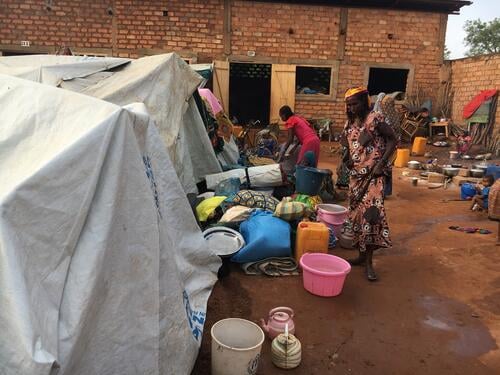
Displaced people stand outside a mosque in Bambari town, Central African Republic, where several thousand people sought refuge after Elevage camp was destroyed in early June. 14 June 2021.
Central African Republic

People in Bambari living in deplorable conditions following camp destruction

Following renewed fighting between government forces and non-state armed groups in Bambari, thousands of sought refuge as the Elevage camp for displaced people was destroyed. Project Update - 17 Jun 2021
 
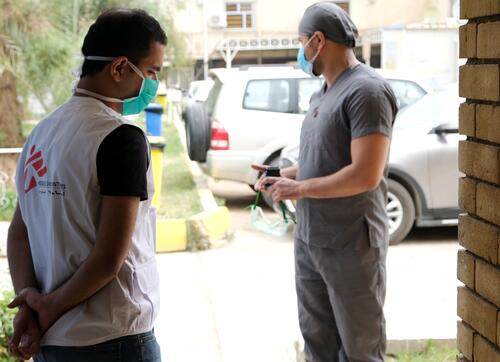
To support Iraqi Ministry of Health on facing COVID-19, MSF is providing MOH hospital staff with technical support on infection prevention and control and patient triage.
Iraq

MSF Iraq annual report 2020

The 2020 MSF Iraq annual report provides an overview on all MSF activities in Iraq during the year. Report - 14 Jun 2021
 
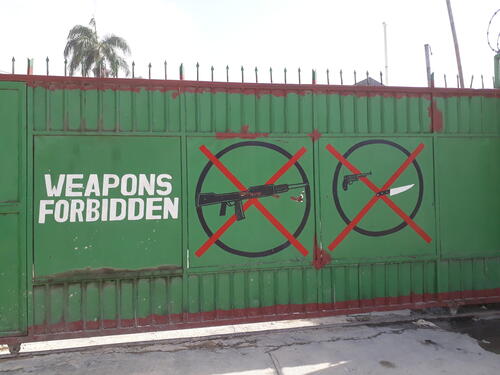
Portal of MSF Emergency Center of Martissant, in Port-au-Prince. On the night of June 23, 2019, a patient was shot dead just in front of this portal while leaving the structure. Ironically, paintings on the portal remind us of the prohibition of carrying weapons in the emergency center.

For months, Haitians have seen a steady decline in their purchasing power as the national currency devalued and fuel prices increased, against a backdrop of seemingly endless political stalemates and scandals. 

Since 9 June, tensions have escalated and there have been almost daily demonstrations and outbursts of violence in cities including Port-au-Prince, Les Cayes and Gonaïves.
Haiti

Haiti: Violence puts patients, medical activities, and staff at risk

A spike in violence in Haiti's capital is putting MSF's medical activities in jeopardy. Press Release - 12 Jun 2021
 
“We don't know where to go to escape this new danger. We too, in Goma, need assistance and medical care. ”- Dieudonné Bizimungu
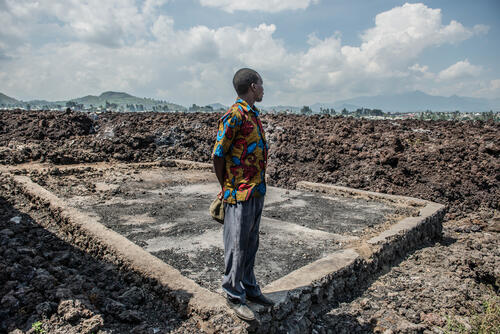
On the Saturday 22 May, the day of the eruption of the Nyiragongo volcano, I was at home, in the Kihisi area of Goma. I was resting with my family after a week of work at Kibumba primary school where I teach. In the evening, it started to get very hot. The lava was heading straight to us. 
We fled, without thinking, without bringing anything with us. In Birere, a neighborhood in Goma where we gathered with other families, I heard that lava was starting to reach my house. I decided to go see what was going on: the lava flow was about a hundred meters from our home. I returned there, very early in the morning: to my surprise, it had stopped a few meters from my house. My roof has remained intact. 
When the government decided that we had to evacuate, we left for the second time, this time to the Kibumba area, north of Goma. Two days later, we decided to come back, having no clean water to drink. The 20-liter can cost 1,000 Congolese Francs (0.46 euros) against the usual 250 (0.10 euros). We only ate potatoes and cabbage. 
Today, the situation remains critical for my family and those around us. Night and day, we continue to feel the heat of the lava. Carbon dioxide continues to exit the cooled lava flow. Scientists and authorities tell us it is dangerous for health, but we remain exposed. We don't know where to go to escape this new danger. Sake (25 km west of Goma) or Minova (in South Kivu) are not the only places where disaster victims find themselves. We in Goma, too, need medical assistance and care. “
Democratic Republic of Congo

Helping each other after the eruption of Nyiragongo

Residents and displaced people share their stories of trying to survive in the wake of the eruption of Mount Nyiragongo, DRC. Exposure - 11 Jun 2021
 
Inpatient care at the Barsalogho Medical Centre.
Burkina Faso

Conflict in Burkina Faso: “Many people are afraid to sleep at night”

Dr Youssouf Dembélé describes the impact of the continuous violence on people caught up in one of the world’s fastest growing humanitarian crises in recent years, in Burkina Faso. Interview - 11 Jun 2021
 
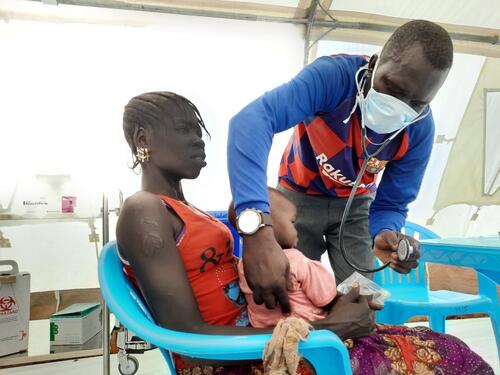
Naïa and her mother Martha are consulted by Simon Kudju. Most of the children come with respiratory tract infections, malaria and acute watery diarrhea.
South Sudan

MSF addresses health needs of people in remote Maruwa, South Sudan

MSF has opened a new project in the east of South Sudan, where people live scattered over long distances and where there are few health facilities Project Update - 11 Jun 2021
 
Mohamed is tested for HIV by activist Mamadou at the Médecins Sans Frontiers (MSF) mobile clinic in the neighbourhood of Sangoyah Market, Conakry, Guinea on March 17, 2016. MSF launched a HIV testing campaign in Conakry with the support of health authorities moving throughout several neighbourhoods throughout 2016.

In Guinea, only one in four people living with HIV are on life-saving antiretroviral treatment. Lack of voluntary HIV testing, estimated at only 5% from the latest study dating from 2012, hampers the necessary increase of people on ART.
HIV/AIDS

HIV/AIDS: A disappointing last final political declaration

While tremendous progress has been achieved over the last 40 years, MSF expresses its disappointment on the final political declaration for HIV/AIDS. Statement - 10 Jun 2021
 
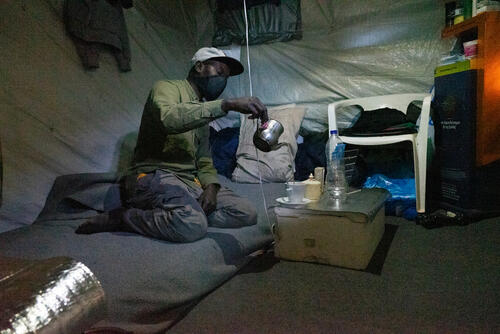
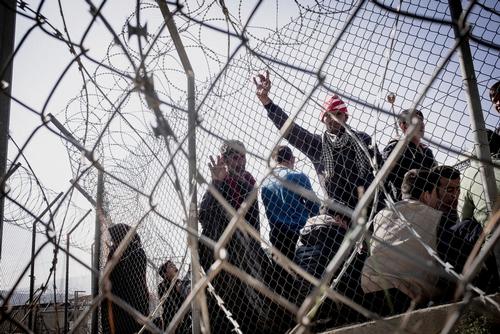
Ebo, 35 years old, from Cameroon inside his tent in Vathy centre. 

Ebo is from Senegal and he is 35 years old. He left his home country because his life was threatened and with the hope in Europe he will be able to build a new life and be safe, but after two years in Samos camp, he is struggling to have hope.
“If I knew, I would have never come here. I’ve lost two years here doing nothing. I had hope when I arrived because Greece is a European country, the country of democracy and humanity. It was very difficult to leave, but I had hope. Now I lost it. If you’re not mentally strong, for sure, you will have psychological problems here. 
I built this shelter by myself. Previously, I was sleeping inside a tent which was one meter and a half, for a whole year. I don’t eat well. I don’t sleep well. They used to give us one bottle of water per day. We have security problems because people are fighting every day about everything. We have rats, we have snakes. The smell of the trash is strong. If you combine all this, you can lose your mind. 
The conditions of the camp don’t correspond to human rights. The food is bad, they give a small portion with a bit of bread. When I started eating this, I had problems with my stomach. Even taking a shower is difficult. During winter, we do not have hot water. Sometimes we stay three days without taking a shower. 
Before coming here, I somewhat respected myself. But the degrading conditions make you lose the respect for yourself. The asylum procedure does not work very well. There is also discrimination and racism. Sometimes you go to the asylum office to ask for information and they talk to you very badly. They treat us without respect. I ask myself why I came here. I feel lost. I feel frustrated and bad. I regret coming here. I want to tell people who have not come here yet, to never come. 
Can you imagine? I have been through all this for almost two years and then they give me a rejection? If I’m not lucky I think I’m going to commit suicide. My only dream is to leave from Samos. 
For two years every day is the same. I wake up, I wash myself, I go to the WiFi to check for information and then I come back and go to sleep. 
We are young, we are strong, we have different education and background, there are electricians, plumbers, constructors or stylists like myself – we want to work. Why are we here? And why they just want to take us again and put us in a cage, like animals? Nobody wants to go in the new camp.”
Greece

Greece and EU must change approach to migration as scale of people’s suffering revealed

MSF urges European leaders to end the policy of containment for migration as its harming the health and wellbeing of asylum seekers, refugees and other migrants. Press Release - 9 Jun 2021
 
Samos island, March 28th 2016
"A few days ago I took a photograph of Omed M.'s family, whom was asking me to publish the picture (took on Agathonisi island). His eldest son who lives in germany contacted me, very worried, asking for news from his family. He was able to make contact with his father. But the news are sad and Omed's family has been, like expected, transfered to a camp in Samos, locked away." said Guillaume Binet, the photographer.
Mediterranean migration

Constructing Crisis at Europe’s Border

Over the past five years, an entirely avoidable and predictable policy-driven humanitarian crisis has been unfolding in the Greek islands with devasting consequences for the migrants trapped there. Report - 9 Jun 2021
 
Bajo Chiquito is an indigenous community in the Embera Wounaan Department and is the first location where migrants arrive. With the increase in numbers of migrants through the Darién forest, this community of around 400 people has been overwhelmed at times. Migrants arrive there after 5-7 days of trekking in the dry season.
Central American migration

Robbed, raped, beaten: safe migration routes urgently needed between Colombia and Panama

Following extreme violence people are experiencing on the migration route between South and Central America, MSF calls for the creation of safe routes between Colombia and Panama Press Release - 9 Jun 2021
Four mothers posing in a corridor of the Hospital in Bili. All four of them are staying in the hospital with their child, that's suffering from a severe case of malaria. Since the beginning of the project in 2016, the pediatric ward already treated more than 4.000 cases of complicated/severe form of malaria.
Médecins Sans Frontières (MSF)

Independent medical humanitarian assistance

We provide medical assistance to people affected by conflict, epidemics, disasters, or exclusion from healthcare. Our teams are made up of tens of thousands of health professionals, logistic and administrative staff - most of them hired locally. Our actions are guided by medical ethics and the principles of independence and impartiality. We are a non-profit, self-governed, member-based organisation.

Learn more