


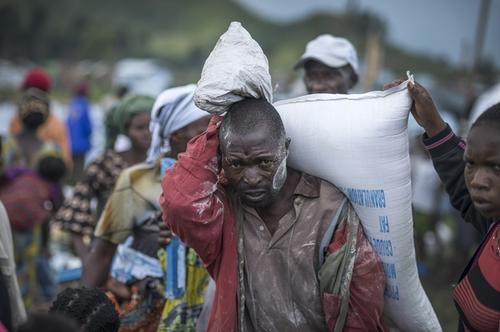
An already fragile humanitarian situation in eastern Democratic Republic of the Congo has deteriorated further after the border city of Goma fell to M23 rebels last week with hundreds of people injured and thousands displaced from their homes.
Teams from Médecins Sans Frontières (MSF) have rapidly set up additional emergency response activities, treating victims of violence and providing assistance to newly displaced people in and around Goma.
Treating victims of violence
Since the end of last week, an MSF surgeon and anesthetist have stepped into Virunga hospital in Goma where 60 patients have been admitted with war injuries. They are performing around 10 surgical interventions per day. Eleven people have been discharged already.
“Health structures in Goma were not prepared to receive such a high number of wounded,” said MSF surgeon Jacky Bonnan. “Before MSF came to Virunga hospital, the hospital’s surgical team worked around the clock for 48 hours to stabilise patients despite a lack of resources. They did an amazing job.”
Although Goma is calm for the moment, elsewhere in the province fighting continues. Medical teams in Masisi general hospital treated 21 people shot on Sunday during fierce fighting in and around the town. Seven of those required emergency surgery. In Mweso hospital, doctors treated 27 war wounded after fighting between the Congolese army and various armed militias.
Teams have been able to cross frontlines to donate medical supplies to the hospital in Minova as well as to 950 families scattered along the road. The hospital registered 26 cases of sexual violence and 200 wounded in the last seven days.
Increase in displaced persons
Displacement has been a feature of the conflict in eastern Congo for many years but numbers have now reached record levels with hundreds of thousands of people currently displaced. Several months ago MSF started to provide free healthcare to 50,000 people who had fled fighting in their villages and spontaneously settled in Mugunga camps just outside Goma. Since the fall of the city, the number of displaced people in these camps has sharply increased with around 45,000 new arrivals. MSF increased its intervention and is currently supporting two health centres with more than 200 free medical consultations per day. Teams are also constructing more than 30 latrines and showers in one camp.
“The most vulnerable are in an increasingly precarious situation,” said Grace Tang, MSF head of mission in North Kivu. “The fighting that has plagued this region for decades has not stopped – people cannot return home, they are being displaced from one place to another.”
Despite the recent developments, MSF continues to run several large reference hospitals and dozens of health centres that provide free healthcare to thousands every month throughout the region in Rutshuru, Masisi, Mweso,Kitchanga, Walikale, Mugunga displaced camps, Kanyaruchinya and Pinga.